
krit.club logo

Playing with Constructions - An Exploration in Rectangles

Grade 6CBSE

Review the key concepts, formulae, and examples before starting your quiz.

🔑Concepts

•

A rectangle is a special quadrilateral where all four interior angles are right angles (90∘90^\circ). Opposite sides are equal in length and parallel to each other.
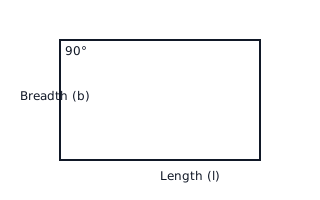
A rectangle showing length, breadth, and a 90-degree corner angle.
•

The perimeter is the total boundary length of the shape. For a rectangle, it is calculated by adding all four sides: l+b+l+b=2(l+b)l + b + l + b = 2(l + b). For a square, it is 4×s4 \times s.

•

Area measures the surface region inside the boundary. It is expressed in square units (e.g., cm2cm^2 or m2m^2). For a rectangle, Area=l×bArea = l \times b.

•

A square is a specific type of rectangle where the length and breadth are equal (l=bl = b). Every square is a rectangle, but not every rectangle is a square.
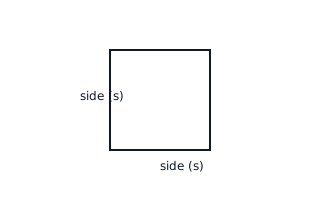
A square with all sides marked as 's'.
•

The diagonal of a rectangle connects opposite vertices and divides the rectangle into two identical right-angled triangles.

📐Formulae

Area of a rectangle=l×bArea\ of\ a\ rectangle = l \times b

Perimeter of a rectangle=2×(l+b)Perimeter\ of\ a\ rectangle = 2 \times (l + b)

Area of a square=s2Area\ of\ a\ square = s^2

Perimeter of a square=4×sPerimeter\ of\ a\ square = 4 \times s

Diagonal of a rectangle=l2+b2Diagonal\ of\ a\ rectangle = \sqrt{l^2 + b^2}

💡Examples

Problem 1:

Calculate the perimeter and area of a rectangle whose length is 12 cm12\text{ cm} and breadth is 7 cm7\text{ cm}.

Solution:

Perimeter=2×(12+7)=2×19=38 cmPerimeter = 2 \times (12 + 7) = 2 \times 19 = 38\text{ cm} Area=12×7=84 cm2Area = 12 \times 7 = 84\text{ cm}^2

Explanation:

To find the perimeter, we sum the length and breadth and multiply by 22. For the area, we multiply the length by the breadth.

Problem 2:

A square has a side of 6 cm6\text{ cm}. Find the difference between its perimeter and the perimeter of a rectangle with length 8 cm8\text{ cm} and breadth 4 cm4\text{ cm}.

Solution:

Perimeter of square: Ps=4×6=24 cmP_s = 4 \times 6 = 24\text{ cm} Perimeter of rectangle: Pr=2×(8+4)=2×12=24 cmP_r = 2 \times (8 + 4) = 2 \times 12 = 24\text{ cm} Difference: 24−24=0 cm24 - 24 = 0\text{ cm}

Explanation:

Both shapes have the same perimeter of 24 cm24\text{ cm}, so the difference is zero.

Problem 3:

If the area of a rectangular plot is 150 m2150\text{ m}^2 and the length is 15 m15\text{ m}, find the breadth.

Solution:

Area=l×bArea = l \times b 150=15×b150 = 15 \times b b=15015b = \frac{150}{15} b=10 mb = 10\text{ m}

Explanation:

To find the breadth, we divide the total area by the given length.

Problem 4:

A rectangular garden has a length of 20 m20\text{ m} and a breadth of 15 m15\text{ m}. A path of 2 m2\text{ m} width is built inside the garden along its boundary. Find the area of the path.
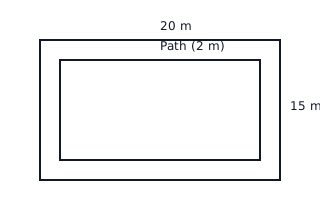
A rectangle within a rectangle representing a garden path.

Solution:

Area of outer rectangle=20×15=300 m2Area\ of\ outer\ rectangle = 20 \times 15 = 300\text{ m}^2 Inner length = 20−(2+2)=16 m20 - (2 + 2) = 16\text{ m} Inner breadth = 15−(2+2)=11 m15 - (2 + 2) = 11\text{ m} Area of inner rectangle=16×11=176 m2Area\ of\ inner\ rectangle = 16 \times 11 = 176\text{ m}^2 Area of path=300−176=124 m2Area\ of\ path = 300 - 176 = 124\text{ m}^2

Explanation:

To find the area of the path, subtract the area of the smaller inner rectangle from the area of the larger outer rectangle. We subtract 4 m4\text{ m} (2 meters from each side) from both length and breadth to find inner dimensions.

Problem 5:

A rectangular playground measures 30 m30\text{ m} by 20 m20\text{ m}. A cross-path of width 4 m4\text{ m} is constructed at the center of the playground, one parallel to the length and the other parallel to the breadth. Find the total area covered by these paths.
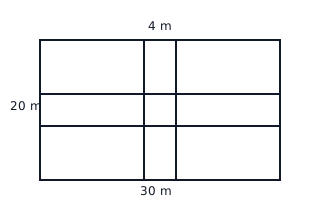
A rectangle representing a playground with two perpendicular intersecting paths forming a cross in the center.

Solution:

Area of path parallel to length=l×w=30 m×4 m=120 m2Area\ of\ path\ parallel\ to\ length = l \times w = 30\text{ m} \times 4\text{ m} = 120\text{ m}^2 Area of path parallel to breadth=b×w=20 m×4 m=80 m2Area\ of\ path\ parallel\ to\ breadth = b \times w = 20\text{ m} \times 4\text{ m} = 80\text{ m}^2 Area of the common middle square=w×w=4 m×4 m=16 m2Area\ of\ the\ common\ middle\ square = w \times w = 4\text{ m} \times 4\text{ m} = 16\text{ m}^2 Total path area=(120+80)−16=200−16=184 m2Total\ path\ area = (120 + 80) - 16 = 200 - 16 = 184\text{ m}^2

Explanation:

To find the total area of the cross-paths, we calculate the area of the two individual rectangular paths. However, the central square where the paths intersect is counted twice. Therefore, we must subtract the area of this common square (4 m×4 m4\text{ m} \times 4\text{ m}) once to get the correct total area.

An Exploration in Rectangles Class 6 Notes & Examples