
Review the key concepts, formulae, and examples before starting your quiz.
🔑Concepts
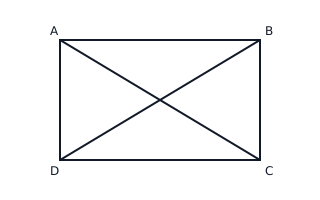
A rectangle is a quadrilateral where all four angles are right angles. One of its unique properties is that its diagonals are equal in length () and they bisect each other.
In a square, the diagonals are not only equal in length but also bisect each other at right angles (). This means the diagonals are perpendicular to each other.
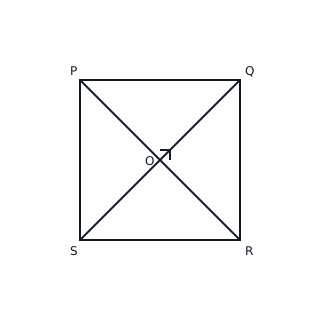
The point where the diagonals intersect is the midpoint of both diagonals. For both rectangles and squares, the distance from the center (intersection point) to any vertex is equal.
A square is a special type of rectangle where all sides are equal. Therefore, it inherits the property of equal diagonals from the rectangle and adds the property of perpendicularity.
📐Formulae
💡Examples
Problem 1:
In a rectangle , if the length of the diagonal is , what is the length of the diagonal ?
Solution:
In a rectangle, the diagonals are always equal in length. Therefore, .
Explanation:
Since is a rectangle, the property of equal diagonals applies.
Problem 2:
In a square , the diagonals and intersect at point . What is the measure of ?
Solution:
Explanation:
In a square, the diagonals are perpendicular bisectors of each other. This means the angle formed at the point of intersection is always a right angle ().
Problem 3:
If the diagonals of a quadrilateral are equal and bisect each other at right angles, identify the shape.
Solution:
The shape is a Square.
Explanation:
A rectangle has equal diagonals that bisect each other, but they do not necessarily meet at . A rhombus has diagonals that meet at , but they are not equal. Only a square satisfies all three conditions: equal length, bisecting, and perpendicularity.
Problem 4:
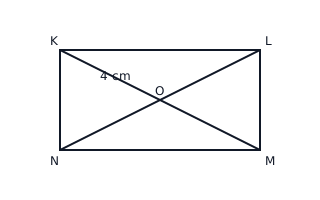
In a rectangle , the diagonals and intersect at point . If , find the length of the diagonal .
Solution:
Explanation:
Since the diagonals of a rectangle bisect each other, the full diagonal is twice the length of the segment . Because diagonals of a rectangle are equal, must be the same length as .
Problem 5:
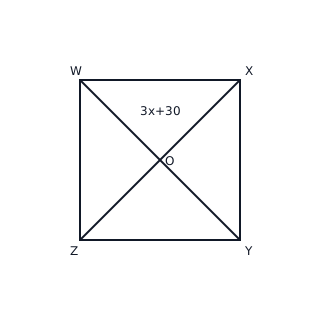
In a square , the diagonals and meet at . If , find the value of .
Solution:
Explanation:
The diagonals of a square always intersect at right angles (). By setting the given expression for the angle equal to 90, we can solve for the unknown variable .