
Review the key concepts, formulae, and examples before starting your quiz.
🔑Concepts
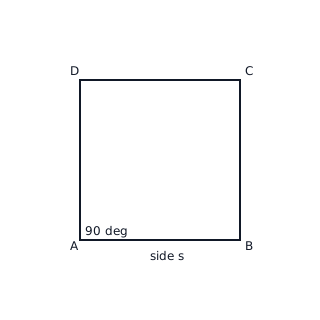
A square is a special quadrilateral where all four sides are equal and each interior angle is exactly . To construct it, we need only one side length.
A rectangle is a quadrilateral where opposite sides are equal and all angles are . Construction requires the length () and the breadth ().
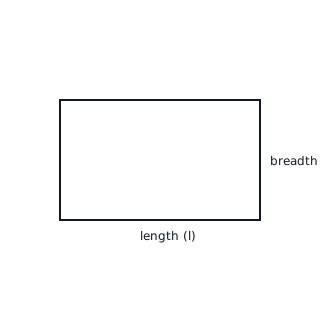
The construction process involves using a ruler to draw the base and a protractor or compass to ensure corners.
Diagonal property: In both squares and rectangles, the diagonals bisect each other. In a square, diagonals are also perpendicular and equal.
📐Formulae
💡Examples
Problem 1:
Construct a square with side length .
Solution:
- Draw a line segment .
- At point , construct an angle of using a compass or protractor.
- From , cut an arc of radius on the perpendicular line to find point .
- Similarly, at point , construct an angle of and cut an arc of to find point .
- Join . is the required square.
Explanation:
Since all sides of a square are equal and all angles are , we use the fixed side and right angles at the base vertices.
Problem 2:
Construct a rectangle where and .
Solution:
- Draw a line segment .
- At , draw a ray such that .
- With as center and radius , draw an arc to cut at .
- From , draw an arc of radius parallel to .
- From , draw an arc of radius to intersect the previous arc at .
- Join and .
Explanation:
In a rectangle, opposite sides are equal. Thus, and . All corners must be .
Problem 3:
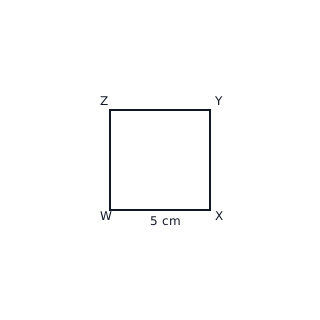
Construct a square where each side measures .
Solution:
- Draw a line segment .
- At point , construct an angle of using a protractor.
- Use a compass set to to mark point on the perpendicular line.
- Similarly, at point , construct a angle and mark point at a distance of .
- Join and to complete the square.
Explanation:
Since all sides of a square are equal and all angles are , we use the side length for all four sides and ensure right angles at each vertex.
Problem 4:
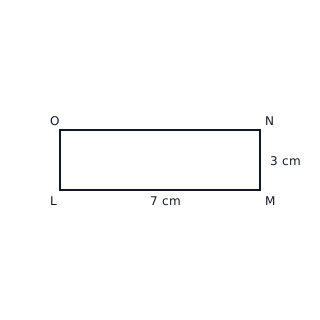
Construct a rectangle with length and width .
Solution:
- Draw a horizontal line segment .
- Construct a angle at point .
- From point , measure upwards and mark it as point .
- Construct a angle at point .
- From point , measure upwards and mark it as point .
- Connect point to point .
Explanation:
A rectangle requires its opposite sides to be equal ( and ) and all angles to be .