
Review the key concepts, formulae, and examples before starting your quiz.
🔑Concepts
A number sequence is a list of numbers that follows a specific pattern or rule. In an arithmetic (number) sequence, we add or subtract the same value, called the common difference, to get the next term.
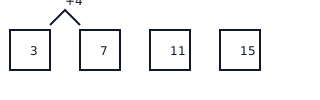
A geometric sequence is formed by multiplying or dividing the previous term by a constant value called the common ratio. For example, doubling the value at each step:
Geometric patterns use shapes to represent sequences. We can describe these by looking at how many new elements are added to each subsequent figure.
To find the rule for a pattern, compare the term value to its position number (). Often, the rule can be expressed as .
📐Formulae
(Common Difference)
(Common Ratio)
(Arithmetic Rule)
(Geometric Rule)
(Rule for simple multiplication patterns)
💡Examples
Problem 1:
Identify the rule and find the next two terms in the sequence:
Solution:
Step 1: Check the difference between terms. and . Since the difference is not the same, it is not an arithmetic sequence. Step 2: Check the ratio between terms. and . Step 3: Since we multiply by each time, the rule is 'Multiply by '. Step 4: Find the next terms: and .
Explanation:
By comparing the terms, we determined that each number is 3 times larger than the previous one, identifying it as a geometric sequence.
Problem 2:
A pattern uses triangles to form a sequence. Position 1 has 5 triangles, Position 2 has 9 triangles, and Position 3 has 13 triangles. How many triangles will be in Position 10?
Solution:
Step 1: List the values: Step 2: Find the common difference: and . The rule is to add . Step 3: Notice the relationship between position () and value. The sequence grows by each time, so the rule involves . Step 4: Test . For , . To get the value , we need to add . So the rule is . Step 5: Calculate for Position 10: .
Explanation:
We first identified the constant increase to find the arithmetic rule, then formulated a general equation to solve for a specific position.
Problem 3:
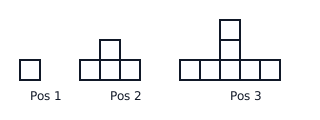
Look at the pattern of squares below. Position 1 has 1 square, Position 2 has 4 squares, and Position 3 has 7 squares. Find the rule for the number of squares at Position and determine how many squares are in Position 6.
Solution:
Position 6 will have 16 squares.
Explanation:
The number of squares increases by 3 each time ( and ). This common difference () is 3. We check the relationship between the position and the squares: , but we need 1, so we subtract 2. Testing for Position 2: . The rule works.
Problem 4:
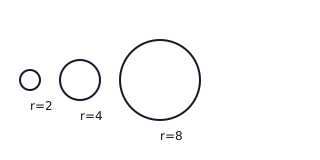
A geometric sequence starts with a circle of radius 2 cm. Every subsequent circle has a radius that is double the previous one. Find the radius of the 4th circle in the sequence.
Solution:
The radius of the 4th circle is 16 cm.
Explanation:
Since the radius doubles every time, the common ratio () is 2. We multiply the current term by 2 to find the next term in the sequence.