
Review the key concepts, formulae, and examples before starting your quiz.
🔑Concepts
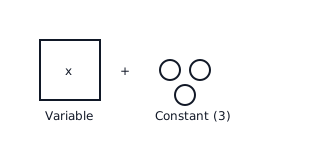
A variable is a letter or symbol that represents an unknown number. In the expression , is the variable. Using variables allows us to describe relationships that work for any number, creating a generalized pattern.
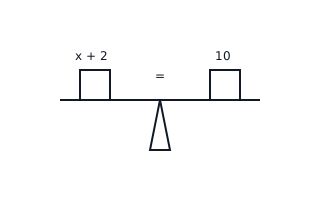
An Equation is like a balanced scale. The equals sign tells us that the value on the left side is exactly the same as the value on the right side. To solve an equation, we must perform the same operation on both sides to keep it balanced.
A Function Machine takes an input, applies a mathematical rule (like or ), and produces an output. If the rule is , an input of yields an output of .

Solving equations using Inverse Operations: To isolate a variable, we do the opposite of what is being done to it. The inverse of addition is subtraction, and the inverse of multiplication is division.
📐Formulae
General Equation Form:
Addition Inverse: If , then
Subtraction Inverse: If , then
Multiplication Inverse: If , then
Division Inverse: If , then
Function Rule:
💡Examples
Problem 1:
Solve the equation for :
Solution:
- Identify the operation being applied to the variable : Addition of .
- Identify the inverse operation: Subtraction of .
- Apply the inverse operation to both sides of the equation to keep it balanced:
- Simplify both sides:
Explanation:
To isolate , we undo the addition of by subtracting from both sides of the equation. This leaves alone on the left side.
Problem 2:
A pattern starts at and follows the rule . If the input is , what is the output?
Solution:
- Write down the given rule: .
- Substitute the input value into the rule: .
- Perform the multiplication inside the parentheses first: .
- Add to the result: .
- The final output is .
Explanation:
This problem uses a function rule. By replacing the word 'Input' with the number and following the order of operations, we calculate the resulting output.
Problem 3:
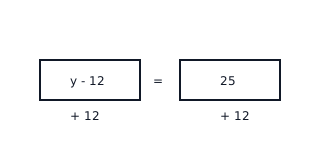
Find the value of in the equation: . Show the steps using the balance method.
Solution:
Explanation:
To find , we need to undo the subtraction of . We use the inverse operation, which is addition. By adding to both sides of the equation, the and on the left side cancel out, leaving alone. On the right side, .
Problem 4:
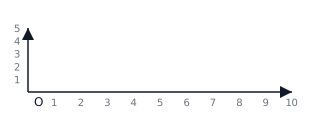
A pattern is formed using squares. The rule for the number of squares is , where is the figure number. How many squares are in Figure 4?
Solution:
Explanation:
Substitute the figure number into the given function rule. First, multiply the figure number by to get , then add to find the total number of squares, which is .