
Review the key concepts, formulae, and examples before starting your quiz.
🔑Concepts
A pattern is a recurring sequence that follows a specific logic. In mathematics, we identify the 'Position' (Input) and the 'Value' (Output) to find the relationship between them.
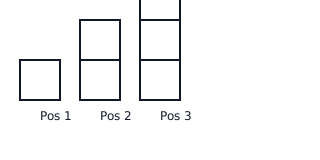
The rule for a linear pattern often takes the form . The value is the 'common difference' (how much the output increases each time), and is the adjustment needed to match the first term.

Function machines help visualize how an input is transformed into an output through a specific operation or set of operations.
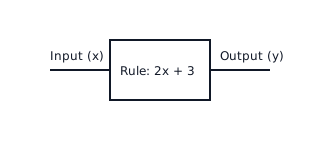
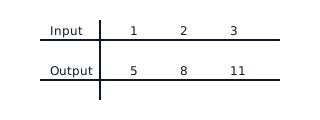
Using a table of values is the most effective way to identify the common difference. If the difference between consecutive outputs is constant, the pattern is linear.
📐Formulae
💡Examples
Problem 1:
Find the rule and the term for the sequence:
Solution:
- Find the common difference: . So, the multiplier is .
- Test the multiplier on the first position: .
- Determine the adjustment: To get from to the actual first term (), we need to add .
- Write the rule: .
- Calculate the term: .
Explanation:
We first identify how much the pattern grows each time to find the multiplier, then adjust the formula to match the starting value of the sequence.
Problem 2:
A pattern of tiles grows according to an Input-Output table where Input gives Output , Input gives , and Input gives . What is the rule?
Solution:
- Identify the change in Output: and . The common difference is .
- Create a trial rule: .
- Check the first entry: . We need the output to be , so we add .
- Final Rule: .
Explanation:
By comparing the expected output (from the multiplier) to the actual output in the table, we find the constant that needs to be added or subtracted.
Problem 3:
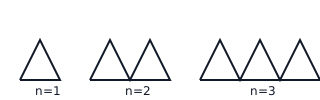
Observe the pattern of matchsticks used to create triangles. How many matchsticks are needed for the figure in the sequence?
Solution:
- Identify the values: Figure 1 uses sticks, Figure 2 uses sticks, Figure 3 uses sticks.
- Find the difference: The difference between terms is (, ).
- Determine the adjustment: . For Figure 1: . The rule is .
- Calculate for : .
Explanation:
We first find the common difference (2) to use as our multiplier. Then we adjust it to fit the first term. Finally, we substitute the position number into our rule.
Problem 4:
A sequence is represented by a function graph. Determine the rule that relates the (Input) to the (Output) and find the value of when .
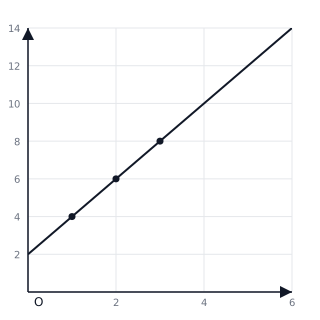
Solution:
- From the graph points: .
- The difference in values is .
- Rule: .
- For : .
Explanation:
By plotting the inputs and outputs on a coordinate plane, we can see they form a straight line. The 'slope' of the line is our multiplier, and where it would cross the y-axis (at ) is our constant.