
Review the key concepts, formulae, and examples before starting your quiz.
🔑Concepts
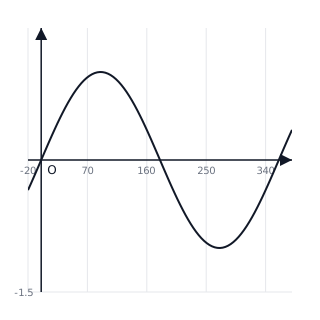
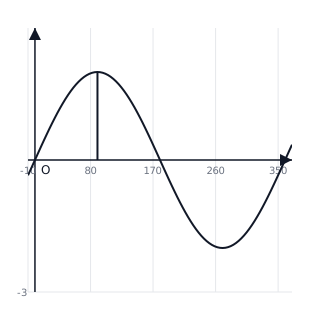
The Sine function graph is a periodic wave with a period of (or ) and an amplitude of . It starts at the origin , reaches its maximum at , and crosses the x-axis at .
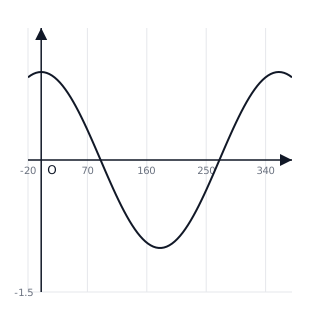
The Cosine function graph is a periodic wave identical in shape to the sine wave but shifted (phase-shifted) to the left by . It starts at its maximum value and crosses the x-axis at and .
For the general trigonometric function or : The value determines the amplitude (vertical stretch), determines the frequency (horizontal stretch/compression), and determines the vertical shift (the principal axis).
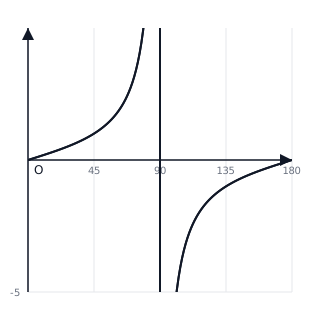
The Tangent function differs from sine and cosine as it has a period of and contains vertical asymptotes where (at , etc.).
📐Formulae
💡Examples
Problem 1:
Solve the equation for .
Solution:
- Isolate the sine function: .
- Find the reference angle: .
- Identify quadrants where sine is positive: Quadrant 1 and Quadrant 2.
- Calculate angles: , . Final Answer: .
Explanation:
To solve trigonometric equations, first isolate the function, find the principal value (reference angle), and then use the CAST rule to find other values within the specified range.
Problem 2:
Simplify the expression: .
Solution:
- Substitute .
- Expression becomes: .
- Cancel : .
- Result: .
Explanation:
Simplification often involves converting all terms to sine and cosine and using algebraic cancellation.
Problem 3:
State the amplitude and period of the function .
Solution:
- Amplitude: The coefficient 'a' is 3, so .
- Period: The coefficient 'b' is 2. .
- Vertical Shift: The graph is shifted up by 1 unit.
Explanation:
In the general form , 'a' determines the vertical stretch (amplitude) and 'b' determines the horizontal compression (affecting the period).
Problem 4:
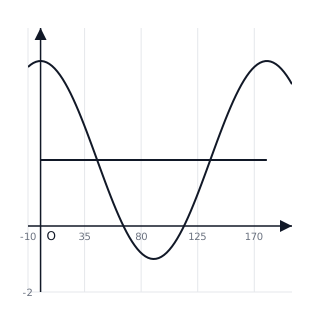
Determine the equation of the trigonometric function shown in the graph, which has a maximum value of , a minimum value of , and a period of .
Solution:
- Find the amplitude :
- Find the vertical shift :
- Find using the period:
- Since the graph starts at the maximum at , we use a cosine function:
Explanation:
To identify the equation from a graph, calculate the amplitude (half the distance between max and min), the principal axis (the average of max and min), and the coefficient based on how many full cycles occur within .
Problem 5:
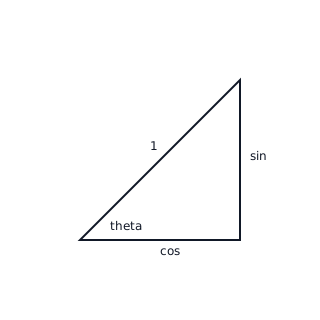
Solve the identity visually using a right-angled triangle or algebra.
Solution:
- Start with the Pythagorean identity:
- Divide every term by :
- Simplify the terms:
- Rearrange to match the target expression:
Explanation:
This identity is a variation of the fundamental Pythagorean identity. By dividing by , we derive the relationship between tangent and secant (reciprocal of cosine).