
Review the key concepts, formulae, and examples before starting your quiz.
🔑Concepts
Pythagoras' Theorem is only applicable to right-angled triangles. The side opposite the right angle () is called the hypotenuse and is always the longest side.
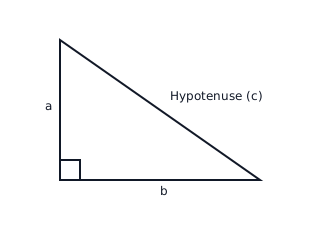
To find the hypotenuse , you square both shorter sides, add them, and take the square root: . To find a shorter side, subtract the square of the known side from the square of the hypotenuse: .
Pythagoras' Theorem can be extended to 3D shapes. For a rectangular cuboid with length , width , and height , the space diagonal is the distance from one corner to the opposite corner through the center.
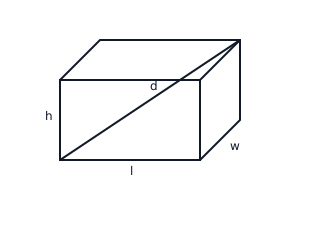
The Converse of Pythagoras' Theorem states that if holds true for a triangle with sides , then the triangle must be right-angled.
📐Formulae
(where is the hypotenuse)
(Diagonal of a cuboid with dimensions )
Distance = (Distance between two points on a Cartesian plane)
💡Examples
Problem 1:
A ladder of length 13m leans against a vertical wall. The foot of the ladder is 5m away from the base of the wall. How high up the wall does the ladder reach?
Solution:
12m
Explanation:
Identify the hypotenuse () and one side (). Using , we get . Taking the square root, .
Problem 2:
Calculate the length of the internal diagonal of a cuboid with dimensions 3cm, 4cm, and 12cm.
Solution:
13cm
Explanation:
Using the 3D Pythagoras formula . Here, . Thus, .
Problem 3:
Determine if a triangle with side lengths 7cm, 24cm, and 25cm is a right-angled triangle.
Solution:
Yes, it is right-angled.
Explanation:
Check if . Calculate . Calculate . Since , the converse of Pythagoras' theorem confirms it is a right-angled triangle.
Problem 4:
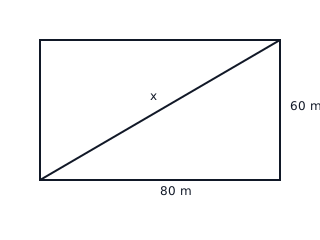
A rectangular field measures by . A person walks diagonally across the field from one corner to the opposite corner. Calculate the distance they walk.
Solution:
- Identify the triangle: The diagonal forms the hypotenuse () of a right-angled triangle with sides and .
- Apply formula:
- Substitute:
- Calculate:
- Solve for :
The distance walked is .
Explanation:
Since the field is rectangular, the corner angle is , allowing the use of Pythagoras' Theorem to find the diagonal length.
Problem 5:
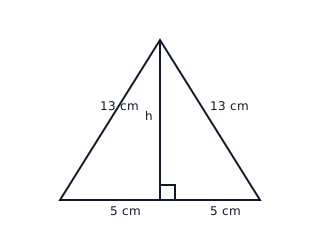
An isosceles triangle has a base of and two equal sides of each. Calculate the vertical height of the triangle.
Solution:
- Split the isosceles triangle into two identical right-angled triangles by drawing the altitude.
- The base of each right-angled triangle is half the total base: .
- The hypotenuse is and one side is . Let height be .
- Apply formula:
- Substitute:
- Calculate:
- Solve for :
The vertical height is .
Explanation:
In an isosceles triangle, the perpendicular height bisects the base, creating two right-angled triangles where the vertical height is one of the legs.