
Review the key concepts, formulae, and examples before starting your quiz.
🔑Concepts
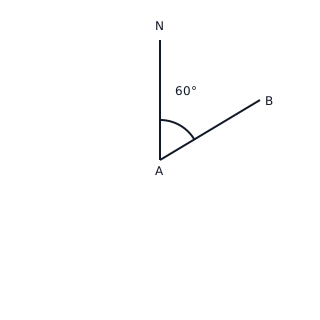
Bearings are measured from North (), in a clockwise direction, and are always written as three digits. For example, East is and South is . The bearing of point from point is the angle measured clockwise from the North line at to the line .
The angle between two planes is found by identifying two lines, one in each plane, that meet at a point on the intersection line and are both perpendicular to that intersection line. The angle between these two lines is the angle between the planes.
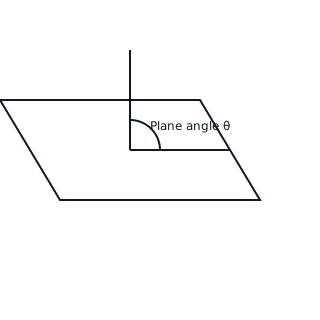
Angle of elevation and depression: The angle of elevation is the angle measured upwards from the horizontal line to the line of sight of an object. The angle of depression is measured downwards from the horizontal line.
3D Pythagoras' Theorem: In a cuboid with dimensions , , and , the length of the space diagonal is given by .
When solving 3D problems, look for right-angled triangles within the 3D shape. Often, you must first calculate a length on one plane (like the base) to find a side for a triangle in a different plane (like a vertical cross-section).
📐Formulae
(Sine Rule)
(Cosine Rule for sides)
(Cosine Rule for angles)
(Area of a non-right triangle)
(3D Distance/Pythagoras)
💡Examples
Problem 1:
A ship sails 10 km from port P on a bearing of 060° to point Q. It then sails 15 km from Q on a bearing of 150° to point R. Calculate the distance PR.
Solution:
- Find the internal angle PQR. The bearing from Q back to P is . The bearing from Q to R is . The angle .
- Since it is a right-angled triangle, use Pythagoras: km.
Explanation:
By finding the relationship between the two bearings at point Q, we determine that the path forms a right-angled triangle, allowing for the use of the Pythagorean theorem.
Problem 2:
In a cuboid with length 8cm, width 6cm, and height 5cm, find the angle that the space diagonal makes with the base.
Solution:
- Find the length of the diagonal of the base (d_base): cm.
- The space diagonal, the base diagonal, and the height form a right-angled triangle.
- Let the angle be . .
- .
Explanation:
To find the angle between a line (space diagonal) and a plane (the base), you first find the projection of that line onto the plane (the base diagonal) and then use SOH CAH TOA.
Problem 3:
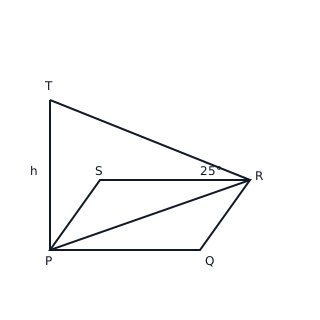
A vertical flagpole of height stands at the corner of a horizontal rectangular field . The length m and m. The angle of elevation of the top of the pole from point is . Calculate the height of the flagpole.
Solution:
- First, find the distance on the horizontal ground using Pythagoras' Theorem:
- In the vertical right-angled triangle , we know the base m and the angle .
- Use the tangent ratio:
- Solve for :
Explanation:
This problem requires identifying a right-angled triangle on the ground to find a length that connects to a vertical triangle containing the unknown height.
Problem 4:
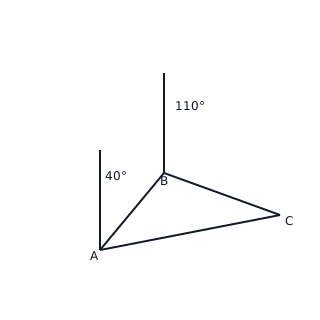
A hiker walks km from point on a bearing of to point . They then walk km on a bearing of to point . Calculate the distance .
Solution:
- Determine the interior angle . Let the North line at be .
- The angle from the line to the North line is (interior angles between parallel North lines).
- The angle from to is .
- The interior angle is .
- Apply the Cosine Rule to :
Explanation:
Bearings are used to find the internal angle of a triangle. Parallel North lines allow us to find angles using the properties of transversals.