
Review the key concepts, formulae, and examples before starting your quiz.
🔑Concepts
The naming of sides in a right-angled triangle depends on the position of the reference angle . The 'Hypotenuse' is always the longest side opposite the angle, the 'Opposite' side is across from , and the 'Adjacent' side is next to .
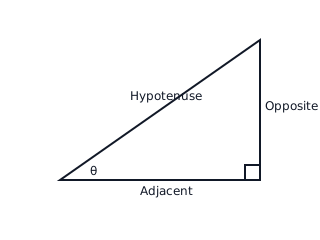
The mnemonic SOH CAH TOA is used to remember the three primary trigonometric ratios: , , and .
To find an unknown angle when two sides are known, use the inverse trigonometric functions: , , or .
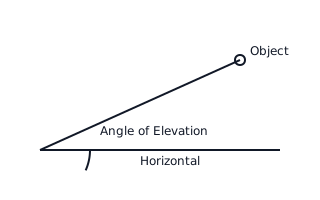
The Angle of Elevation is the angle measured upwards from the horizontal line of sight to an object above. Conversely, the Angle of Depression is the angle measured downwards from the horizontal to an object below.
📐Formulae
💡Examples
Problem 1:
In a right-angled triangle , the angle , angle , and the hypotenuse cm. Find the length of the side .
Solution:
7.00 cm (to 3 sig figs)
Explanation:
- Identify the given values: Angle , Hypotenuse .
- Identify the required side: is the side 'Opposite' to the angle ().
- Choose the ratio: SOH uses and , so .
- Rearrange: .
- Calculate: which rounds to 6.88 cm (Note: Re-calculating ).
Problem 2:
A ladder 5 meters long leans against a vertical wall. The base of the ladder is 3 meters away from the wall. Calculate the angle the ladder makes with the ground.
Solution:
Explanation:
- The ladder forms a right-angled triangle where the ladder is the Hypotenuse () and the distance from the wall is the Adjacent side ().
- We need to find the angle at the ground.
- Use CAH: .
- Use the inverse function: .
- Result: .
Problem 3:
Find the height of a tree if the angle of elevation to the top of the tree is from a point 15 meters away from the base on level ground.
Solution:
7.98 m
Explanation:
- The distance from the tree is the Adjacent side ().
- The height of the tree is the Opposite side ().
- Use TOA: .
- Rearrange: .
- Calculate: which rounds to 7.98 m.
Problem 4:
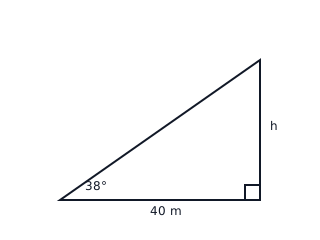
A surveyor stands m away from the base of a building and measures the angle of elevation to the top of the building as . Determine the height of the building to two decimal places.
Solution:
- Identify knowns: , m.
- Identify unknown: .
- Use the Tangent ratio: .
- Solve for : .
- .
- The height is m.
Explanation:
Since we have the distance from the base (Adjacent) and want to find the height (Opposite), we use TOA ().
Problem 5:
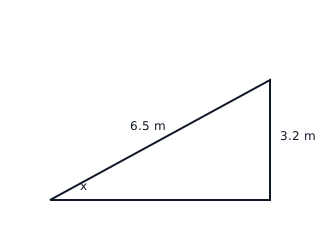
A slide is m long. Its vertical height is m. Calculate the angle that the slide makes with the horizontal ground.
Solution:
- Identify knowns: m, m.
- Identify unknown: .
- Use the Sine ratio: .
- Solve for : .
- .
- .
Explanation:
We use the SOH ratio (Sine = Opposite / Hypotenuse) because we are given the length of the slide (Hypotenuse) and its height (Opposite).