krit.club logo

Trigonometry - Sine and Cosine Rules

Grade 12A Level

Review the key concepts, formulae, and examples before starting your quiz.

πŸ”‘Concepts

β€’

Labeling a Triangle: In any triangle ABCABC, sides are denoted by lowercase letters a,b,ca, b, c such that they are opposite to the corresponding uppercase angles A,B,CA, B, C. The Sine and Cosine rules apply to any triangle, not just right-angled ones.
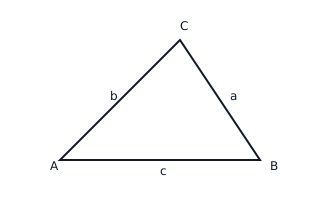
Standard labeling of a triangle with sides opposite their respective angles.
β€’

The Sine Rule: Used when you know an angle and its opposite side (a 'known pair') plus one other piece of information. It is essential for solving problems involving two sides and two angles.
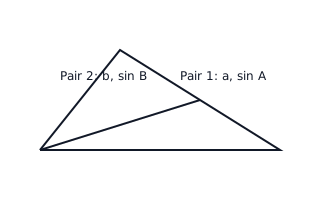
Visualizing the relationship between opposite sides and angles for the Sine Rule.
β€’

The Cosine Rule: Used when you have 'Side-Angle-Side' (SAS) to find the third side, or 'Side-Side-Side' (SSS) to find an angle. It is a generalization of the Pythagorean theorem.
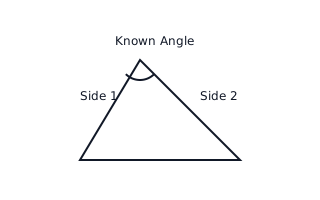
SAS configuration for the Cosine Rule.
β€’

Area of a Triangle: The formula Area=12absin⁑C\text{Area} = \frac{1}{2}ab \sin C allows you to find the area using any two sides and the included angle (SAS configuration).
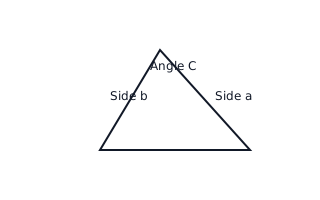
Sides a and b with included angle C used for Area calculation.

πŸ“Formulae

Sine Rule (Sides): asin⁑A=bsin⁑B=csin⁑C\frac{a}{\sin A} = \frac{b}{\sin B} = \frac{c}{\sin C}

Sine Rule (Angles): sin⁑Aa=sin⁑Bb=sin⁑Cc\frac{\sin A}{a} = \frac{\sin B}{b} = \frac{\sin C}{c}

Cosine Rule (Side): a2=b2+c2βˆ’2bccos⁑Aa^2 = b^2 + c^2 - 2bc \cos A

Cosine Rule (Angle): cos⁑A=b2+c2βˆ’a22bc\cos A = \frac{b^2 + c^2 - a^2}{2bc}

Area of Triangle: Area=12absin⁑C\text{Area} = \frac{1}{2}ab \sin C

πŸ’‘Examples

Problem 1:

In triangle ABC, side a=12a = 12 cm, side c=15c = 15 cm, and angle B=70∘B = 70^\circ. Find the length of side bb and the area of the triangle.

Solution:

b2=122+152βˆ’2(12)(15)cos⁑70βˆ˜β€…β€ŠβŸΉβ€…β€Šb2=144+225βˆ’360(0.342)β€…β€ŠβŸΉβ€…β€Šb2=245.88β€…β€ŠβŸΉβ€…β€Šbβ‰ˆ15.68b^2 = 12^2 + 15^2 - 2(12)(15) \cos 70^\circ \implies b^2 = 144 + 225 - 360(0.342) \implies b^2 = 245.88 \implies b \approx 15.68 cm. Area =12(12)(15)sin⁑70∘=90(0.9397)β‰ˆ84.57= \frac{1}{2}(12)(15) \sin 70^\circ = 90(0.9397) \approx 84.57 cmΒ².

Explanation:

Since we are given two sides and the included angle (SAS), we use the Cosine Rule to find the missing side. The area is found using the formula 12acsin⁑B\frac{1}{2}ac \sin B.

Problem 2:

In triangle PQR, PQ=8PQ = 8 cm, QR=10QR = 10 cm, and angle P=60∘P = 60^\circ. Find angle RR.

Solution:

sin⁑R8=sin⁑60∘10β€…β€ŠβŸΉβ€…β€Šsin⁑R=8Γ—sin⁑60∘10β€…β€ŠβŸΉβ€…β€Šsin⁑R=8Γ—0.86610=0.6928β€…β€ŠβŸΉβ€…β€ŠR=arcsin⁑(0.6928)β‰ˆ43.9∘\frac{\sin R}{8} = \frac{\sin 60^\circ}{10} \implies \sin R = \frac{8 \times \sin 60^\circ}{10} \implies \sin R = \frac{8 \times 0.866}{10} = 0.6928 \implies R = \arcsin(0.6928) \approx 43.9^\circ.

Explanation:

We use the Sine Rule because we have a known angle-side pair (PP and QRQR) and want to find an angle opposite a known side (PQPQ).

Problem 3:

Find the largest angle in a triangle with side lengths 5 cm, 7 cm, and 10 cm.

Solution:

Let a=10,b=5,c=7a=10, b=5, c=7. cos⁑A=52+72βˆ’1022(5)(7)=25+49βˆ’10070=βˆ’2670=βˆ’0.3714\cos A = \frac{5^2 + 7^2 - 10^2}{2(5)(7)} = \frac{25 + 49 - 100}{70} = \frac{-26}{70} = -0.3714. A=arccos⁑(βˆ’0.3714)β‰ˆ111.8∘A = \arccos(-0.3714) \approx 111.8^\circ.

Explanation:

The largest angle is always opposite the longest side. We use the rearranged Cosine Rule (SSS) to find the angle opposite the 10 cm side.

Problem 4:

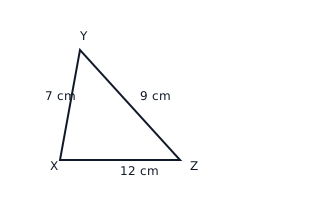
In triangle XYZXYZ, XY=7XY = 7 cm, YZ=9YZ = 9 cm, and XZ=12XZ = 12 cm. Calculate the size of the angle YY.

Triangle XYZ with sides 7, 9, and 12 cm.

Solution:

We use the Cosine Rule for angles: cos⁑Y=x2+z2βˆ’y22xz\cos Y = \frac{x^2 + z^2 - y^2}{2xz} In this triangle, y=XZ=12y = XZ = 12, x=YZ=9x = YZ = 9, and z=XY=7z = XY = 7. cos⁑Y=92+72βˆ’1222Γ—9Γ—7\cos Y = \frac{9^2 + 7^2 - 12^2}{2 \times 9 \times 7} cos⁑Y=81+49βˆ’144126\cos Y = \frac{81 + 49 - 144}{126} cos⁑Y=βˆ’14126=βˆ’19\cos Y = \frac{-14}{126} = -\frac{1}{9} Y=cosβ‘βˆ’1(βˆ’19)β‰ˆ96.38∘Y = \cos^{-1}\left(-\frac{1}{9}\right) \approx 96.38^\circ

Explanation:

Since all three sides are known (SSS), the Cosine Rule is required to find any angle. The negative result for cos⁑Y\cos Y indicates that YY is an obtuse angle.

Problem 5:

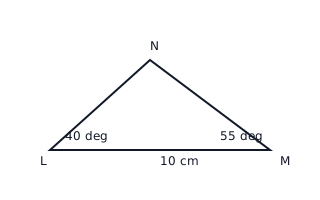
In triangle LMNLMN, angle L=40∘L = 40^\circ, angle M=55∘M = 55^\circ, and side n=10n = 10 cm. Calculate the length of side ll.

Triangle LMN with two angles and the included side.

Solution:

First, find angle NN: N=180βˆ˜βˆ’(40∘+55∘)=85∘N = 180^\circ - (40^\circ + 55^\circ) = 85^\circ Now use the Sine Rule to find ll: lsin⁑L=nsin⁑N\frac{l}{\sin L} = \frac{n}{\sin N} lsin⁑40∘=10sin⁑85∘\frac{l}{\sin 40^\circ} = \frac{10}{\sin 85^\circ} l=10Γ—sin⁑40∘sin⁑85∘l = \frac{10 \times \sin 40^\circ}{\sin 85^\circ} lβ‰ˆ10Γ—0.64280.9962β‰ˆ6.45Β cml \approx \frac{10 \times 0.6428}{0.9962} \approx 6.45 \text{ cm}

Explanation:

To use the Sine Rule, we need a side and its opposite angle. Since we were given side nn, we first calculated angle NN using the sum of angles in a triangle.