krit.club logo

Continuity and Differentiability - Exponential and Logarithmic Functions

Grade 12CBSE

Review the key concepts, formulae, and examples before starting your quiz.

🔑Concepts

•

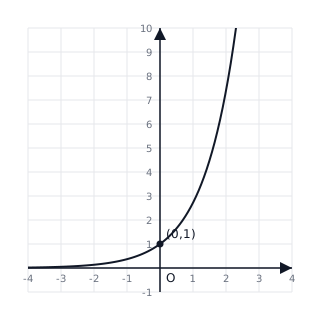
The exponential function f(x)=exf(x) = e^x is the unique function that is its own derivative. Geometrically, it is a strictly increasing, concave-up function that passes through the point (0,1)(0, 1) and has the xx-axis as a horizontal asymptote as x→−∞x \to -\infty.

Graph of the natural exponential function e^x showing growth and the y-intercept at (0,1).
•

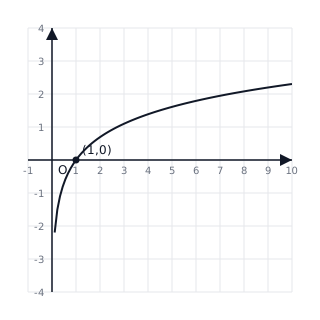
The natural logarithmic function f(x)=ln⁡(x)f(x) = \ln(x) is the inverse of the exponential function. It is defined only for x>0x > 0. The derivative is ddx(ln⁡x)=1x\frac{d}{dx}(\ln x) = \frac{1}{x}, which implies the slope of the tangent decreases as xx increases.

Graph of the natural logarithmic function ln(x) showing it passes through (1,0).
•

Logarithmic differentiation is a technique used to differentiate functions of the form y=[f(x)]g(x)y = [f(x)]^{g(x)} or complex products/quotients. By taking the natural log of both sides, we use the property ln⁡(uv)=vln⁡u\ln(u^v) = v \ln u to transform exponentiation into multiplication before applying the chain rule.

Flowchart showing the steps of logarithmic differentiation.
•

For the general exponential function axa^x where a>0a > 0, the derivative is axln⁡aa^x \ln a. This signifies that the rate of change is proportional to the value of the function itself, with the constant of proportionality being the natural log of the base.
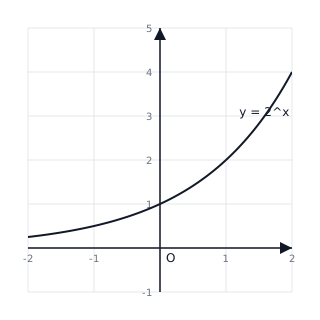
Graph of y = 2^x.

📐Formulae

ddx(ex)=ex\frac{d}{dx}(e^x) = e^x

ddx(ax)=axlog⁡ea\frac{d}{dx}(a^x) = a^x \log_e a

ddx(log⁡ex)=1x, where x>0\frac{d}{dx}(\log_e x) = \frac{1}{x}, \text{ where } x > 0

ddx(log⁡ax)=1xlog⁡ea\frac{d}{dx}(\log_a x) = \frac{1}{x \log_e a}

log⁡a(mn)=log⁡am+log⁡an\log_a(mn) = \log_a m + \log_a n

log⁡a(mn)=log⁡am−log⁡an\log_a\left(\frac{m}{n}\right) = \log_a m - \log_a n

log⁡a(mn)=nlog⁡am\log_a(m^n) = n \log_a m

log⁡ab=log⁡cblog⁡ca (Change of Base formula)\log_a b = \frac{\log_c b}{\log_c a} \text{ (Change of Base formula)}

💡Examples

Problem 1:

Differentiate y=esin⁡(x2)y = e^{\sin(x^2)} with respect to xx.

Solution:

Given y=esin⁡(x2)y = e^{\sin(x^2)}. Applying the Chain Rule: dydx=ddx(esin⁡(x2))=esin⁡(x2)⋅ddx(sin⁡(x2))\frac{dy}{dx} = \frac{d}{dx}(e^{\sin(x^2)}) = e^{\sin(x^2)} \cdot \frac{d}{dx}(\sin(x^2)) dydx=esin⁡(x2)⋅cos⁡(x2)⋅ddx(x2)\frac{dy}{dx} = e^{\sin(x^2)} \cdot \cos(x^2) \cdot \frac{d}{dx}(x^2) dydx=esin⁡(x2)⋅cos⁡(x2)⋅2x=2xcos⁡(x2)esin⁡(x2)\frac{dy}{dx} = e^{\sin(x^2)} \cdot \cos(x^2) \cdot 2x = 2x \cos(x^2) e^{\sin(x^2)}

Explanation:

We use the derivative rule for eue^u which is eu⋅dudxe^u \cdot \frac{du}{dx}, where u=sin⁡(x2)u = \sin(x^2).

Problem 2:

Find dydx\frac{dy}{dx} if y=log⁡(log⁡x),x>1y = \log(\log x), x > 1.

Solution:

Let u=log⁡xu = \log x. Then y=log⁡uy = \log u. Using the Chain Rule: dydx=ddu(log⁡u)⋅dudx\frac{dy}{dx} = \frac{d}{du}(\log u) \cdot \frac{du}{dx} dydx=1u⋅ddx(log⁡x)=1log⁡x⋅1x=1xlog⁡x\frac{dy}{dx} = \frac{1}{u} \cdot \frac{d}{dx}(\log x) = \frac{1}{\log x} \cdot \frac{1}{x} = \frac{1}{x \log x}

Explanation:

The derivative of the outer logarithm is taken first, followed by the derivative of the inner function log⁡x\log x.

Problem 3:

Differentiate y=xsin⁡xy = x^{\sin x} with respect to xx.

Solution:

Taking natural log on both sides: log⁡y=log⁡(xsin⁡x)=sin⁡xlog⁡x\log y = \log(x^{\sin x}) = \sin x \log x Differentiating both sides with respect to xx: 1ydydx=ddx(sin⁡xlog⁡x)\frac{1}{y} \frac{dy}{dx} = \frac{d}{dx}(\sin x \log x) Using the Product Rule: 1ydydx=sin⁡x⋅ddx(log⁡x)+log⁡x⋅ddx(sin⁡x)\frac{1}{y} \frac{dy}{dx} = \sin x \cdot \frac{d}{dx}(\log x) + \log x \cdot \frac{d}{dx}(\sin x) 1ydydx=sin⁡xx+log⁡xcos⁡x\frac{1}{y} \frac{dy}{dx} = \frac{\sin x}{x} + \log x \cos x dydx=y(sin⁡xx+cos⁡xlog⁡x)=xsin⁡x(sin⁡xx+cos⁡xlog⁡x)\frac{dy}{dx} = y \left( \frac{\sin x}{x} + \cos x \log x \right) = x^{\sin x} \left( \frac{\sin x}{x} + \cos x \log x \right)

Explanation:

Logarithmic differentiation is necessary here because the variable xx appears in both the base and the exponent.

Problem 4:

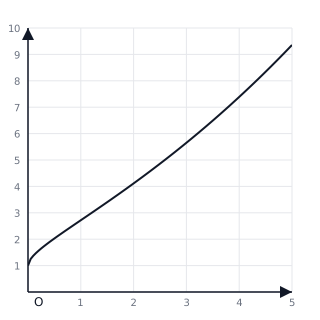
Differentiate y=exy = e^{\sqrt{x}} with respect to xx.

Graph of the function e^sqrt(x) starting from x=0.

Solution:

Let u=xu = \sqrt{x}. Then y=euy = e^u. Using the Chain Rule: dydx=ddu(eu)⋅dudx\frac{dy}{dx} = \frac{d}{du}(e^u) \cdot \frac{du}{dx} dydx=eu⋅ddx(x1/2)\frac{dy}{dx} = e^u \cdot \frac{d}{dx}(x^{1/2}) dydx=ex⋅(12x−1/2)\frac{dy}{dx} = e^{\sqrt{x}} \cdot \left(\frac{1}{2}x^{-1/2}\right) dydx=ex2x\frac{dy}{dx} = \frac{e^{\sqrt{x}}}{2\sqrt{x}}

Explanation:

This problem applies the Chain Rule to a composition of the natural exponential function and a square root function. The inner function is x\sqrt{x} and the outer function is exe^x.

Problem 5:

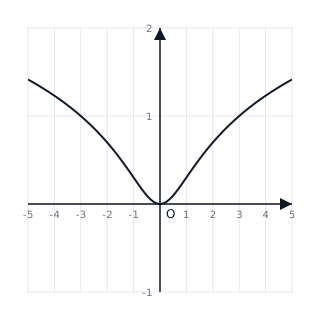
Find the derivative of y=log⁡10(x2+1)y = \log_{10}(x^2 + 1).

Graph of the function log10(x^2 + 1) which is symmetric about the y-axis.

Solution:

First, use the change of base formula to express the log in terms of natural logarithms: y=ln⁡(x2+1)ln⁡10y = \frac{\ln(x^2 + 1)}{\ln 10} Differentiating with respect to xx: dydx=1ln⁡10⋅ddx(ln⁡(x2+1))\frac{dy}{dx} = \frac{1}{\ln 10} \cdot \frac{d}{dx}(\ln(x^2 + 1)) Using the Chain Rule for the term ln⁡(x2+1)\ln(x^2 + 1): dydx=1ln⁡10⋅1x2+1⋅ddx(x2+1)\frac{dy}{dx} = \frac{1}{\ln 10} \cdot \frac{1}{x^2 + 1} \cdot \frac{d}{dx}(x^2 + 1) dydx=2x(x2+1)ln⁡10\frac{dy}{dx} = \frac{2x}{(x^2 + 1) \ln 10}

Explanation:

Standard differentiation rules apply to natural logarithms. For logs with other bases, we convert to base ee using log⁡ab=ln⁡bln⁡a\log_a b = \frac{\ln b}{\ln a} before differentiating.