krit.club logo

Continuity and Differentiability - Derivative of inverse trigonometric functions, implicit functions, exponential and logarithmic functions

Grade 12CBSE

Review the key concepts, formulae, and examples before starting your quiz.

🔑Concepts

Implicit Differentiation: This technique is used when yy cannot be easily expressed as an explicit function of xx (e.g., x2+y2=r2x^2 + y^2 = r^2). We differentiate every term with respect to xx, applying the Chain Rule to terms involving yy by multiplying by dydx\frac{dy}{dx}. Visually, this allows us to find the slope of the tangent at any point (x,y)(x, y) on a curve, even if the curve fails the vertical line test (like a circle).

Derivatives of Inverse Trigonometric Functions: These derivatives are defined within specific restricted domains to ensure the functions are one-to-one. For example, the derivative of sin1x\sin^{-1} x is 11x2\frac{1}{\sqrt{1-x^2}}. Visually, the graph of sin1x\sin^{-1} x is an increasing curve that becomes steeper as xx approaches 11 or 1-1, where the slope becomes infinite, explaining why the derivative is undefined at those boundaries.

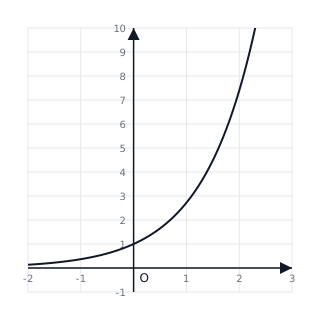
Exponential Functions: The derivative of the natural exponential function exe^x is unique because it is its own derivative, ddx(ex)=ex\frac{d}{dx}(e^x) = e^x. Graphically, this means the height of the curve at any point is exactly equal to the slope of the tangent line at that point. For any other base a>0a > 0, the derivative is axlnaa^x \ln a, where the lna\ln a acts as a vertical scaling factor for the slope.

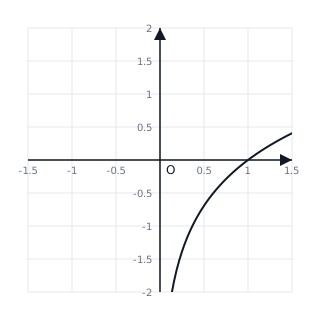
Logarithmic Functions: The derivative of lnx\ln x is 1x\frac{1}{x} for x>0x > 0. Visually, as xx increases, the slope of the logarithmic curve 1x\frac{1}{x} decreases, indicating that the function grows slower and slower. The function is only defined for positive xx, and its derivative shows that the curve is always increasing but concave down.

Logarithmic Differentiation: This method is essential for functions where the variable is in both the base and the exponent, such as y=[f(x)]g(x)y = [f(x)]^{g(x)}, or for products of many terms. By taking the natural log of both sides, we use the property ln(uv)=vlnu\ln(u^v) = v \ln u to transform an exponential relationship into a product, making it easier to differentiate using the Product Rule and Chain Rule.

Chain Rule for Composite Functions: When dealing with nested functions like ln(sinx)\ln(\sin x), we differentiate from the outside in. Visually, this is like examining how a change in the input xx ripples through a sequence of transformations. If y=f(u)y = f(u) and u=g(x)u = g(x), then the total rate of change dydx\frac{dy}{dx} is the product of the rate of change of each 'layer': dydududx\frac{dy}{du} \cdot \frac{du}{dx}.

📐Formulae

ddx(sin1x)=11x2, for x(1,1)\frac{d}{dx}(\sin^{-1} x) = \frac{1}{\sqrt{1-x^2}}, \text{ for } x \in (-1, 1)

ddx(cos1x)=11x2, for x(1,1)\frac{d}{dx}(\cos^{-1} x) = -\frac{1}{\sqrt{1-x^2}}, \text{ for } x \in (-1, 1)

ddx(tan1x)=11+x2, for xR\frac{d}{dx}(\tan^{-1} x) = \frac{1}{1+x^2}, \text{ for } x \in \mathbb{R}

ddx(ex)=ex\frac{d}{dx}(e^x) = e^x

ddx(ax)=axlna\frac{d}{dx}(a^x) = a^x \ln a

ddx(lnx)=1x, for x>0\frac{d}{dx}(\ln x) = \frac{1}{x}, \text{ for } x > 0

ddx(logax)=1xlna\frac{d}{dx}(\log_a x) = \frac{1}{x \ln a}

ddx(uv)=uv[vududx+lnudvdx]\frac{d}{dx}(u^v) = u^v \left[ \frac{v}{u} \frac{du}{dx} + \ln u \frac{dv}{dx} \right]

💡Examples

Problem 1:

Find dydx\frac{dy}{dx} if x2+xy+y2=100x^2 + xy + y^2 = 100.

Solution:

  1. Differentiate both sides of the equation with respect to xx: ddx(x2)+ddx(xy)+ddx(y2)=ddx(100)\frac{d}{dx}(x^2) + \frac{d}{dx}(xy) + \frac{d}{dx}(y^2) = \frac{d}{dx}(100)
  2. Apply the power rule to x2x^2 and the product rule to xyxy: 2x+(xdydx+y1)+2ydydx=02x + (x \frac{dy}{dx} + y \cdot 1) + 2y \frac{dy}{dx} = 0
  3. Group the terms involving dydx\frac{dy}{dx}: xdydx+2ydydx=2xyx \frac{dy}{dx} + 2y \frac{dy}{dx} = -2x - y
  4. Factor out dydx\frac{dy}{dx}: dydx(x+2y)=(2x+y)\frac{dy}{dx}(x + 2y) = -(2x + y)
  5. Solve for dydx\frac{dy}{dx}: dydx=2x+yx+2y\frac{dy}{dx} = -\frac{2x + y}{x + 2y}

Explanation:

This is an implicit differentiation problem. We treat yy as a function of xx and use the Product Rule for the term xyxy and the Chain Rule for y2y^2.

Problem 2:

Differentiate y=xsinxy = x^{\sin x} with respect to xx.

Solution:

  1. Since the variable is in both the base and the exponent, take the natural logarithm of both sides: lny=ln(xsinx)\ln y = \ln(x^{\sin x})
  2. Use the logarithm power property: lny=sinxlnx\ln y = \sin x \cdot \ln x
  3. Differentiate both sides with respect to xx using the Product Rule on the right side: 1ydydx=ddx(sinx)lnx+sinxddx(lnx)\frac{1}{y} \frac{dy}{dx} = \frac{d}{dx}(\sin x) \cdot \ln x + \sin x \cdot \frac{d}{dx}(\ln x) 1ydydx=cosxlnx+sinx1x\frac{1}{y} \frac{dy}{dx} = \cos x \ln x + \sin x \cdot \frac{1}{x}
  4. Multiply by yy to isolate dydx\frac{dy}{dx}: dydx=y(cosxlnx+sinxx)\frac{dy}{dx} = y \left( \cos x \ln x + \frac{\sin x}{x} \right)
  5. Substitute the original expression for yy: dydx=xsinx(cosxlnx+sinxx)\frac{dy}{dx} = x^{\sin x} \left( \cos x \ln x + \frac{\sin x}{x} \right)

Explanation:

This problem requires logarithmic differentiation because the function is of the form u(x)v(x)u(x)^{v(x)}. Taking logs simplifies the exponent into a product.