
Continuity and Differentiability - Derivative of functions expressed in parametric forms
Review the key concepts, formulae, and examples before starting your quiz.
🔑Concepts
Parametric representation involves expressing variables and as functions of a common third variable, usually or . For example, a circle of radius is represented as and . This allows us to track the position of a point on a curve as the parameter varies.
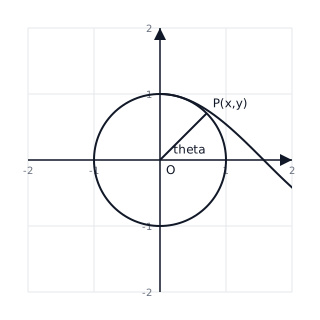
The Chain Rule is the foundation for differentiating parametric equations. To find the rate of change of with respect to (), we calculate the rate of change of both variables with respect to the parameter independently. The ratio of these rates, , gives the required derivative, provided .
Geometrically, represents the slope of the tangent to the curve at any point . In parametric form, this slope is a function of the parameter (e.g., or ). If we need to find the slope at a specific point, we substitute the given value of the parameter into the expression for .
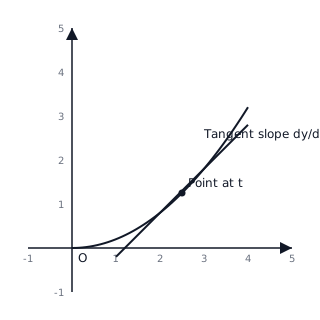
Higher-order derivatives like require careful application of the chain rule twice. After finding as a function of , you must differentiate that result with respect to again, and then multiply by (which is ). A common error is forgetting the final division by .

📐Formulae
💡Examples
Problem 1:
Find if and .
Solution:
Step 1: Differentiate with respect to : Step 2: Differentiate with respect to : Step 3: Use the parametric differentiation formula: Step 4: Simplify the expression:
Explanation:
To solve this, we differentiate both the and functions using the chain rule (power rule combined with trigonometric derivatives) and then divide the results.
Problem 2:
If and , find .
Solution:
Step 1: Find the first derivative . Step 2: Differentiate with respect to to find : Step 3: Compute the derivatives: Step 4: Multiply the terms:
Explanation:
The second derivative requires an extra step: differentiating the first derivative with respect to the parameter and then dividing by according to the chain rule.
Problem 3:
Find the slope of the tangent to the curve given by and at .
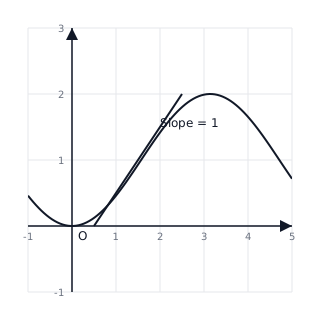
Solution:
- Find :
- Find :
- Apply the formula for :
- Using trigonometric identities:
- At :
Explanation:
We differentiate both parametric components with respect to the parameter . The slope of the tangent is the ratio of these derivatives. Simplification using half-angle formulas helps evaluate the specific value easily.
Problem 4:
Find for the curve and at .
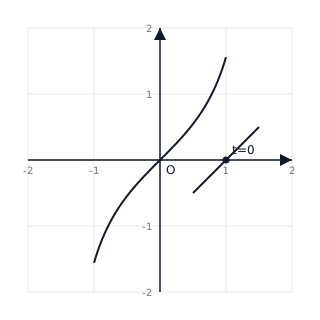
Solution:
- Differentiate wrt (Product Rule):
- Differentiate wrt (Product Rule):
- Calculate :
- Evaluate at :
Explanation:
By applying the product rule to each parametric equation, we find the rates of change with respect to . Dividing them gives the derivative in Cartesian terms. At , the exponential terms cancel and trigonometric values simplify to 1.