
Review the key concepts, formulae, and examples before starting your quiz.
🔑Concepts
The Algebra of Continuous Functions states that if two functions and are continuous at a point , then their sum , difference , and product are also continuous at . The quotient is continuous at provided .
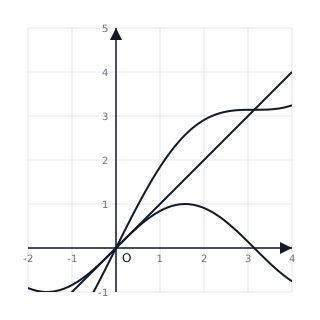
Every polynomial function is continuous everywhere in its domain. This is because constant functions and the identity function are continuous, and any polynomial is a finite sum of products of these.
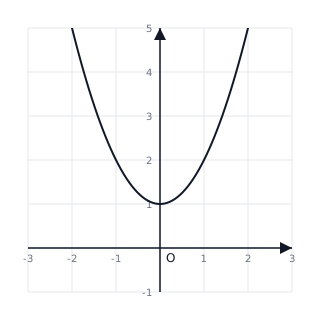
Rational functions are continuous everywhere except at points where the denominator is zero. A rational function is continuous for all such that .
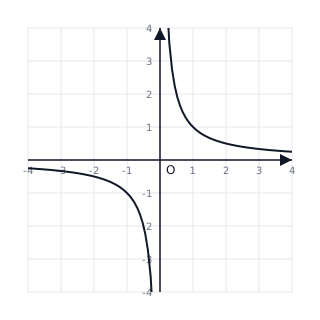
The composition of two continuous functions is continuous. If is continuous at and is continuous at , then is continuous at .
📐Formulae
💡Examples
Problem 1:
Prove that the function is a continuous function.
Solution:
Let and . We know that both and are continuous functions for all . According to the algebra of continuous functions, if and are continuous, then their sum is also continuous. Therefore, is continuous for all .
Explanation:
This solution uses the theorem that the sum of two continuous functions is itself continuous.
Problem 2:
Discuss the continuity of .
Solution:
Let and . Here, is a polynomial function, so it is continuous for all . Also, is a trigonometric function which is continuous for all . The function can be written as the composition of and , i.e., . Since the composition of two continuous functions is continuous, is continuous for all .
Explanation:
The continuity of the composite function is established by identifying the inner function (polynomial) and outer function (sine), both of which are known to be continuous.
Problem 3:
Is the function continuous at ?
Solution:
Let and . Both and are polynomial functions and are continuous for all . By the algebra of continuous functions, is continuous at all points where . At , . Since the denominator becomes zero, the function is not defined at . Therefore, is not continuous at .
Explanation:
A rational function is only continuous at points where the denominator is non-zero. Since makes the denominator zero, the function is discontinuous (specifically, it has a point of discontinuity) there.
Problem 4:
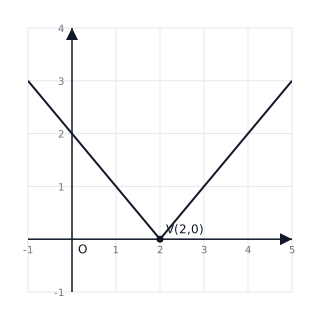
Discuss the continuity of the function .
Solution:
- Let , which is a polynomial function and hence continuous for all .
- Let , which is a known continuous function for all .
- The given function can be written as the composition .
- Since both and are continuous functions on , their composition is also continuous for all real numbers.
Explanation:
We use the property that the composition of two continuous functions is continuous. The absolute value of a polynomial is always continuous because the polynomial and the absolute value function are individually continuous.
Problem 5:
Examine the continuity of the function .
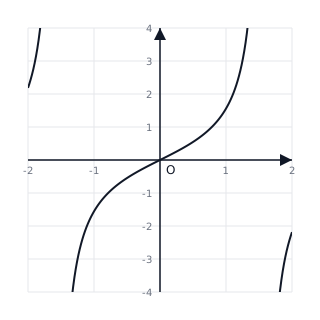
Solution:
- We know that .
- The functions and are continuous for all .
- According to the algebra of continuous functions, the quotient is continuous at all points where .
- when for .
- Therefore, is continuous at all points in its domain, which is .
Explanation:
Continuity of a quotient depends on the continuity of the numerator and denominator, as well as the denominator being non-zero. is continuous wherever it is defined.