krit.club logo

Continuity and Differentiability - Derivative of composite functions, chain rule

Grade 12CBSE

Review the key concepts, formulae, and examples before starting your quiz.

🔑Concepts

•

The Chain Rule is used to find the derivative of composite functions. If a function yy is defined as y=f(u)y = f(u) where u=g(x)u = g(x), then yy is a function of xx through the intermediate variable uu. The rate of change of yy with respect to xx is the product of the rate of change of yy with respect to uu and the rate of change of uu with respect to xx.

Flowchart showing the composition of functions where x maps to u, and u maps to y.
•

Mathematically, the rule is expressed as dydx=dydu⋅dudx\frac{dy}{dx} = \frac{dy}{du} \cdot \frac{du}{dx}. This can be visualized as 'unpeeling' layers of a function, starting from the outermost function and moving inward.
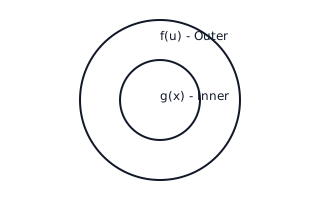
Concentric circles representing the layers of composite functions f(g(x)).
•

For functions of the form y=[f(x)]ny = [f(x)]^n, the chain rule simplifies to n[f(x)]n−1⋅f′(x)n[f(x)]^{n-1} \cdot f'(x). This is frequently used in polynomial and radical composite functions.
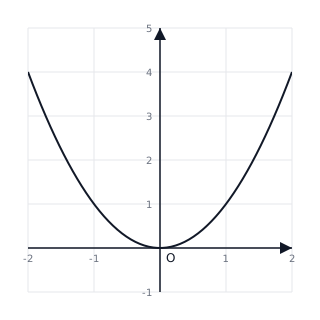
Graph of y = x^2 as a basic example of power rule composition.
•

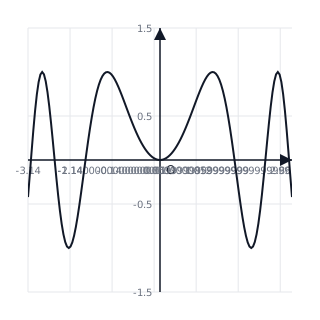
Trigonometric composites like sin⁡(g(x))\sin(g(x)) or cos⁡(g(x))\cos(g(x)) require multiplying the derivative of the trig function by the derivative of the angle g(x)g(x). For example, ddx(sin⁡(x2))=cos⁡(x2)⋅2x\frac{d}{dx}(\sin(x^2)) = \cos(x^2) \cdot 2x.

Graph of sin(x^2) showing changing frequency due to the inner function.

📐Formulae

dydx=dydu⋅dudx\frac{dy}{dx} = \frac{dy}{du} \cdot \frac{du}{dx}

ddx[f(g(x))]=f′(g(x))⋅g′(x)\frac{d}{dx} [f(g(x))] = f'(g(x)) \cdot g'(x)

ddx[un]=nun−1⋅dudx\frac{d}{dx} [u^n] = n u^{n-1} \cdot \frac{du}{dx}

ddx[sin⁡(u)]=cos⁡(u)⋅dudx\frac{d}{dx} [\sin(u)] = \cos(u) \cdot \frac{du}{dx}

ddx[eu]=eu⋅dudx\frac{d}{dx} [e^{u}] = e^{u} \cdot \frac{du}{dx}

ddx[log⁡(u)]=1u⋅dudx\frac{d}{dx} [\log(u)] = \frac{1}{u} \cdot \frac{du}{dx}

ddx[tan⁡(u)]=sec⁡2(u)⋅dudx\frac{d}{dx} [\tan(u)] = \sec^2(u) \cdot \frac{du}{dx}

💡Examples

Problem 1:

Differentiate y=sin⁡(x2+5)y = \sin(x^2 + 5) with respect to xx.

Solution:

Step 1: Identify the inner and outer functions. Let u=x2+5u = x^2 + 5 (inner) and y=sin⁡(u)y = \sin(u) (outer). Step 2: Find the derivative of the outer function with respect to uu: dydu=cos⁡(u)\frac{dy}{du} = \cos(u). Step 3: Find the derivative of the inner function with respect to xx: dudx=ddx(x2+5)=2x\frac{du}{dx} = \frac{d}{dx}(x^2 + 5) = 2x. Step 4: Apply the chain rule: dydx=dydu⋅dudx=cos⁡(u)⋅2x\frac{dy}{dx} = \frac{dy}{du} \cdot \frac{du}{dx} = \cos(u) \cdot 2x. Step 5: Substitute back u=x2+5u = x^2 + 5: dydx=2xcos⁡(x2+5)\frac{dy}{dx} = 2x \cos(x^2 + 5).

Explanation:

This problem uses the basic chain rule for a trigonometric composite function. We differentiate the sine function (outer) to get cosine, then multiply by the derivative of the quadratic expression (inner).

Problem 2:

Find dydx\frac{dy}{dx} if y=(3x2−7x+3)5y = (3x^2 - 7x + 3)^5.

Solution:

Step 1: Let the inner function be u=3x2−7x+3u = 3x^2 - 7x + 3. Then y=u5y = u^5. Step 2: Differentiate yy with respect to uu using the power rule: dydu=5u4\frac{dy}{du} = 5u^4. Step 3: Differentiate uu with respect to xx: dudx=6x−7\frac{du}{dx} = 6x - 7. Step 4: Combine using the chain rule: dydx=5u4⋅(6x−7)\frac{dy}{dx} = 5u^4 \cdot (6x - 7). Step 5: Substitute uu back into the equation: dydx=5(3x2−7x+3)4(6x−7)\frac{dy}{dx} = 5(3x^2 - 7x + 3)^4 (6x - 7).

Explanation:

This example demonstrates the generalized power rule. The entire polynomial is treated as a single variable uu raised to the 5th power, and the result is scaled by the derivative of that polynomial.

Problem 3:

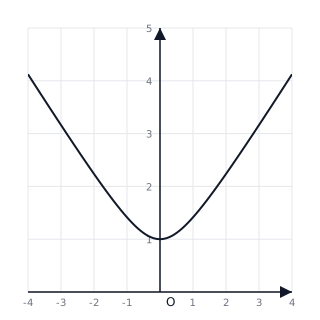
Differentiate y=x2+1y = \sqrt{x^2 + 1} with respect to xx.

Graph of y = sqrt(x^2 + 1) showing a smooth curve defined for all x.

Solution:

Let u=x2+1u = x^2 + 1. Then y=u=u1/2y = \sqrt{u} = u^{1/2}. By Chain Rule: dydx=dydu⋅dudx\frac{dy}{dx} = \frac{dy}{du} \cdot \frac{du}{dx} Since dydu=12u\frac{dy}{du} = \frac{1}{2\sqrt{u}} and dudx=2x\frac{du}{dx} = 2x, dydx=12x2+1⋅2x\frac{dy}{dx} = \frac{1}{2\sqrt{x^2 + 1}} \cdot 2x dydx=xx2+1\frac{dy}{dx} = \frac{x}{\sqrt{x^2 + 1}}

Explanation:

We treat the square root as the outer function and the polynomial inside as the inner function. The derivative of u\sqrt{u} is 12u\frac{1}{2\sqrt{u}}, which is then multiplied by the derivative of x2+1x^2+1.

Problem 4:

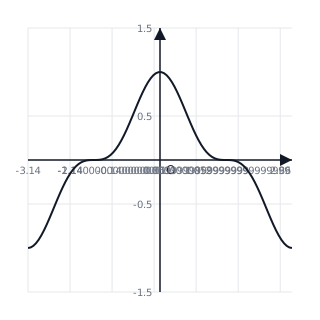
Find the derivative of y=cos⁡3(x)y = \cos^3(x).

Graph of y = (cos x)^3 showing periodic behavior.

Solution:

The function can be written as y=(cos⁡x)3y = (\cos x)^3. Let u=cos⁡xu = \cos x, then y=u3y = u^3. By Chain Rule: dydx=dydu⋅dudx\frac{dy}{dx} = \frac{dy}{du} \cdot \frac{du}{dx} dydu=3u2=3cos⁡2x\frac{dy}{du} = 3u^2 = 3\cos^2 x dudx=−sin⁡x\frac{du}{dx} = -\sin x Therefore, dydx=3cos⁡2x⋅(−sin⁡x)=−3cos⁡2xsin⁡x\frac{dy}{dx} = 3\cos^2 x \cdot (-\sin x) = -3\cos^2 x \sin x

Explanation:

Here, the power 3 is the outer function and cos⁡x\cos x is the inner function. We apply the power rule first and then multiply by the derivative of cos⁡x\cos x.