krit.club logo

Trigonometry - Trigonometric Identities of Sum and Difference of Angles

Grade 11ICSE

Review the key concepts, formulae, and examples before starting your quiz.

🔑Concepts

•

The sum and difference identities allow us to evaluate trigonometric functions of angles that are not standard (e.g., 15∘15^{\circ}, 75∘75^{\circ}) by expressing them as A±BA \pm B, where AA and BB are standard angles like 30∘30^{\circ}, 45∘45^{\circ}, or 60∘60^{\circ}.

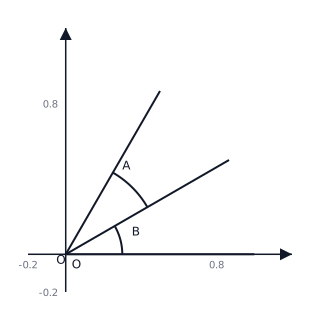
A diagram showing two adjacent angles A and B at the origin O to illustrate the sum of angles A+B.
•

The identity for cos⁡(A−B)\cos(A-B) can be visualized using two unit vectors at angles AA and BB with the positive x-axis; their dot product relates directly to the cosine of the difference between them.
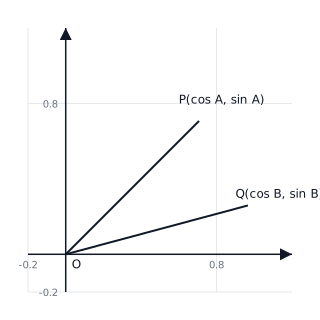
Unit circle vectors at angles A and B.
•

The tan⁡(A±B)\tan(A \pm B) identities are derived by dividing the sine sum/difference by the cosine sum/difference and then dividing the numerator and denominator by cos⁡Acos⁡B\cos A \cos B.

•

Specific products like sin⁡(A+B)sin⁡(A−B)\sin(A+B)\sin(A-B) result in differences of squares, such as sin⁡2A−sin⁡2B\sin^2 A - \sin^2 B, which are highly useful in simplifying complex trigonometric expressions.

📐Formulae

sin⁡(A+B)=sin⁡Acos⁡B+cos⁡Asin⁡B\sin(A + B) = \sin A \cos B + \cos A \sin B

sin⁡(A−B)=sin⁡Acos⁡B−cos⁡Asin⁡B\sin(A - B) = \sin A \cos B - \cos A \sin B

cos⁡(A+B)=cos⁡Acos⁡B−sin⁡Asin⁡B\cos(A + B) = \cos A \cos B - \sin A \sin B

cos⁡(A−B)=cos⁡Acos⁡B+sin⁡Asin⁡B\cos(A - B) = \cos A \cos B + \sin A \sin B

tan⁡(A+B)=tan⁡A+tan⁡B1−tan⁡Atan⁡B\tan(A + B) = \frac{\tan A + \tan B}{1 - \tan A \tan B}

tan⁡(A−B)=tan⁡A−tan⁡B1+tan⁡Atan⁡B\tan(A - B) = \frac{\tan A - \tan B}{1 + \tan A \tan B}

cot⁡(A+B)=cot⁡Acot⁡B−1cot⁡B+cot⁡A\cot(A + B) = \frac{\cot A \cot B - 1}{\cot B + \cot A}

cot⁡(A−B)=cot⁡Acot⁡B+1cot⁡B−cot⁡A\cot(A - B) = \frac{\cot A \cot B + 1}{\cot B - \cot A}

sin⁡(A+B)sin⁡(A−B)=sin⁡2A−sin⁡2B=cos⁡2B−cos⁡2A\sin(A + B)\sin(A - B) = \sin^2 A - \sin^2 B = \cos^2 B - \cos^2 A

cos⁡(A+B)cos⁡(A−B)=cos⁡2A−sin⁡2B=cos⁡2B−sin⁡2A\cos(A + B)\cos(A - B) = \cos^2 A - \sin^2 B = \cos^2 B - \sin^2 A

💡Examples

Problem 1:

Find the exact value of sin⁡75∘\sin 75^\circ using sum and difference identities.

Solution:

  1. Express 75∘75^\circ as a sum of two standard angles: 75∘=45∘+30∘75^\circ = 45^\circ + 30^\circ
  2. Apply the sine sum identity sin⁡(A+B)=sin⁡Acos⁡B+cos⁡Asin⁡B\sin(A+B) = \sin A \cos B + \cos A \sin B: sin⁡(45∘+30∘)=sin⁡45∘cos⁡30∘+cos⁡45∘sin⁡30∘\sin(45^\circ + 30^\circ) = \sin 45^\circ \cos 30^\circ + \cos 45^\circ \sin 30^\circ
  3. Substitute the standard values: sin⁡75∘=(12)(32)+(12)(12)\sin 75^\circ = \left(\frac{1}{\sqrt{2}}\right) \left(\frac{\sqrt{3}}{2}\right) + \left(\frac{1}{\sqrt{2}}\right) \left(\frac{1}{2}\right)
  4. Simplify the expression: sin⁡75∘=322+122=3+122\sin 75^\circ = \frac{\sqrt{3}}{2\sqrt{2}} + \frac{1}{2\sqrt{2}} = \frac{\sqrt{3} + 1}{2\sqrt{2}}

Explanation:

To solve for an angle not on the standard unit circle, we decompose it into the sum of two angles whose sine and cosine values are known (45∘45^\circ and 30∘30^\circ). We then apply the sine sum formula and simplify the fractions.

Problem 2:

Prove that cos⁡8∘−sin⁡8∘cos⁡8∘+sin⁡8∘=tan⁡37∘\frac{\cos 8^\circ - \sin 8^\circ}{\cos 8^\circ + \sin 8^\circ} = \tan 37^\circ.

Solution:

  1. Start with the Left Hand Side (LHS) and divide both numerator and denominator by cos⁡8∘\cos 8^\circ: LHS=cos⁡8∘cos⁡8∘−sin⁡8∘cos⁡8∘cos⁡8∘cos⁡8∘+sin⁡8∘cos⁡8∘=1−tan⁡8∘1+tan⁡8∘LHS = \frac{\frac{\cos 8^\circ}{\cos 8^\circ} - \frac{\sin 8^\circ}{\cos 8^\circ}}{\frac{\cos 8^\circ}{\cos 8^\circ} + \frac{\sin 8^\circ}{\cos 8^\circ}} = \frac{1 - \tan 8^\circ}{1 + \tan 8^\circ}
  2. Recognize that 1=tan⁡45∘1 = \tan 45^\circ. Substitute this into the formula: LHS=tan⁡45∘−tan⁡8∘1+(tan⁡45∘)(tan⁡8∘)LHS = \frac{\tan 45^\circ - \tan 8^\circ}{1 + (\tan 45^\circ)(\tan 8^\circ)}
  3. This expression matches the structure of the identity tan⁡(A−B)=tan⁡A−tan⁡B1+tan⁡Atan⁡B\tan(A-B) = \frac{\tan A - \tan B}{1 + \tan A \tan B}: LHS=tan⁡(45∘−8∘)LHS = \tan(45^\circ - 8^\circ)
  4. Simplify the subtraction: LHS=tan⁡37∘=RHSLHS = \tan 37^\circ = RHS

Explanation:

This is a common algebraic manipulation in trigonometry. By dividing by cos⁡θ\cos \theta, we convert a sine-cosine expression into a tangent expression, which allows us to use the tan⁡(A−B)\tan(A-B) identity by recognizing that 11 is tan⁡45∘\tan 45^\circ.

Problem 3:

Evaluate the exact value of cos⁡105∘\cos 105^{\circ}.

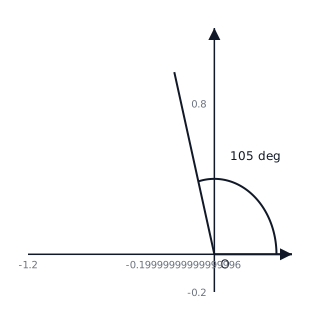
An angle of 105 degrees shown in the second quadrant.

Solution:

We can write 105∘105^{\circ} as 60∘+45∘60^{\circ} + 45^{\circ}. Using the identity cos⁡(A+B)=cos⁡Acos⁡B−sin⁡Asin⁡B\cos(A + B) = \cos A \cos B - \sin A \sin B: cos⁡(60∘+45∘)=cos⁡60∘cos⁡45∘−sin⁡60∘sin⁡45∘\cos(60^{\circ} + 45^{\circ}) = \cos 60^{\circ} \cos 45^{\circ} - \sin 60^{\circ} \sin 45^{\circ} Substitute the standard values: cos⁡105∘=(12)(12)−(32)(12)\cos 105^{\circ} = \left(\frac{1}{2}\right) \left(\frac{1}{\sqrt{2}}\right) - \left(\frac{\sqrt{3}}{2}\right) \left(\frac{1}{\sqrt{2}}\right) cos⁡105∘=122−322\cos 105^{\circ} = \frac{1}{2\sqrt{2}} - \frac{\sqrt{3}}{2\sqrt{2}} cos⁡105∘=1−322\cos 105^{\circ} = \frac{1 - \sqrt{3}}{2\sqrt{2}}

Explanation:

To find the value of a non-standard angle, we decompose it into the sum of two standard angles (60 and 45) and apply the cosine sum identity.

Problem 4:

Prove that tan⁡15∘=2−3\tan 15^{\circ} = 2 - \sqrt{3}.

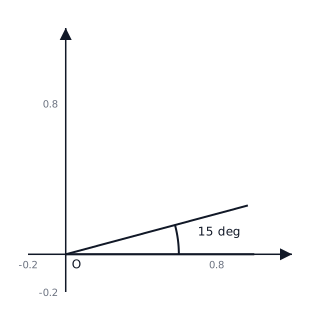
A small angle of 15 degrees at the origin.

Solution:

We can write 15∘15^{\circ} as 45∘−30∘45^{\circ} - 30^{\circ}. Using the identity tan⁡(A−B)=tan⁡A−tan⁡B1+tan⁡Atan⁡B\tan(A - B) = \frac{\tan A - \tan B}{1 + \tan A \tan B}: tan⁡(45∘−30∘)=tan⁡45∘−tan⁡30∘1+tan⁡45∘tan⁡30∘\tan(45^{\circ} - 30^{\circ}) = \frac{\tan 45^{\circ} - \tan 30^{\circ}}{1 + \tan 45^{\circ} \tan 30^{\circ}} Substitute tan⁡45∘=1\tan 45^{\circ} = 1 and tan⁡30∘=13\tan 30^{\circ} = \frac{1}{\sqrt{3}}: tan⁡15∘=1−131+1⋅13=3−13+1\tan 15^{\circ} = \frac{1 - \frac{1}{\sqrt{3}}}{1 + 1 \cdot \frac{1}{\sqrt{3}}} = \frac{\sqrt{3} - 1}{\sqrt{3} + 1} Rationalize the denominator: tan⁡15∘=(3−1)2(3+1)(3−1)=3+1−233−1\tan 15^{\circ} = \frac{(\sqrt{3} - 1)^2}{(\sqrt{3} + 1)(\sqrt{3} - 1)} = \frac{3 + 1 - 2\sqrt{3}}{3 - 1} tan⁡15∘=4−232=2−3\tan 15^{\circ} = \frac{4 - 2\sqrt{3}}{2} = 2 - \sqrt{3} Hence proved.

Explanation:

By representing 15 degrees as a difference of 45 and 30, we use the tangent difference formula and simplify the resulting radical expression through rationalization.