
Review the key concepts, formulae, and examples before starting your quiz.
🔑Concepts
The Sexagesimal System (Degree Measure) divides one complete revolution into equal parts called degrees. Each degree () is divided into minutes (), and each minute is divided into seconds ().
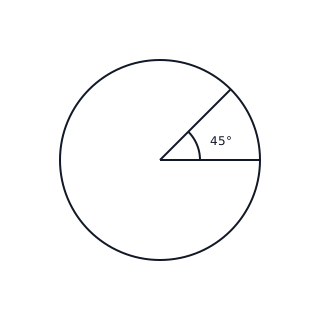
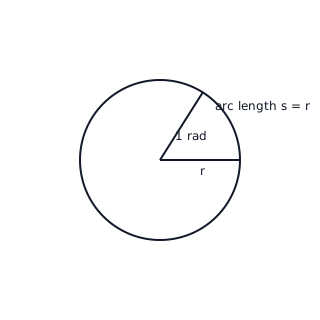
The Circular System (Radian Measure) defines radian as the angle subtended at the center of a circle by an arc whose length is equal to the radius of the circle. This leads to the fundamental relationship: , where is in radians.
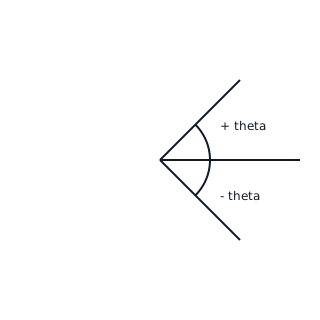
Angle Measurement Direction: An angle is considered positive if it is measured in the counter-clockwise direction from the initial side, and negative if it is measured in the clockwise direction.
The relationship between Radian and Degree measure is based on the semi-circle: . To convert from degrees to radians, multiply by . To convert from radians to degrees, multiply by .
📐Formulae
(minutes)
(seconds)
(where is in radians)
(where is in radians)
💡Examples
Problem 1:
Convert into radian measure.
Solution:
Step 1: Convert the minutes into degrees. Since , then . Step 2: Express the total angle in degrees: . Step 3: Convert degrees to radians using the formula . Step 4: Radian Measure .
Explanation:
We first ensure the entire angle is in a single unit (degrees) by converting minutes to a fraction of a degree. Then, we apply the conversion factor to find the equivalent circular measure.
Problem 2:
Find the length of an arc of a circle of radius cm subtending a central angle measuring .
Solution:
Step 1: Identify the given values: cm and . Step 2: Convert the angle from degrees to radians because the arc length formula requires in radians. radians. Step 3: Substitute the values into the arc length formula: cm. Step 4: Using , cm.
Explanation:
The most important step in calculating arc length is ensuring the angle is converted to radians. Once the angle is in the correct unit, the arc length is simply the product of the radius and the angle.
Problem 3:
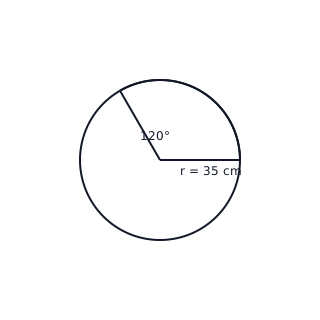
Calculate the distance a point on the rim of a wheel of radius cm travels when the wheel rotates through an angle of . (Use )
Solution:
- Convert the angle from degrees to radians:
- Use the arc length formula :
- Substitute : The distance traveled is approximately cm.
Explanation:
To find the distance on the rim (arc length), we must first ensure the angle is in radians before applying the formula .
Problem 4:
Find the angle in degrees subtended at the center of a circle of radius cm by an arc of length cm. (Use )
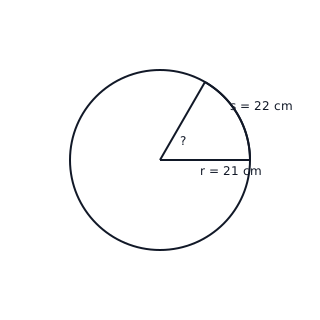
Solution:
- Use the formula to find the angle in radians:
- Convert radians to degrees by multiplying by :
- Substitute : The angle is .
Explanation:
The ratio of arc length to radius gives the angle in radians. We then apply the conversion factor to find the value in degrees.