krit.club logo

Trigonometry - Trigonometric Equations (General Solutions)

Grade 11ICSE

Review the key concepts, formulae, and examples before starting your quiz.

🔑Concepts

•

The general solution of a trigonometric equation is a formula that represents all the possible values of the variable satisfying the equation, usually expressed in terms of an integer nn. Due to the periodicity of trigonometric functions, solutions repeat at regular intervals.
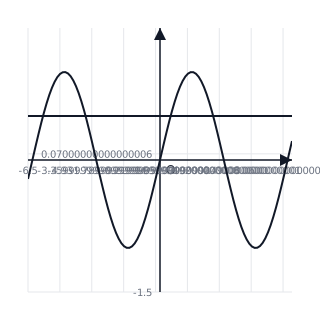
Graph of sin(x) showing multiple intersection points with a horizontal line to illustrate periodic solutions.
•

The Principal Value is the smallest numerical value of the angle α\alpha (positive or negative) which satisfies the equation. For sin⁡θ\sin \theta, we usually take α∈[−π2,π2]\alpha \in [-\frac{\pi}{2}, \frac{\pi}{2}], for cos⁡θ\cos \theta we take α∈[0,π]\alpha \in [0, \pi], and for tan⁡θ\tan \theta we take α∈(−π2,π2)\alpha \in (-\frac{\pi}{2}, \frac{\pi}{2}).

•

To solve equations of the form acos⁡θ+bsin⁡θ=ca \cos \theta + b \sin \theta = c, we divide throughout by a2+b2\sqrt{a^2 + b^2}. Let cos⁡ϕ=aa2+b2\cos \phi = \frac{a}{\sqrt{a^2 + b^2}} and sin⁡ϕ=ba2+b2\sin \phi = \frac{b}{\sqrt{a^2 + b^2}}, then the equation becomes cos⁡(θ−ϕ)=ca2+b2\cos(\theta - \phi) = \frac{c}{\sqrt{a^2 + b^2}}. This is solvable only if ∣c∣≤a2+b2|c| \le \sqrt{a^2 + b^2}.

•

Square forms like sin⁡2θ=sin⁡2α\sin^2 \theta = \sin^2 \alpha share a common general solution: θ=nπ±α\theta = n\pi \pm \alpha. This is because the square removes the sign dependency, making the solution symmetric across all four quadrants.

📐Formulae

If sin⁡θ=0\sin \theta = 0, then θ=nπ,n∈Z\theta = n\pi, n \in \mathbb{Z}

If cos⁡θ=0\cos \theta = 0, then θ=(2n+1)π2,n∈Z\theta = (2n + 1)\frac{\pi}{2}, n \in \mathbb{Z}

If tan⁡θ=0\tan \theta = 0, then θ=nπ,n∈Z\theta = n\pi, n \in \mathbb{Z}

If sin⁡θ=sin⁡α\sin \theta = \sin \alpha, then θ=nπ+(−1)nα,n∈Z\theta = n\pi + (-1)^n \alpha, n \in \mathbb{Z}

If cos⁡θ=cos⁡α\cos \theta = \cos \alpha, then θ=2nπ±α,n∈Z\theta = 2n\pi \pm \alpha, n \in \mathbb{Z}

If tan⁡θ=tan⁡α\tan \theta = \tan \alpha, then θ=nπ+α,n∈Z\theta = n\pi + \alpha, n \in \mathbb{Z}

If sin⁡2θ=sin⁡2α\sin^2 \theta = \sin^2 \alpha, then θ=nπ±α,n∈Z\theta = n\pi \pm \alpha, n \in \mathbb{Z}

If cos⁡2θ=cos⁡2α\cos^2 \theta = \cos^2 \alpha, then θ=nπ±α,n∈Z\theta = n\pi \pm \alpha, n \in \mathbb{Z}

If tan⁡2θ=tan⁡2α\tan^2 \theta = \tan^2 \alpha, then θ=nπ±α,n∈Z\theta = n\pi \pm \alpha, n \in \mathbb{Z}

💡Examples

Problem 1:

Find the general solution of the equation 3sec⁡2θ=2\sqrt{3} \sec 2\theta = 2.

Solution:

Step 1: Convert the equation to a basic trigonometric form. sec⁡2θ=23\sec 2\theta = \frac{2}{\sqrt{3}} cos⁡2θ=32\cos 2\theta = \frac{\sqrt{3}}{2}

Step 2: Find the principal value α\alpha. We know cos⁡π6=32\cos \frac{\pi}{6} = \frac{\sqrt{3}}{2}, so let α=π6\alpha = \frac{\pi}{6}.

Step 3: Apply the general solution formula for cosine. 2θ=2nπ±π62\theta = 2n\pi \pm \frac{\pi}{6}

Step 4: Solve for θ\theta. θ=nπ±π12,n∈Z\theta = n\pi \pm \frac{\pi}{12}, n \in \mathbb{Z}

Explanation:

We first express the secant function in terms of cosine. Then, we identify the basic angle α\alpha for which the cosine value is 32\frac{\sqrt{3}}{2}. Finally, we use the general solution formula for cos⁡θ=cos⁡α\cos \theta = \cos \alpha and divide by the coefficient of θ\theta.

Problem 2:

Solve for the general solution: 2sin⁡2x+sin⁡x−1=02\sin^2 x + \sin x - 1 = 0.

Solution:

Step 1: Treat the equation as a quadratic in terms of sin⁡x\sin x. Let y=sin⁡xy = \sin x, then 2y2+y−1=02y^2 + y - 1 = 0.

Step 2: Factorize the quadratic equation. 2y2+2y−y−1=02y^2 + 2y - y - 1 = 0 2y(y+1)−1(y+1)=02y(y + 1) - 1(y + 1) = 0 (2y−1)(y+1)=0(2y - 1)(y + 1) = 0

Step 3: Solve for sin⁡x\sin x. Case 1: sin⁡x=12  ⟹  sin⁡x=sin⁡π6\sin x = \frac{1}{2} \implies \sin x = \sin \frac{\pi}{6} x=nπ+(−1)nπ6x = n\pi + (-1)^n \frac{\pi}{6} Case 2: sin⁡x=−1  ⟹  sin⁡x=sin⁡(−π2)\sin x = -1 \implies \sin x = \sin (-\frac{\pi}{2}) x=kπ+(−1)k(−π2)x = k\pi + (-1)^k (-\frac{\pi}{2})

Step 4: Combine the solutions. x=nπ+(−1)nπ6x = n\pi + (-1)^n \frac{\pi}{6} or x=kπ−(−1)kπ2x = k\pi - (-1)^k \frac{\pi}{2} where n,k∈Zn, k \in \mathbb{Z}.

Explanation:

This is a quadratic trigonometric equation. We factor it like a standard polynomial to find two possible values for sin⁡x\sin x. Each value leads to a separate general solution using the sine formula.

Problem 3:

Find the general solution of the equation tan⁡3x=3\tan 3x = \sqrt{3}.

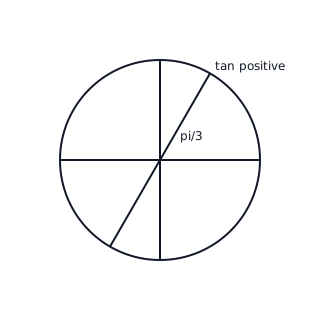
Unit circle showing angles in the 1st and 3rd quadrants where tangent is positive sqrt(3).

Solution:

  1. We know that tan⁡π3=3\tan \frac{\pi}{3} = \sqrt{3}.
  2. The equation is of the form tan⁡θ=tan⁡α\tan \theta = \tan \alpha, where θ=3x\theta = 3x and α=π3\alpha = \frac{\pi}{3}.
  3. The general solution is 3x=nπ+π3,n∈Z3x = n\pi + \frac{\pi}{3}, n \in \mathbb{Z}.
  4. Dividing by 3, we get x=nπ3+π9,n∈Zx = \frac{n\pi}{3} + \frac{\pi}{9}, n \in \mathbb{Z}.

Explanation:

We identify the principal value α\alpha for the tangent function and apply the general formula θ=nπ+α\theta = n\pi + \alpha.

Problem 4:

Solve for the general solution: cos⁡x+sin⁡x=1\cos x + \sin x = 1.

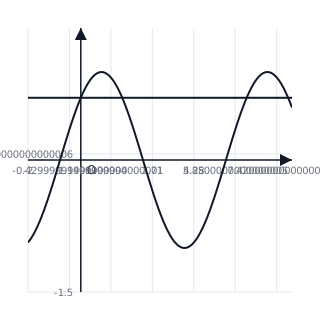
Graph of cos(x - pi/4) and the line y = 1/sqrt(2) showing intersection points at 0 and pi/2.

Solution:

  1. Divide both sides by 12+12=2\sqrt{1^2 + 1^2} = \sqrt{2}.
  2. 12cos⁡x+12sin⁡x=12\frac{1}{\sqrt{2}}\cos x + \frac{1}{\sqrt{2}}\sin x = \frac{1}{\sqrt{2}}.
  3. This can be written as cos⁡xcos⁡π4+sin⁡xsin⁡π4=cos⁡π4\cos x \cos \frac{\pi}{4} + \sin x \sin \frac{\pi}{4} = \cos \frac{\pi}{4}.
  4. cos⁡(x−π4)=cos⁡π4\cos(x - \frac{\pi}{4}) = \cos \frac{\pi}{4}.
  5. General solution: x−π4=2nπ±π4x - \frac{\pi}{4} = 2n\pi \pm \frac{\pi}{4}.
  6. Case 1: x=2nπ+π4+π4=2nπ+π2x = 2n\pi + \frac{\pi}{4} + \frac{\pi}{4} = 2n\pi + \frac{\pi}{2}.
  7. Case 2: x=2nπ−π4+π4=2nπx = 2n\pi - \frac{\pi}{4} + \frac{\pi}{4} = 2n\pi.

Explanation:

By normalizing the coefficients using the square root of the sum of squares, we convert the equation into a single cosine identity to find the general solution.