
Review the key concepts, formulae, and examples before starting your quiz.
🔑Concepts
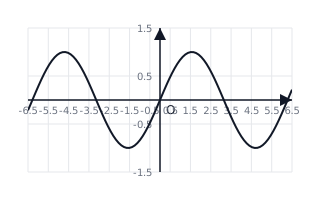
The Sine function is a periodic function with a period of . It oscillates between a maximum value of and a minimum value of . The graph passes through the origin and has -intercepts at , where is an integer.
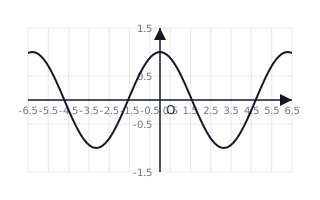
The Cosine function also has a period of and an amplitude of . Unlike the sine function, it is an even function (symmetric about the -axis) and starts at its maximum value when .
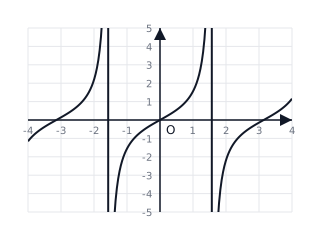
The Tangent function has a period of . It is undefined at (where ), resulting in vertical asymptotes at these points. The range of the tangent function is .
Signs of Trigonometric Functions: In the Cartesian plane, the signs of trig functions depend on the quadrant: All are positive in Quadrant I, Sine in Quadrant II, Tangent in Quadrant III, and Cosine in Quadrant IV (CAST rule).
Transformations: For , is the amplitude, is the period, is the phase shift (horizontal), and is the vertical shift.
📐Formulae
💡Examples
Problem 1:
Given and lies in the third quadrant (), find the values of and .
Solution:
Step 1: Use the identity . Step 2: Determine the sign based on the quadrant. In the third quadrant, is negative. So, . Step 3: Calculate using .
Explanation:
We use the fundamental Pythagorean identity to find the magnitude of the missing function and then apply the ASTC rule to determine the correct sign based on the specified quadrant.
Problem 2:
Determine the amplitude and period of the function and describe its graph compared to .
Solution:
Step 1: Identify the amplitude ''. In , . Amplitude . Step 2: Identify the frequency coefficient ''. Here . Step 3: Calculate the period using . Step 4: Comparison. The graph of is vertically stretched by a factor of 4 (reaching peaks at and troughs at ) and horizontally compressed by a factor of 3 (completing one full cycle every instead of ).
Explanation:
The amplitude is the absolute value of the leading coefficient, representing the peak height. The period is calculated by dividing the standard period () by the coefficient of .
Problem 3:
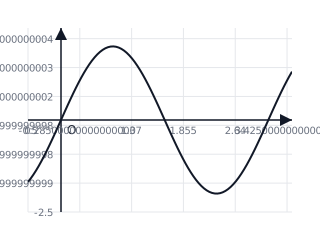
Sketch the graph of for the interval and identify its amplitude and period.
Solution:
- Identify parameters: For , we have and .
- Amplitude: The amplitude is .
- Period: The period is .
- Key Points: Since the period is , we divide it into four quarters: . At , . At , . At , . At , . At , .
Explanation:
The coefficient 2 outside the sine function stretches the graph vertically (amplitude), while the coefficient 2 inside the sine function compresses the graph horizontally, halving the period from to .
Problem 4:
Find the values of and if and is in the second quadrant ().
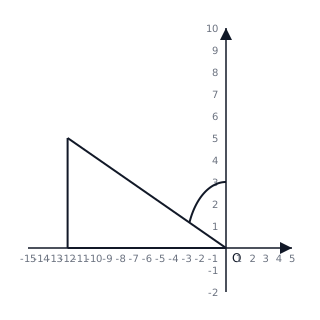
Solution:
- Using Identity: We know .
- Determine Sign: In the second quadrant, is negative.
- Find Tangent:
Explanation:
In Quadrant II, only Sine (and Cosecant) is positive. Both Cosine and Tangent must result in negative values. The Pythagorean triplet is used here.