krit.club logo

Trigonometry - Trigonometric Identities of Multiple and Sub-multiple Angles

Grade 11ICSE

Review the key concepts, formulae, and examples before starting your quiz.

🔑Concepts

•

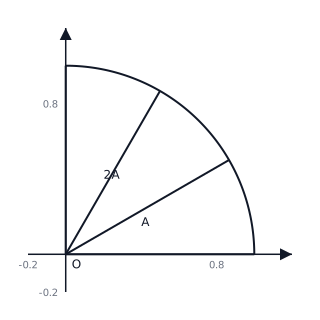
Double Angle Transformations: The double angle identities allow us to relate the trigonometric functions of 2θ2\theta to those of θ\theta. Geometrically, this relates the components of a vector at angle 2θ2\theta to the squares of the components at angle θ\theta.

Unit circle showing angle A and angle 2A for trigonometric comparison.
•

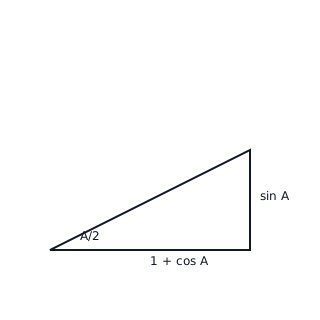
Sub-multiple Angle Half-Angle Relationships: The identities for A2\frac{A}{2} are derived from the cos⁡2θ\cos 2\theta formula. They are vital for finding exact values of angles like 22.5∘22.5^\circ (half of 45∘45^\circ) or 15∘15^\circ (half of 30∘30^\circ).

Right triangle representation of half-angle relationships.
•

Triple Angle Identities: The formulas for sin⁡3A\sin 3A and cos⁡3A\cos 3A are cubic in terms of sin⁡A\sin A and cos⁡A\cos A respectively. These are used to solve cubic equations in trigonometry.
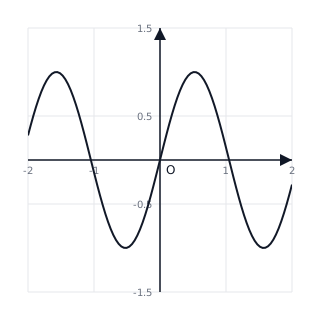
Graph of the function representing sin(3A) in terms of sin(A).
•

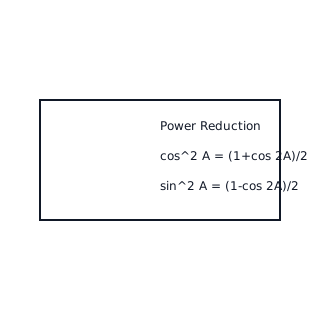
The 1±cos⁡2A1 \pm \cos 2A Rule: This is the most frequently used substitution in calculus and trigonometry simplification. 1+cos⁡2A=2cos⁡2A1 + \cos 2A = 2 \cos^2 A and 1−cos⁡2A=2sin⁡2A1 - \cos 2A = 2 \sin^2 A.

Summary box of power reduction identities.

📐Formulae

sin⁡2A=2sin⁡Acos⁡A=2tan⁡A1+tan⁡2A\sin 2A = 2 \sin A \cos A = \frac{2 \tan A}{1 + \tan^2 A}

cos⁡2A=cos⁡2A−sin⁡2A=2cos⁡2A−1=1−2sin⁡2A=1−tan⁡2A1+tan⁡2A\cos 2A = \cos^2 A - \sin^2 A = 2 \cos^2 A - 1 = 1 - 2 \sin^2 A = \frac{1 - \tan^2 A}{1 + \tan^2 A}

tan⁡2A=2tan⁡A1−tan⁡2A\tan 2A = \frac{2 \tan A}{1 - \tan^2 A}

sin⁡3A=3sin⁡A−4sin⁡3A\sin 3A = 3 \sin A - 4 \sin^3 A

cos⁡3A=4cos⁡3A−3cos⁡A\cos 3A = 4 \cos^3 A - 3 \cos A

tan⁡3A=3tan⁡A−tan⁡3A1−3tan⁡2A\tan 3A = \frac{3 \tan A - \tan^3 A}{1 - 3 \tan^2 A}

sin⁡A=2sin⁡A2cos⁡A2=2tan⁡A21+tan⁡2A2\sin A = 2 \sin \frac{A}{2} \cos \frac{A}{2} = \frac{2 \tan \frac{A}{2}}{1 + \tan^2 \frac{A}{2}}

cos⁡A=cos⁡2A2−sin⁡2A2=1−tan⁡2A21+tan⁡2A2\cos A = \cos^2 \frac{A}{2} - \sin^2 \frac{A}{2} = \frac{1 - \tan^2 \frac{A}{2}}{1 + \tan^2 \frac{A}{2}}

1−cos⁡A=2sin⁡2A2  ⟹  sin⁡A2=±1−cos⁡A21 - \cos A = 2 \sin^2 \frac{A}{2} \implies \sin \frac{A}{2} = \pm \sqrt{\frac{1 - \cos A}{2}}

1+cos⁡A=2cos⁡2A2  ⟹  cos⁡A2=±1+cos⁡A21 + \cos A = 2 \cos^2 \frac{A}{2} \implies \cos \frac{A}{2} = \pm \sqrt{\frac{1 + \cos A}{2}}

💡Examples

Problem 1:

Prove that 1−cos⁡2θsin⁡2θ=tan⁡θ\frac{1 - \cos 2\theta}{\sin 2\theta} = \tan \theta.

Solution:

LHS: 1−cos⁡2θsin⁡2θ\frac{1 - \cos 2\theta}{\sin 2\theta}

Step 1: Substitute 1−cos⁡2θ1 - \cos 2\theta with 2sin⁡2θ2 \sin^2 \theta and sin⁡2θ\sin 2\theta with 2sin⁡θcos⁡θ2 \sin \theta \cos \theta.

=2sin⁡2θ2sin⁡θcos⁡θ= \frac{2 \sin^2 \theta}{2 \sin \theta \cos \theta}

Step 2: Cancel the common terms 22 and sin⁡θ\sin \theta.

=sin⁡θcos⁡θ= \frac{\sin \theta}{\cos \theta}

Step 3: Use the identity tan⁡θ=sin⁡θcos⁡θ\tan \theta = \frac{\sin \theta}{\cos \theta}.

=tan⁡θ=RHS= \tan \theta = RHS.

Explanation:

This solution uses double angle identities for cosine (specifically the power reduction form) and sine to simplify the fraction into a single trigonometric ratio.

Problem 2:

If sin⁡A=35\sin A = \frac{3}{5} and AA is in the first quadrant, find the value of sin⁡3A\sin 3A.

Solution:

Step 1: Write down the triple angle formula for sine.

sin⁡3A=3sin⁡A−4sin⁡3A\sin 3A = 3 \sin A - 4 \sin^3 A

Step 2: Substitute the given value sin⁡A=35\sin A = \frac{3}{5} into the formula.

sin⁡3A=3(35)−4(35)3\sin 3A = 3 \left(\frac{3}{5}\right) - 4 \left(\frac{3}{5}\right)^3

Step 3: Perform the arithmetic calculations.

sin⁡3A=95−4(27125)\sin 3A = \frac{9}{5} - 4 \left(\frac{27}{125}\right)

sin⁡3A=95−108125\sin 3A = \frac{9}{5} - \frac{108}{125}

Step 4: Find a common denominator (125125).

sin⁡3A=9×25125−108125=225−108125=117125\sin 3A = \frac{9 \times 25}{125} - \frac{108}{125} = \frac{225 - 108}{125} = \frac{117}{125}

Explanation:

This problem demonstrates the direct application of the triple angle identity. Since the result is positive and AA is in the first quadrant (0<A<90∘0 < A < 90^{\circ}), 3A3A will fall between 00 and 270∘270^{\circ}. The value 117125\frac{117}{125} (approx 0.9360.936) is a valid sine value.

Problem 3:

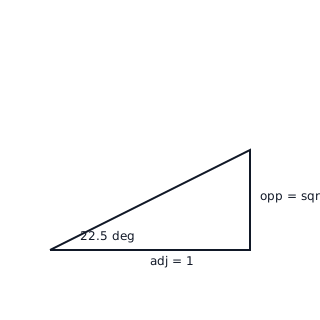
Prove that sin⁡2θ1+cos⁡2θ=tan⁡θ\frac{\sin 2\theta}{1 + \cos 2\theta} = \tan \theta and use this to find the value of tan⁡22.5∘\tan 22.5^\circ.

Right triangle for tan(22.5 degrees) with sides 1 and sqrt(2)-1.

Solution:

  1. LHS: sin⁡2θ1+cos⁡2θ\frac{\sin 2\theta}{1 + \cos 2\theta}
  2. Substitute sin⁡2θ=2sin⁡θcos⁡θ\sin 2\theta = 2\sin\theta \cos\theta and 1+cos⁡2θ=2cos⁡2θ1 + \cos 2\theta = 2\cos^2 \theta
  3. Expression becomes: 2sin⁡θcos⁡θ2cos⁡2θ\frac{2\sin\theta \cos\theta}{2\cos^2 \theta}
  4. Cancel 22 and one cos⁡θ\cos \theta: sin⁡θcos⁡θ=tan⁡θ=RHS\frac{\sin \theta}{\cos \theta} = \tan \theta = RHS
  5. To find tan⁡22.5∘\tan 22.5^\circ, let θ=22.5∘\theta = 22.5^\circ, so 2θ=45∘2\theta = 45^\circ.
  6. tan⁡22.5∘=sin⁡45∘1+cos⁡45∘=121+12=12+1\tan 22.5^\circ = \frac{\sin 45^\circ}{1 + \cos 45^\circ} = \frac{\frac{1}{\sqrt{2}}}{1 + \frac{1}{\sqrt{2}}} = \frac{1}{\sqrt{2} + 1}
  7. Rationalizing: 2−1\sqrt{2} - 1.

Explanation:

This problem uses the double angle identities for sine and the power-reduction related identity for 1+cos⁡2θ1+\cos 2\theta to simplify a rational trigonometric expression into a single tangent ratio.

Problem 4:

Show that 4(cos⁡310∘+sin⁡320∘)=3(cos⁡10∘+sin⁡20∘)4(\cos^3 10^\circ + \sin^3 20^\circ) = 3(\cos 10^\circ + \sin 20^\circ).

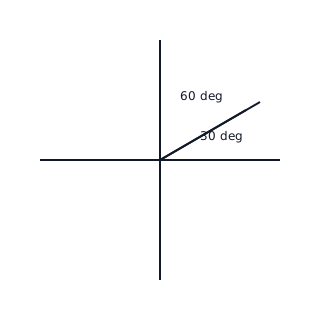
Angular diagram showing the relationship between 30 and 60 degrees.

Solution:

  1. Using Triple Angle Identities: cos⁡3A=4cos⁡3A−3cos⁡A  ⟹  4cos⁡3A=cos⁡3A+3cos⁡A\cos 3A = 4\cos^3 A - 3\cos A \implies 4\cos^3 A = \cos 3A + 3\cos A
  2. Also, sin⁡3B=3sin⁡B−4sin⁡3B  ⟹  4sin⁡3B=3sin⁡B−sin⁡3B\sin 3B = 3\sin B - 4\sin^3 B \implies 4\sin^3 B = 3\sin B - \sin 3B
  3. Let A=10∘A = 10^\circ and B=20∘B = 20^\circ.
  4. 4cos⁡310∘=cos⁡30∘+3cos⁡10∘4\cos^3 10^\circ = \cos 30^\circ + 3\cos 10^\circ
  5. 4sin⁡320∘=3sin⁡20∘−sin⁡60∘4\sin^3 20^\circ = 3\sin 20^\circ - \sin 60^\circ
  6. Adding the two: 4(cos⁡310∘+sin⁡320∘)=(cos⁡30∘−sin⁡60∘)+3cos⁡10∘+3sin⁡20∘4(\cos^3 10^\circ + \sin^3 20^\circ) = (\cos 30^\circ - \sin 60^\circ) + 3\cos 10^\circ + 3\sin 20^\circ
  7. Since cos⁡30∘=32\cos 30^\circ = \frac{\sqrt{3}}{2} and sin⁡60∘=32\sin 60^\circ = \frac{\sqrt{3}}{2}, they cancel out.
  8. Result: 3(cos⁡10∘+sin⁡20∘)3(\cos 10^\circ + \sin 20^\circ).

Explanation:

This example demonstrates the utility of triple angle identities in reducing the power of trigonometric terms from cubic to linear, facilitating simplification.