
Review the key concepts, formulae, and examples before starting your quiz.
🔑Concepts
A Venn diagram represents sets as regions inside a rectangle (the Universal Set ) and circles (individual sets). Operations like union and intersection are visualized by shading specific regions.
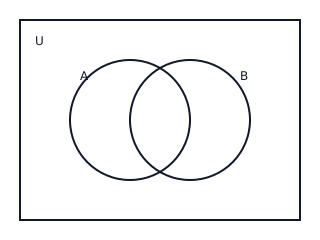
The Union of sets and , denoted as , represents the set of all elements belonging to or or both. In a Venn diagram, this is the entire region covered by both circles.
The Intersection of sets and , denoted as , represents elements common to both sets. In a Venn diagram, this is the overlapping region between the circles.
The Difference of sets represents elements that belong to but not to . This is often called the 'only A' region.
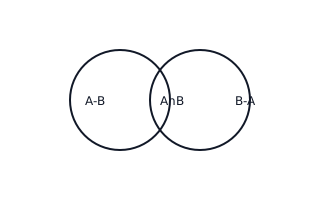
The Complement of a set , denoted as , consists of all elements in the universal set that are not in .
Symmetric Difference is the set of elements in either or but not in their intersection: .
📐Formulae
De Morgan's First Law:
De Morgan's Second Law:
💡Examples
Problem 1:
In a class of 50 students, 30 study Mathematics, 25 study Physics, and 10 study both subjects. Find the number of students who study: (i) either Mathematics or Physics, and (ii) neither of the two subjects.
Solution:
Let be the set of students studying Mathematics and be the set of students studying Physics. Given: , , , and . (i) To find those studying either subject, we find the union: . (ii) To find those studying neither, we find the complement of the union: .
Explanation:
We use the Principle of Inclusion-Exclusion to find the number of students in at least one set, then subtract from the total universal set to find those outside both sets.
Problem 2:
If , , and , verify De Morgan's First Law: .
Solution:
Step 1: Find . . \nStep 2: Find the LHS relative to . . \nStep 3: Find and . . \nStep 4: Find the RHS . . \nSince LHS = RHS, the law is verified.
Explanation:
This demonstrates De Morgan's Law by calculating the complement of a union and showing it equals the intersection of the individual complements.
Problem 3:
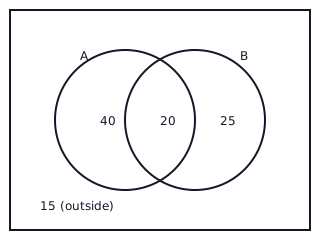
In a survey of 100 families, 60 use Brand A detergent, 45 use Brand B, and 20 use both. Represent this on a Venn diagram and find the number of families using neither brand.
Solution:
- Let , , , and .
- Families using only Brand A: .
- Families using only Brand B: .
- Total families using at least one brand: .
- Families using neither brand: .
Explanation:
We subtract the intersection from individual sets to find the 'only' regions. The sum of all regions within the circles subtracted from the universal set gives the 'neither' category.
Problem 4:
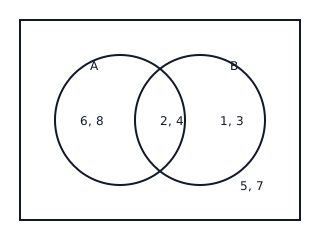
Given , , and . Find and illustrate and .
Solution:
- Intersection .
- .
- .
- Elements in not in or : .
Explanation:
Elements common to both sets are placed in the overlap. contains elements found exclusively in , and contains elements found exclusively in .