krit.club logo

Sets and Functions - Relations, Domain, Co-domain, and Range

Grade 11ICSE

Review the key concepts, formulae, and examples before starting your quiz.

🔑Concepts

•

A Relation RR from set AA to set BB is a subset of the Cartesian product A×BA \times B. It represents a connection between elements of the first set (domain) and the second set (co-domain).
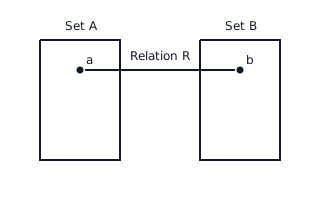
Mapping of a relation between elements of set A and set B
•

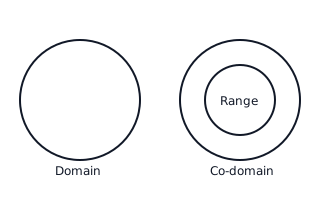
The Domain of a relation is the set of all first components of the ordered pairs in RR, while the Range is the set of all second components. The entire set BB is known as the Co-domain.

Venn diagram showing Domain, Co-domain, and Range
•

The Inverse Relation R−1R^{-1} is obtained by swapping the elements of every ordered pair in RR. If (a,b)∈R(a, b) \in R, then (b,a)∈R−1(b, a) \in R^{-1}.

•

Functions are a specific type of relation where every element in the domain is associated with exactly one element in the co-domain.

📐Formulae

n(A×B)=n(A)×n(B)n(A \times B) = n(A) \times n(B)

Total number of relations from A to B=2n(A)⋅n(B)\text{Total number of relations from } A \text{ to } B = 2^{n(A) \cdot n(B)}

R⊆(A×B)R \subseteq (A \times B)

Domain(R)={a∈A:(a,b)∈R for some b∈B}\text{Domain}(R) = \{a \in A : (a, b) \in R \text{ for some } b \in B\}

Range(R)={b∈B:(a,b)∈R for some a∈A}\text{Range}(R) = \{b \in B : (a, b) \in R \text{ for some } a \in A\}

R−1={(y,x):(x,y)∈R}R^{-1} = \{(y, x) : (x, y) \in R\}

💡Examples

Problem 1:

Let A={1,2,3,4,5,6}A = \{1, 2, 3, 4, 5, 6\}. Define a relation RR from AA to AA by R={(x,y):y=x+1}R = \{(x, y) : y = x + 1\}. Write down the relation in roster form and find its domain, co-domain, and range.

Solution:

Step 1: Identify pairs satisfying y=x+1y = x + 1 where x,y∈Ax, y \in A. When x=1,y=2x=1, y=2; When x=2,y=3x=2, y=3; When x=3,y=4x=3, y=4; When x=4,y=5x=4, y=5; When x=5,y=6x=5, y=6; When x=6,y=7x=6, y=7 (But 7∉A7 \notin A, so this pair is excluded). Step 2: Write in roster form: R={(1,2),(2,3),(3,4),(4,5),(5,6)}R = \{(1, 2), (2, 3), (3, 4), (4, 5), (5, 6)\}. Step 3: Extract the Domain: {1,2,3,4,5}\{1, 2, 3, 4, 5\}. Step 4: Extract the Range: {2,3,4,5,6}\{2, 3, 4, 5, 6\}. Step 5: The Co-domain is the entire set AA: {1,2,3,4,5,6}\{1, 2, 3, 4, 5, 6\}.

Explanation:

To solve this, we test each element of the first set in the given equation y=x+1y = x+1. If the resulting yy is also in the set, the pair is part of the relation. The domain is the set of starting values, and the range is the set of resulting values.

Problem 2:

Given A={x,y,z}A = \{x, y, z\} and B={1,2}B = \{1, 2\}. Find the total number of relations from AA to BB.

Solution:

Step 1: Find the number of elements in set AA: n(A)=3n(A) = 3. Step 2: Find the number of elements in set BB: n(B)=2n(B) = 2. Step 3: Calculate the number of elements in the Cartesian product A×BA \times B: n(A×B)=n(A)×n(B)=3×2=6n(A \times B) = n(A) \times n(B) = 3 \times 2 = 6. Step 4: Apply the formula for the number of relations: 2n(A×B)=26=642^{n(A \times B)} = 2^6 = 64.

Explanation:

Since every relation is a subset of the Cartesian product, the total number of relations is equal to the number of subsets of A×BA \times B, which is 2n(A×B)2^{n(A \times B)}.

Problem 3:

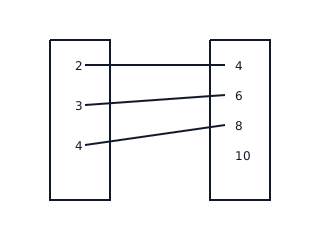
Let P={2,3,4}P = \{2, 3, 4\} and Q={4,6,8,10}Q = \{4, 6, 8, 10\}. Define a relation RR from PP to QQ by R={(x,y):y=2x}R = \{(x, y) : y = 2x\}. Find RR, its Domain, and its Range.

Mapping diagram showing the relation y = 2x from P to Q

Solution:

R={(2,4),(3,6),(4,8)}R = \{(2, 4), (3, 6), (4, 8)\} Domain (R)={2,3,4}(R) = \{2, 3, 4\} Range (R)={4,6,8}(R) = \{4, 6, 8\} Co-domain ={4,6,8,10}= \{4, 6, 8, 10\}

Explanation:

We check each element x∈Px \in P: for x=2,y=2(2)=4x=2, y=2(2)=4; for x=3,y=2(3)=6x=3, y=2(3)=6; for x=4,y=2(4)=8x=4, y=2(4)=8. All these values of yy exist in QQ.

Problem 4:

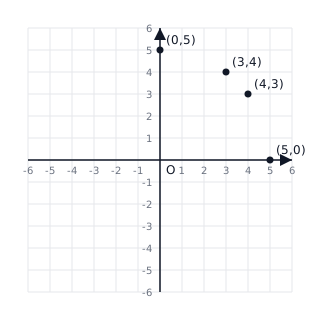
Determine the domain and range of the relation R={(x,y):x2+y2=25,x,y∈Z}R = \{(x, y) : x^2 + y^2 = 25, x, y \in \mathbb{Z}\}.

Circle graph representing the relation x^2 + y^2 = 25 with integer points

Solution:

R={(0,5),(0,−5),(5,0),(−5,0),(3,4),(3,−4),(−3,4),(−3,−4),(4,3),(4,−3),(−4,3),(−4,−3)}R = \{(0, 5), (0, -5), (5, 0), (-5, 0), (3, 4), (3, -4), (-3, 4), (-3, -4), (4, 3), (4, -3), (-4, 3), (-4, -3)\} Domain ={0,5,−5,3,−3,4,−4}= \{0, 5, -5, 3, -3, 4, -4\} Range ={0,5,−5,3,−3,4,−4}= \{0, 5, -5, 3, -3, 4, -4\}

Explanation:

Since xx and yy must be integers and their squares sum to 25, we look for integer coordinates on a circle of radius 5.