
Review the key concepts, formulae, and examples before starting your quiz.
🔑Concepts
A Set is a well-defined collection of distinct objects. Objects in a set are called elements or members. We use capital letters (e.g., ) to denote sets and small letters (e.g., ) for elements. If is an element of set , we write .
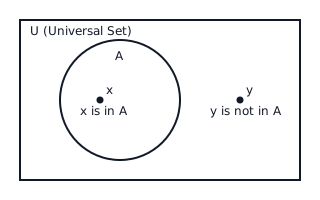
Sets can be represented in two ways: Roster (Tabular) Form, where elements are listed within braces separated by commas, e.g., ; and Set-Builder Form, where we state the common property of elements, e.g., .

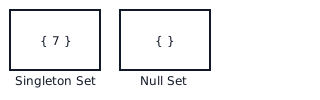
A Subset means every element of is also in . If there is at least one element in not in , then is a Proper Subset (). An Empty Set ( or ) has no elements and is a subset of every set.
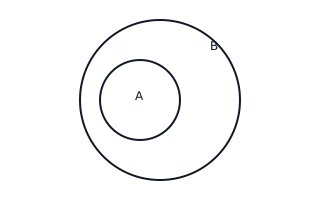
Types of Sets include: Finite Sets (countable elements), Infinite Sets (uncountable, e.g., ), Singleton Sets (exactly one element), and Equal Sets (identical elements regardless of order).
📐Formulae
Cardinal number of a set :
Number of subsets of a set with elements:
Number of proper subsets of a set with elements:
Condition for Equality:
Power Set notation:
Set-Builder notation:
💡Examples
Problem 1:
Write the set in Roster form and find its cardinal number .
Solution:
- Identify the condition: must be an integer () and its square must be less than .
- Test integers: (Yes) (Yes) (Yes) (Yes) (Yes) (No)
- List the elements: .
- Count the elements: There are elements in total.
- Therefore, .
Explanation:
This problem requires converting a logic-based set-builder notation into a specific list of elements by checking which integers satisfy the inequality .
Problem 2:
If , find the Power Set and verify the number of elements.
Solution:
- List all possible subsets of :
- Subsets with 0 elements:
- Subsets with 1 element:
- Subsets with 2 elements:
- Subsets with 3 elements:
- Combine them into one set: .
- Verify the count: The number of elements in is . The formula for the number of elements in is . Counting the listed subsets, we get exactly .
Explanation:
The Power Set is the set of all subsets. Systematic listing (by number of elements) ensures no subset is missed, and the formula serves as a check for accuracy.
Problem 3:
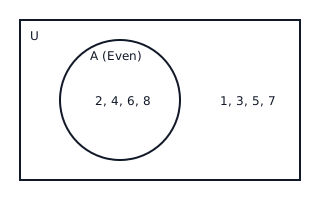
Given the Universal set and set , represent in Roster form and visualize its position in .
Solution:
In , the even numbers are . Therefore, in Roster form: . The cardinal number .
Explanation:
We filter the elements of based on the condition 'is even' to form set .
Problem 4:
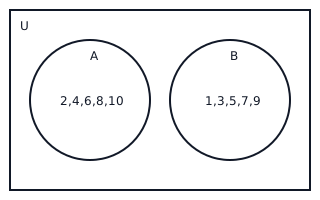
Given the Universal set and two sets and , identify the relationship between and . Represent these sets using a Venn diagram and determine if they are disjoint.
Solution:
Checking for common elements: Since there are no common elements between set and set , they are called Disjoint Sets. Cardinality: Since , they are also Equivalent Sets.
Explanation:
Two sets are disjoint if their intersection is an empty set. Here, consists of even numbers and consists of odd numbers from the universal set . Since no number is both even and odd, the sets do not overlap. The Venn diagram shows two separate circles within the rectangle representing the Universal set.