krit.club logo

Sets and Functions - Sum, Difference, Product and Quotients of Functions

Grade 11ICSE

Review the key concepts, formulae, and examples before starting your quiz.

🔑Concepts

•

Algebra of real functions involves combining two functions f:D1→Rf: D_1 \to \mathbb{R} and g:D2→Rg: D_2 \to \mathbb{R} to create a new function. The operations are defined pointwise, meaning for any xx in the common domain, the outputs are added, subtracted, or multiplied.

•

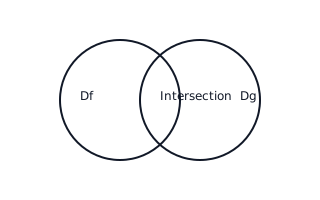
The domain of the sum (f+g)(f+g), difference (f−g)(f-g), and product (fg)(fg) is the intersection of the domains of ff and gg, denoted as Df∩DgD_f \cap D_g. This ensures that both f(x)f(x) and g(x)g(x) are defined for every xx in the new domain.

Venn diagram showing the intersection of domain Df and Dg where the combined functions are defined.
•

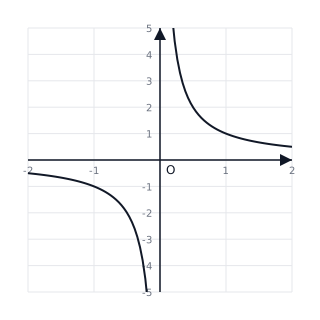
The quotient function (fg)(\frac{f}{g}) is defined as (fg)(x)=f(x)g(x)(\frac{f}{g})(x) = \frac{f(x)}{g(x)}. Its domain is Df∩DgD_f \cap D_g excluding all points xx where g(x)=0g(x) = 0, as division by zero is undefined.

Graph of 1/x illustrating a vertical asymptote where the denominator is zero.
•

Scalar multiplication (cf)(x)=c⋅f(x)(cf)(x) = c \cdot f(x) stretches or compresses the function ff vertically by a factor of cc. The domain remains the same as DfD_f.

📐Formulae

Sum: (f+g)(x)=f(x)+g(x)(f + g)(x) = f(x) + g(x) where x∈Df∩Dgx \in D_f \cap D_g

Difference: (f−g)(x)=f(x)−g(x)(f - g)(x) = f(x) - g(x) where x∈Df∩Dgx \in D_f \cap D_g

Product: (fg)(x)=f(x)g(x)(fg)(x) = f(x)g(x) where x∈Df∩Dgx \in D_f \cap D_g

Quotient: (fg)(x)=f(x)g(x)(\frac{f}{g})(x) = \frac{f(x)}{g(x)} where x∈Df∩Dgx \in D_f \cap D_g and g(x)≠0g(x) \neq 0

Scalar Multiplication: (cf)(x)=c⋅f(x)(cf)(x) = c \cdot f(x) where cc is a real number

Domain of f±gf \pm g and fgfg: Df±g=Dfg=Df∩DgD_{f \pm g} = D_{fg} = D_f \cap D_g

Domain of fg\frac{f}{g}: Df/g={x∈Df∩Dg:g(x)≠0}D_{f/g} = \{x \in D_f \cap D_g : g(x) \neq 0\}

💡Examples

Problem 1:

Given f(x)=xf(x) = \sqrt{x} and g(x)=x−4g(x) = x - 4, find (f+g)(x)(f + g)(x) and (f⋅g)(x)(f \cdot g)(x), and determine their domains.

Solution:

  1. Find individual domains: For f(x)=xf(x) = \sqrt{x}, Df=[0,∞)D_f = [0, \infty). For g(x)=x−4g(x) = x - 4, Dg=RD_g = \mathbb{R}.
  2. The intersection of domains is Df∩Dg=[0,∞)∩(−∞,∞)=[0,∞)D_f \cap D_g = [0, \infty) \cap (-\infty, \infty) = [0, \infty).
  3. Calculate the sum: (f+g)(x)=f(x)+g(x)=x+x−4(f + g)(x) = f(x) + g(x) = \sqrt{x} + x - 4.
  4. Calculate the product: (fg)(x)=f(x)⋅g(x)=x(x−4)=xx−4x(fg)(x) = f(x) \cdot g(x) = \sqrt{x}(x - 4) = x\sqrt{x} - 4\sqrt{x}.
  5. The domain for both (f+g)(f+g) and (fg)(fg) is [0,∞)[0, \infty).

Explanation:

To combine functions, we first identify the domain where both functions are defined. Since x\sqrt{x} requires non-negative values, the intersection is limited to [0,∞)[0, \infty). The operations are then performed algebraically on the expressions.

Problem 2:

Let f(x)=x2+1f(x) = x^2 + 1 and g(x)=x−1g(x) = x - 1. Find the quotient function (fg)(x)(\frac{f}{g})(x) and specify its domain.

Solution:

  1. Define the quotient: (fg)(x)=f(x)g(x)=x2+1x−1(\frac{f}{g})(x) = \frac{f(x)}{g(x)} = \frac{x^2 + 1}{x - 1}.
  2. Find individual domains: Df=RD_f = \mathbb{R} and Dg=RD_g = \mathbb{R}.
  3. Find intersection: Df∩Dg=RD_f \cap D_g = \mathbb{R}.
  4. Identify values where g(x)=0g(x) = 0: x−1=0  ⟹  x=1x - 1 = 0 \implies x = 1.
  5. Exclude x=1x = 1 from the domain.
  6. Domain of (fg)(\frac{f}{g}) is R−{1}\mathbb{R} - \{1\} or (−∞,1)∪(1,∞)(-\infty, 1) \cup (1, \infty).

Explanation:

When finding the quotient of two functions, the domain is the intersection of the domains of ff and gg, but we must specifically exclude any value of xx that makes the denominator g(x)g(x) equal to zero to avoid division by zero.

Problem 3:

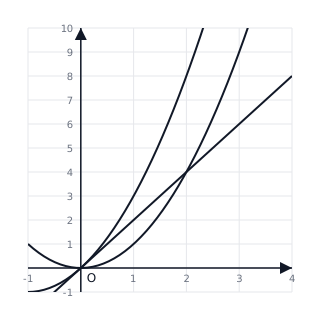
Given f(x)=x2f(x) = x^2 and g(x)=2xg(x) = 2x, find (f+g)(x)(f+g)(x) and visualize the resulting curve at x=1x=1 and x=2x=2.

Graph showing the parabola x^2, the line 2x, and their sum x^2+2x.

Solution:

  1. Define the sum: (f+g)(x)=f(x)+g(x)=x2+2x(f+g)(x) = f(x) + g(x) = x^2 + 2x.
  2. Calculate specific values: For x=1x=1, (f+g)(1)=12+2(1)=3(f+g)(1) = 1^2 + 2(1) = 3. For x=2x=2, (f+g)(2)=22+2(2)=8(f+g)(2) = 2^2 + 2(2) = 8.

Explanation:

The sum function is found by adding the algebraic expressions. The graph represents the vertical addition of the yy-coordinates of f(x)f(x) and g(x)g(x) for every xx.

Problem 4:

Find the quotient function (fg)(x)(\frac{f}{g})(x) for f(x)=x−2f(x) = x - 2 and g(x)=x2−4g(x) = x^2 - 4, and state its domain.

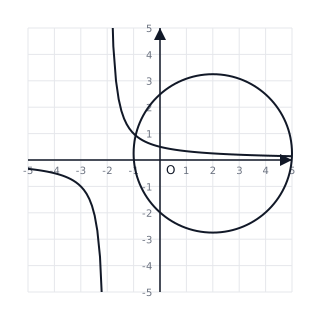
Graph of 1/(x+2) with a vertical asymptote at x=-2 and a removable discontinuity (hole) at x=2.

Solution:

  1. Expression: (fg)(x)=x−2x2−4(\frac{f}{g})(x) = \frac{x-2}{x^2-4}.
  2. Simplify: (fg)(x)=x−2(x−2)(x+2)=1x+2(\frac{f}{g})(x) = \frac{x-2}{(x-2)(x+2)} = \frac{1}{x+2} for x≠2x \neq 2.
  3. Domain: Df=RD_f = \mathbb{R}, Dg=RD_g = \mathbb{R}. We must exclude values where g(x)=0g(x) = 0. x2−4=0  ⟹  x=2x^2 - 4 = 0 \implies x = 2 or x=−2x = -2. Therefore, Domain = R∖{−2,2}\mathbb{R} \setminus \{-2, 2\}.

Explanation:

Even though (x−2)(x-2) cancels out, the function is still undefined at the original point where the denominator was zero (x=2x=2), creating a 'hole' in the graph.