
Review the key concepts, formulae, and examples before starting your quiz.
🔑Concepts
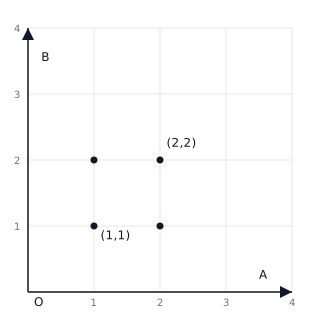
The Cartesian Product of two sets and is the set of all ordered pairs where and . Visually, if is represented on the x-axis and on the y-axis, the product forms a grid of points.
A Relation from set to set is a subset of the Cartesian product . It is often depicted using an arrow diagram where arrows connect elements of to related elements in .
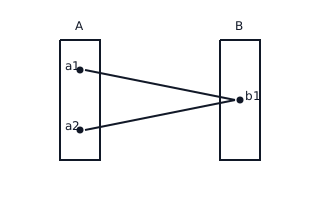
The Domain of a relation is the set of all first elements of the ordered pairs in , while the Range is the set of all second elements. The entire set is called the Codomain.
The total number of possible relations from set (size ) to set (size ) is , which represents all possible subsets of the Cartesian product.
📐Formulae
Total relations from to
💡Examples
Problem 1:
If , find the values of and .
Solution:
Step 1: Since the ordered pairs are equal, equate the corresponding elements. Step 2: Solve the first equation for : Step 3: Solve the second equation for : Final Answer: and .
Explanation:
This solution relies on the fundamental property of ordered pairs: two pairs are identical if and only if their first components are equal and their second components are equal.
Problem 2:
Let and . Define a relation from to by . Write in roster form and find its domain.
Solution:
Step 1: Test the 'difference is odd' condition for all pairs . Recall that a difference is odd if one number is even and the other is odd. Step 2: Check for (odd): (odd), (odd), (even). Pairs: . Step 3: Check for (even): (even), (even), (odd). Pair: . Step 4: Check for (odd): (odd), (odd), (even). Pairs: . Step 5: Check for (odd): (odd), (odd), (even). Pairs: . Step 6: Write in roster form: Step 7: Find the domain (set of all first elements):
Explanation:
To solve this, we systematically verify the arithmetic condition for every possible pairing in the Cartesian product , then extract the unique first elements to define the domain.
Problem 3:
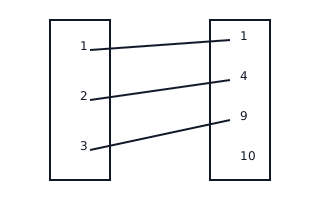
Let and . Define a relation from to such that . List the elements of and find the Domain and Range.
Solution:
- Calculate for each :
- For .
- For .
- For .
- The relation in roster form is .
- Domain = .
- Range = .
Explanation:
We check each element of the first set to see if its square exists in set . The resulting ordered pairs form the relation . The first components of these pairs are the domain, and the second components are the range.
Problem 4:
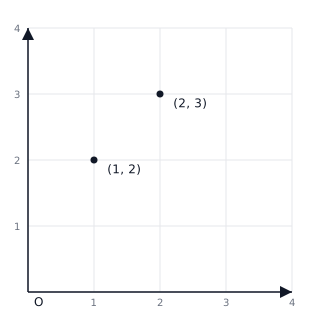
Identify the relation shown in the coordinate plot where and . Express in set-builder form.
Solution:
- From the diagram, the points plotted are and .
- Observe the relationship between and : and .
- Thus, .
- In set-builder form: .
Explanation:
By identifying the coordinates of the points in the Cartesian plane, we can deduce a mathematical rule that links (from set ) to (from set ).