krit.club logo

Relations and Functions - Cartesian Product of Sets

Grade 11CBSE

Review the key concepts, formulae, and examples before starting your quiz.

🔑Concepts

•

The Cartesian Product of two non-empty sets AA and BB, denoted by A×BA \times B, is the set of all ordered pairs (a,b)(a, b) such that a∈Aa \in A and b∈Bb \in B. Visually, if sets are represented on axes, the product forms a grid of points.
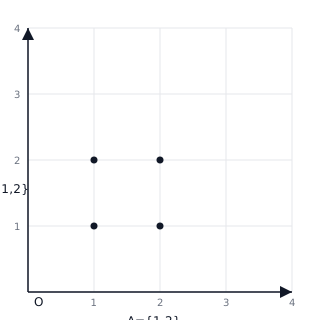
A coordinate plane showing a 2x2 grid of points representing the Cartesian product of two sets.
•

Two ordered pairs (a,b)(a, b) and (x,y)(x, y) are equal if and only if their corresponding elements are identical, i.e., a=xa = x and b=yb = y. Changing the order of elements generally results in a different ordered pair.
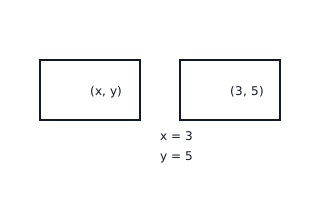
Comparison of two ordered pairs showing matching components.
•

The number of elements in A×BA \times B is the product of the number of elements in AA and BB. If n(A)=pn(A) = p and n(B)=qn(B) = q, then n(A×B)=p×qn(A \times B) = p \times q. If either set is infinite, the product is infinite.

Flowchart showing how the number of elements in sets A and B combine to give the total pairs in the Cartesian product.
•

The Cartesian product of three sets A×B×CA \times B \times C consists of ordered triplets (a,b,c)(a, b, c). This can be visualized as points in a 3D space.
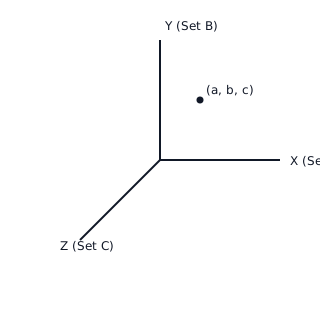
A 3D coordinate system representing an ordered triplet.

📐Formulae

AtimesB=(a,b):ainA,binBA \\times B = \\{ (a, b) : a \\in A, b \\in B \\}

(a,b)=(x,y)impliesa=xtextandb=y(a, b) = (x, y) \\implies a = x \\text{ and } b = y

n(AtimesB)=n(A)timesn(B)n(A \\times B) = n(A) \\times n(B)

Atimesphi=phiA \\times \\phi = \\phi

Atimes(BcupC)=(AtimesB)cup(AtimesC)A \\times (B \\cup C) = (A \\times B) \\cup (A \\times C)

Atimes(BcapC)=(AtimesB)cap(AtimesC)A \\times (B \\cap C) = (A \\times B) \\cap (A \\times C)

AtimesAtimesA=(a,b,c):a,b,cinAA \\times A \\times A = \\{ (a, b, c) : a, b, c \\in A \\}

💡Examples

Problem 1:

If the ordered pairs (x+1,y−2)(x + 1, y - 2) and (3,1)(3, 1) are equal, find the values of xx and yy.

Solution:

Step 1: Use the definition of equality of ordered pairs, which states that corresponding elements must be equal. Step 2: Set the first elements equal: x+1=3x + 1 = 3. Step 3: Solve for xx: x=3−1impliesx=2x = 3 - 1 \\implies x = 2. Step 4: Set the second elements equal: y−2=1y - 2 = 1. Step 5: Solve for yy: y=1+2impliesy=3y = 1 + 2 \\implies y = 3. Final Answer: x=2,y=3x = 2, y = 3.

Explanation:

Since (a,b)=(c,d)(a, b) = (c, d) implies a=ca=c and b=db=d, we create two simple linear equations to solve for the unknown variables.

Problem 2:

Let A=1,2A = \\{1, 2\\} and B=3,4B = \\{3, 4\\}. Write AtimesBA \\times B and find n(AtimesB)n(A \\times B).

Solution:

Step 1: Identify elements of AA and BB. A=1,2A = \\{1, 2\\}, B=3,4B = \\{3, 4\\}. Step 2: Form all possible ordered pairs where the first element is from AA and the second is from BB. Pairs with 11 as first element: (1,3),(1,4)(1, 3), (1, 4). Pairs with 22 as first element: (2,3),(2,4)(2, 3), (2, 4). Step 3: Combine them into a set: AtimesB=(1,3),(1,4),(2,3),(2,4).A \\times B = \\{(1, 3), (1, 4), (2, 3), (2, 4)\\}. Step 4: Calculate n(AtimesB)n(A \\times B). Since n(A)=2n(A) = 2 and n(B)=2n(B) = 2, n(AtimesB)=2times2=4n(A \\times B) = 2 \\times 2 = 4.

Explanation:

The Cartesian product is found by pairing every element of the first set with every element of the second set systematically. The total count follows the fundamental principle of counting.

Problem 3:

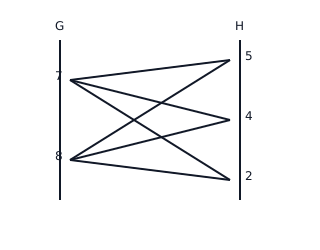
If G={7,8}G = \{7, 8\} and H={5,4,2}H = \{5, 4, 2\}, find G×HG \times H and H×GH \times G. Represent the mapping for G×HG \times H.

Mapping diagram showing connections from elements of set G to set H.

Solution:

G×H={(7,5),(7,4),(7,2),(8,5),(8,4),(8,2)}G \times H = \{(7, 5), (7, 4), (7, 2), (8, 5), (8, 4), (8, 2)\} H×G={(5,7),(5,8),(4,7),(4,8),(2,7),(2,8)}H \times G = \{(5, 7), (5, 8), (4, 7), (4, 8), (2, 7), (2, 8)\} Note that G×H≠H×GG \times H \neq H \times G.

Explanation:

To find G×HG \times H, we pair each element of GG with every element of HH. Since n(G)=2n(G)=2 and n(H)=3n(H)=3, the resulting set has 2×3=62 \times 3 = 6 ordered pairs.

Problem 4:

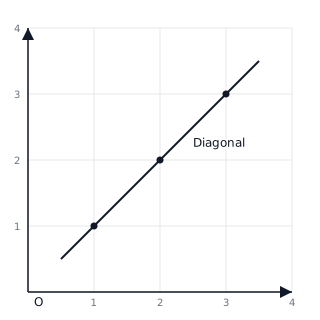
Given A={1,2,3}A = \{1, 2, 3\}, determine the set A×AA \times A and identify the diagonal elements.

Grid showing the Cartesian product A x A with a diagonal line passing through points (1,1), (2,2), and (3,3).

Solution:

A×A={(1,1),(1,2),(1,3),(2,1),(2,2),(2,3),(3,1),(3,2),(3,3)}A \times A = \{(1, 1), (1, 2), (1, 3), (2, 1), (2, 2), (2, 3), (3, 1), (3, 2), (3, 3)\} The diagonal elements (where a=ba=b) are {(1,1),(2,2),(3,3)}\{(1, 1), (2, 2), (3, 3)\}.

Explanation:

When a set is multiplied by itself, the Cartesian product represents all possible pairings of its elements. The diagonal elements are those where both components of the ordered pair are identical.