krit.club logo

Relations and Functions - Algebra of real functions

Grade 11CBSE

Review the key concepts, formulae, and examples before starting your quiz.

🔑Concepts

•

Algebra of real functions deals with operations on two real-valued functions f:D1→Rf: D_1 \to \mathbb{R} and g:D2→Rg: D_2 \to \mathbb{R}. The basic operations include addition, subtraction, multiplication, and division, which are defined point-wise for values of xx in their common domain.

Flowchart showing how two functions f and g take the same input x to produce an algebraic combination.
•

The domain of the sum (f+g)(f+g), difference (f−g)(f-g), and product (fg)(fg) is the intersection of the domains of ff and gg, i.e., Df∩DgD_f \cap D_g. This ensures both functions are defined at the same point.
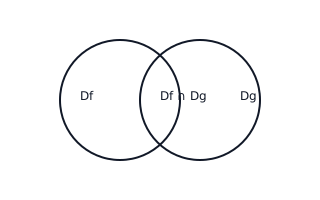
Venn diagram showing the intersection of domain f and domain g.
•

For the quotient function (fg)(\frac{f}{g}), the domain is (Df∩Dg)(D_f \cap D_g) excluding all xx such that g(x)=0g(x) = 0. This is crucial because division by zero is undefined in real numbers.

•

Scalar multiplication (αf)(x)=α⋅f(x)(\alpha f)(x) = \alpha \cdot f(x) scales the output of the function by a constant factor α\alpha. The domain remains the same as the original function ff.

📐Formulae

Addition: (f+g)(x)=f(x)+g(x)(f+g)(x) = f(x) + g(x)

Subtraction: (f−g)(x)=f(x)−g(x)(f-g)(x) = f(x) - g(x)

Scalar Multiplication: (αf)(x)=αf(x)(\alpha f)(x) = \alpha f(x) for α∈R\alpha \in \mathbb{R}

Multiplication: (fg)(x)=f(x)g(x)(fg)(x) = f(x)g(x)

Quotient: (fg)(x)=f(x)g(x),g(x)≠0(\frac{f}{g})(x) = \frac{f(x)}{g(x)}, g(x) \neq 0

Domain of f±gf \pm g and fgfg: Df±g=Dfg=Df∩DgD_{f \pm g} = D_{fg} = D_f \cap D_g

Domain of f/gf/g: Df/g={x∈Df∩Dg:g(x)≠0}D_{f/g} = \{x \in D_f \cap D_g : g(x) \neq 0\}

💡Examples

Problem 1:

Let f(x)=x2f(x) = x^2 and g(x)=2x+1g(x) = 2x + 1 be two real functions. Find (f+g)(x)(f + g)(x), (f−g)(x)(f - g)(x), (fg)(x)(fg)(x), and (fg)(x)(\frac{f}{g})(x).

Solution:

  1. Addition: (f+g)(x)=f(x)+g(x)=x2+2x+1=(x+1)2(f+g)(x) = f(x) + g(x) = x^2 + 2x + 1 = (x+1)^2
  2. Subtraction: (f−g)(x)=f(x)−g(x)=x2−(2x+1)=x2−2x−1(f-g)(x) = f(x) - g(x) = x^2 - (2x + 1) = x^2 - 2x - 1
  3. Multiplication: (fg)(x)=f(x)⋅g(x)=x2(2x+1)=2x3+x2(fg)(x) = f(x) \cdot g(x) = x^2(2x + 1) = 2x^3 + x^2
  4. Quotient: (fg)(x)=f(x)g(x)=x22x+1(\frac{f}{g})(x) = \frac{f(x)}{g(x)} = \frac{x^2}{2x + 1}, where 2x+1≠0⇒x≠−122x + 1 \neq 0 \Rightarrow x \neq -\frac{1}{2}.

Explanation:

To solve these, we apply the pointwise algebraic definitions. For the quotient, we must identify the restriction on the domain where the denominator g(x)g(x) becomes zero.

Problem 2:

Given f(x)=xf(x) = \sqrt{x} and g(x)=xg(x) = x, find the domain of (fg)(x)(\frac{f}{g})(x).

Solution:

  1. Find individual domains: Df=[0,∞)D_f = [0, \infty) because the square root is defined for non-negative numbers. Dg=RD_g = \mathbb{R} because it is a linear polynomial.
  2. Find the intersection: Df∩Dg=[0,∞)D_f \cap D_g = [0, \infty).
  3. Identify where g(x)=0g(x) = 0: g(x)=x=0g(x) = x = 0 at x=0x = 0.
  4. Apply the quotient domain rule: Df/g=(Df∩Dg)−{x:g(x)=0}=[0,∞)−{0}=(0,∞)D_{f/g} = (D_f \cap D_g) - \{x : g(x) = 0\} = [0, \infty) - \{0\} = (0, \infty).

Explanation:

The domain of a quotient function is the intersection of the domains of the numerator and denominator, excluding any points that make the denominator zero. Here, x=0x=0 is excluded even though it is in the domain of f(x)f(x).

Problem 3:

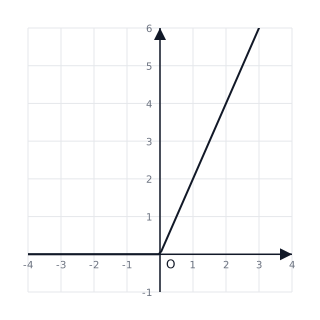
Let f(x)=∣x∣f(x) = |x| and g(x)=xg(x) = x. Graphically represent the sum (f+g)(x)(f+g)(x) and find its value for x<0x < 0 and x≥0x \geq 0.

Graph of the sum of |x| and x, which is zero for negative x and a line with slope 2 for positive x.

Solution:

  1. For x≥0x \geq 0, f(x)=xf(x) = x, so (f+g)(x)=x+x=2x(f+g)(x) = x + x = 2x.
  2. For x<0x < 0, f(x)=−xf(x) = -x, so (f+g)(x)=−x+x=0(f+g)(x) = -x + x = 0. Therefore, (f+g)(x)={2xif x≥00if x<0(f+g)(x) = \begin{cases} 2x & \text{if } x \geq 0 \\ 0 & \text{if } x < 0 \end{cases}.

Explanation:

We use the definition of the absolute value function to split the sum into two cases based on the domain of xx.

Problem 4:

Consider f(x)=x+2f(x) = x + 2 and g(x)=x−2g(x) = x - 2. Find the function (fg)(x)(\frac{f}{g})(x) and identify the point where the function is undefined.
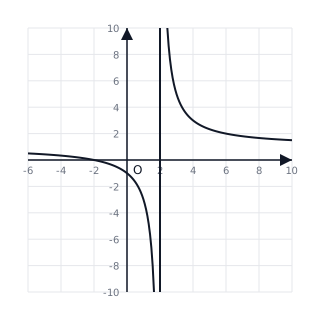
Graph of (x+2)/(x-2) showing a vertical asymptote at x=2.

Solution:

  1. The quotient function is given by (fg)(x)=f(x)g(x)=x+2x−2(\frac{f}{g})(x) = \frac{f(x)}{g(x)} = \frac{x+2}{x-2}.
  2. To find where it is undefined, set the denominator to zero: x−2=0  ⟹  x=2x - 2 = 0 \implies x = 2.
  3. The domain is R−{2}\mathbb{R} - \{2\}.

Explanation:

The quotient of two real functions is defined everywhere the denominator is non-zero. Here, a vertical asymptote occurs at x=2x = 2.