
Review the key concepts, formulae, and examples before starting your quiz.
🔑Concepts
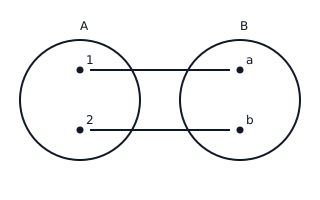
A function from a set to a set is a specific type of relation where every element of set has exactly one image in set . In a mapping diagram, this means every element in the domain must have exactly one arrow originating from it.
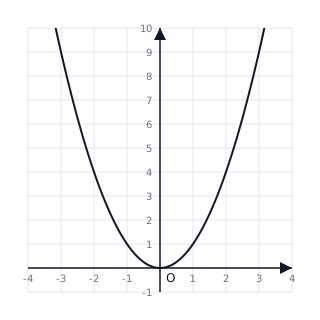
The Square Function maps every real number to its square. Its domain is and its range is . The graph is a parabola opening upwards with the vertex at the origin.
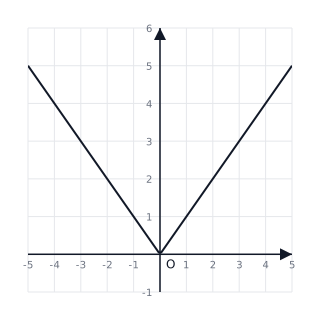
The Modulus Function is defined as if and if . Geometrically, it represents a 'V' shaped graph symmetric about the y-axis.
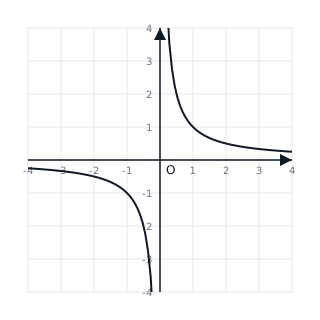
A Rational Function is defined as , where and are polynomial functions and . The domain excludes values of that make the denominator zero.
📐Formulae
Identity Function:
Constant Function: , where is a constant
Modulus Function:
Signum Function:
Greatest Integer Function: , where
Domain of :
Domain of :
💡Examples
Problem 1:
Find the domain and range of the real function .
Solution:
- For to be defined as a real function, the expression inside the square root must be non-negative: .
- Factoring the inequality: . This implies . So, Domain .
- To find the range, let . Since square roots are non-negative, .
- Squaring both sides: .
- Since , then .
- Combining and , we get . So, Range .
Explanation:
We determine the domain by ensuring the radicand of the square root is non-negative. For the range, we solve for in terms of and apply the constraints of the square root's output.
Problem 2:
Let and . Find , , and .
Solution:
- Addition: .
- Subtraction: .
- Division: .
- Condition for division: The denominator cannot be zero, so .
Explanation:
This demonstrates the algebraic operations on functions. For addition and subtraction, we combine like terms. For division, we must explicitly state the restriction on the domain where the divisor is zero.
Problem 3:
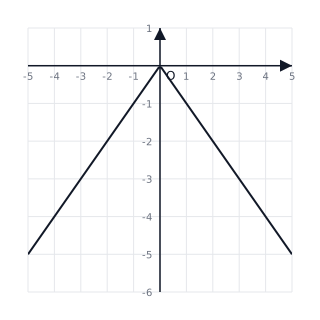
Identify the domain and range of the real function . Sketch its graph.
Solution:
- For , can be any real number. Hence, Domain .
- Since for all , multiplying by gives . Thus, the values of are always non-positive. Range .
- The graph is the reflection of in the x-axis.
Explanation:
The modulus is always non-negative. Applying a negative sign flips the V-shape downwards, restricting the output to negative values and zero.
Problem 4:
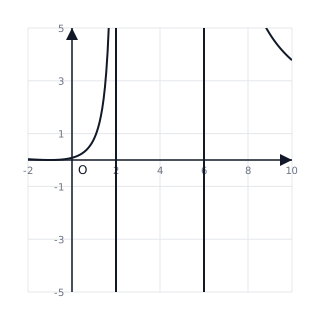
Find the domain of the function .
Solution:
- The function is defined for all such that the denominator .
- Factorize the denominator: .
- Set .
- Therefore, the domain is .
Explanation:
A rational function is undefined when its denominator is zero. By finding the roots of the quadratic denominator, we identify the values to exclude from the set of real numbers.