
Review the key concepts, formulae, and examples before starting your quiz.
🔑Concepts
The fundamental theorem of circles states that the tangent at any point of a circle is perpendicular to the radius through the point of contact. This means if is a tangent to a circle with center at point , then , forming a angle.
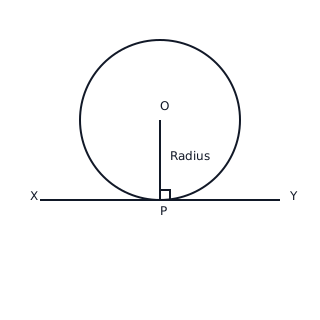
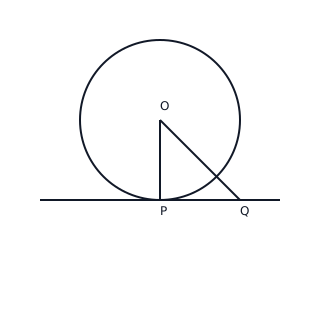
The proof of this theorem uses the fact that the shortest distance from a point to a line is the perpendicular distance. For any point on the tangent (other than ), must be greater than because lies outside the circle. Since is the shortest distance from to line , .
Tangent segments from an external point to a circle are equal in length. If and are tangents from to a circle with center , then . This results in being congruent to by the RHS congruence rule.
The line joining the center to the external point bisects the angle between the two tangents () and also bisects the angle between the radii at the center ().
📐Formulae
Length of tangent segment from external point to contact point : (where is center and is radius)
Pythagoras Theorem in :
Angle relation: (where are points of contact and is the external point)
In (where is external point and are contact points):
Area of quadrilateral
💡Examples
Problem 1:
From a point , the length of the tangent to a circle is cm and the distance of from the center is cm. Find the radius of the circle.
Solution:
- Let be the center of the circle and be the point of contact.
- In , the radius is perpendicular to the tangent . Therefore, is a right-angled triangle at .
- Using the Pythagoras Theorem:
- Substitute the given values:
- cm.
Explanation:
This problem uses the fundamental property that the radius is perpendicular to the tangent at the point of contact, creating a right-angled triangle where the distance from the center is the hypotenuse.
Problem 2:
Two tangents and are drawn to a circle with center from an external point . Prove that .
Solution:
- Let .
- Since lengths of tangents from an external point are equal, . Thus, is an isosceles triangle.
- In , .
- We know the radius , so .
- .
- Therefore, , which means .
Explanation:
This proof relies on the properties of isosceles triangles formed by tangents and the angle relationship between the radius and the tangent.
Problem 3:
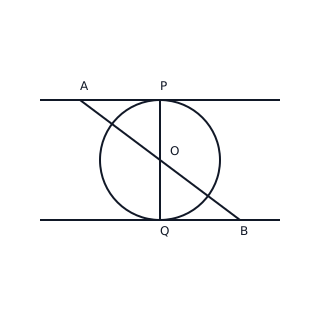
In the given figure, and are two parallel tangents to a circle with center and another tangent with point of contact intersecting at and at . Prove that .
Solution:
- Connect . In and : (radii) (tangents from ) (common) (SSS rule), which means .
- Similarly, , which means .
- Since is a diameter (straight line), .
- .
- .
Explanation:
By proving the congruence of the triangles formed by the radii and tangents, we establish that the center line bisects the angles. The sum of angles on a diameter line leads to the conclusion.
Problem 4:
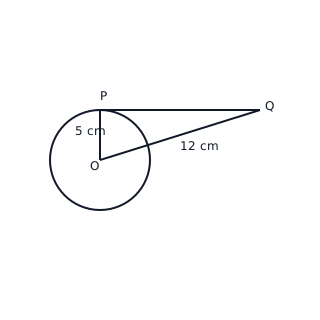
A tangent at a point of a circle of radius cm meets a line through the center at a point so that cm. Find the length .
Solution:
- According to the theorem, the radius is perpendicular to the tangent at the point of contact .
- Therefore, is a right-angled triangle with .
- Using Pythagoras Theorem: .
- cm.
Explanation:
We apply the perpendicular property of the radius to the tangent to create a right triangle and then use the Pythagoras Theorem to solve for the missing side.