
Review the key concepts, formulae, and examples before starting your quiz.
🔑Concepts
The length of tangents drawn from an external point to a circle are equal. If is an external point and are tangents to the circle with center , then .
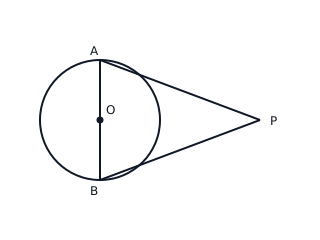
The center of the circle lies on the angle bisector of the angle between the two tangents. This means .
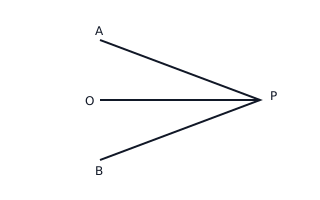
A tangent at any point of a circle is perpendicular to the radius through the point of contact. Thus, and , creating two congruent right-angled triangles and .
The quadrilateral formed by the radii and tangents is cyclic if the angle between the tangents and the angle between the radii are supplementary, i.e., .
📐Formulae
(Equality of tangent lengths from external point )
(Length of tangent using Pythagoras theorem, where is distance from center and is radius)
(Radius Tangent at point of contact)
(Sum of opposite angles in quadrilateral )
(Trigonometric relation in )
💡Examples
Problem 1:
A point is at a distance of cm from the center of a circle and the length of the tangent to the circle is cm. Find the radius of the circle.
Solution:
- Let be the center of the circle and be the radius.
- In the right-angled triangle , because the radius is perpendicular to the tangent at the point of contact.
- Using the Pythagoras Theorem:
- Substitute the given values:
- cm.
Explanation:
We identify the right-angled triangle formed by the radius, the tangent, and the line from the center to the external point, then apply the Pythagoras theorem to find the missing side.
Problem 2:
Two tangents and are drawn to a circle with center from an external point . If , then find the measure of .
Solution:
- In quadrilateral , and because the radius is perpendicular to the tangent at the point of contact.
- The sum of interior angles of a quadrilateral is .
- Therefore, .
- Substituting the values: .
- .
- .
Explanation:
This problem uses the property that the angles formed by the radii and tangents at the points of contact are , and that the angle at the center and the angle between tangents are supplementary.
Problem 3:
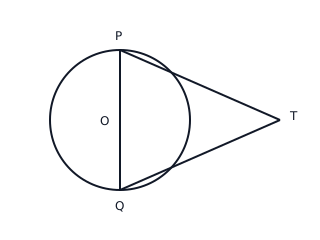
Two tangents and are drawn to a circle with center from an external point . Prove that .
Solution:
Let . In , we have (Tangents from an external point). So, is an isosceles triangle. Therefore, . We know that (Radius is perpendicular to tangent). So, . Now, . Hence, , which implies .
Explanation:
This proof utilizes the property that tangents from an external point are equal in length, forming an isosceles triangle, and the radius is perpendicular to the tangent at the point of contact.
Problem 4:
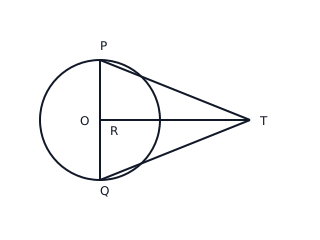
In the given figure, is a chord of length cm of a circle of radius cm. The tangents at and intersect at a point . Find the length .
Solution:
Let and . Let be the center. and bisects . So, cm. In , cm. In , (Pythagoras theorem) ... (1) In , (Tangent Radius) ... (2) Subtracting (1) from (2): ? No, calculation: , so ? Re-check. Correct approach: is incorrect. is correct. cm.
Explanation:
By using similarity between and (or using Pythagoras in two related triangles), the length of the tangent can be calculated.