
Review the key concepts, formulae, and examples before starting your quiz.
🔑Concepts
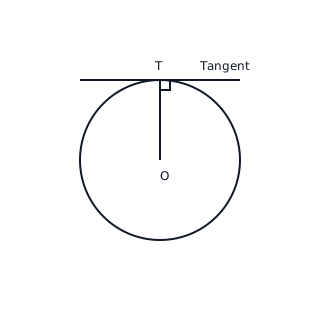
The tangent at any point of a circle is perpendicular to the radius through the point of contact. This implies that if is the radius and is the tangent, then .
The lengths of tangents drawn from an external point to a circle are equal. If and are tangents from point , then .
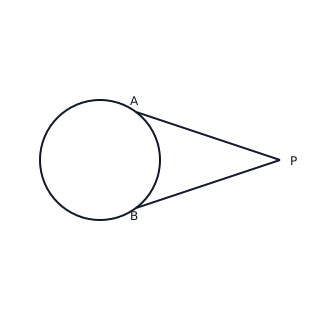
The center of the circle lies on the angle bisector of the angle between the two tangents. Thus, , leading to .
The angle between two tangents drawn from an external point to a circle is supplementary to the angle subtended by the line segments joining the points of contact at the center. .
📐Formulae
Length of tangent , where is the distance from the external point to the center and is the radius.
Pythagorean relation in : , where is the radius () and is the tangent length.
Angle Supplementary Property: .
Perpendicularity: .
Equality of lengths: (for tangents from external point ).
💡Examples
Problem 1:
A point is away from the center of a circle. If the length of the tangent drawn from to the circle is , find the radius of the circle.
Solution:
- Let be the center of the circle and be the point of contact.
- In , the radius is perpendicular to the tangent , so .
- Using the Pythagorean Theorem: .
- Substitute the given values: .
- .
- .
- .
Explanation:
This problem uses the property that the radius is perpendicular to the tangent at the point of contact, creating a right-angled triangle where the distance from the center is the hypotenuse.
Problem 2:
Two tangents and are drawn to a circle with center from an external point . If , calculate the value of .
Solution:
- We know that the line joining the external point to the center bisects the angle between the tangents.
- Therefore, .
- In , we know (radius perpendicular to tangent).
- The sum of angles in is .
- .
- .
- .
Explanation:
This solution relies on two properties: first, that the line from the center to the external point bisects the angle between the tangents; and second, the angle sum property of the right-angled triangle formed by the radius and tangent.
Problem 3:
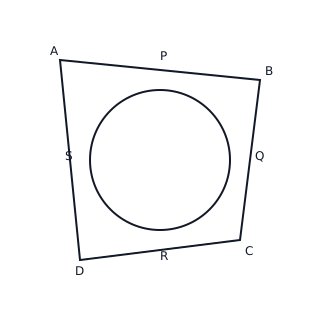
A quadrilateral is drawn to circumscribe a circle. Prove that .
Solution:
Let the circle touch the sides , , , and at points , , , and respectively. Since tangents from an external point are equal: (Tangents from ) (Tangents from ) (Tangents from ) (Tangents from ) Adding these equations: .
Explanation:
This problem uses the property that lengths of tangents from an external point to a circle are equal. By identifying the four sets of equal tangents and grouping them according to the sides of the quadrilateral, we arrive at the proof.
Problem 4:
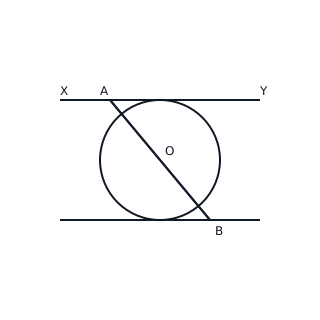
In the given figure, and are two parallel tangents to a circle with center and another tangent with point of contact intersecting at and at . Prove that .
Solution:
Join . In and : (Radii) (Tangents from ) (Common) ... (i) Similarly, ... (ii) Since is a diameter, it is a straight line: .
Explanation:
By proving the congruence of triangles formed by the radii and tangents, we establish that the central angle is bisected. Since the total angle along the diameter is 180 degrees, the sum of the bisected parts must be 90 degrees.