
Review the key concepts, formulae, and examples before starting your quiz.
🔑Concepts
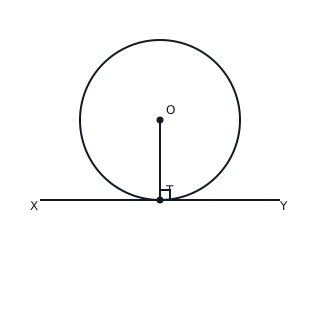
A tangent to a circle is a straight line that intersects the circle at exactly one point, known as the point of tangency. At this point, the radius drawn from the center of the circle is perpendicular to the tangent line ().
From any point outside a circle, exactly two tangents can be drawn to the circle. The lengths of these two tangents from the external point to the circle are equal ().
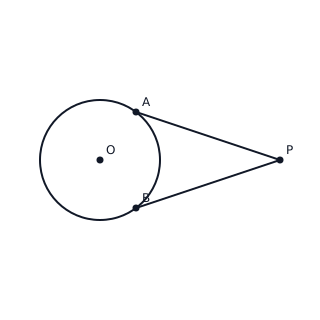
The center of the circle lies on the angle bisector of the angle between the two tangents. This means by RHS congruence, which implies .
The quadrilateral formed by the center, the point of tangency, the external point, and the second point of tangency () is a cyclic quadrilateral because the sum of the angles at the points of tangency is . Thus, and are supplementary.
📐Formulae
💡Examples
Problem 1:
From a point , the length of the tangent to a circle is cm and the distance of from the center is cm. Find the radius of the circle.
Solution:
Let be the center and be the point of contact. Given cm and cm. Since radius , is a right-angled triangle. Using Pythagoras Theorem:
Explanation:
The radius is calculated using the property that the radius is perpendicular to the tangent at the point of contact, forming a right triangle with the distance from the center.
Problem 2:
If tangents and from a point to a circle with center are inclined to each other at an angle of , then find .
Solution:
Given . Since and are tangents, and . In quadrilateral , . In and , is common and , so . Thus, bisects :
Explanation:
First, we find the central angle using the supplementary property of tangents. Then, we use the symmetry of the tangents from an external point to find that is half of the central angle.
Problem 3:
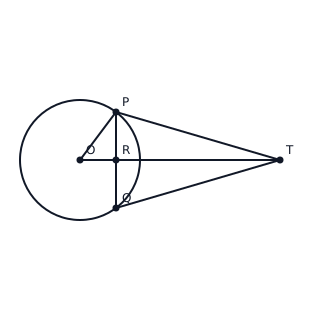
In the given figure, is a chord of length cm of a circle of radius cm. The tangents at and intersect at a point . Find the length of .
Solution:
Let intersect at . Since is the angle bisector of , . Thus, cm. In , by Pythagoras Theorem: Now, in right and : So, Thus,
Explanation:
We use the property that the line joining the center to the external point is the perpendicular bisector of the chord joining the points of contact. We then apply Pythagoras theorem to find OR and use similar triangles (TRP and PRO) to find the tangent length TP.
Problem 4:
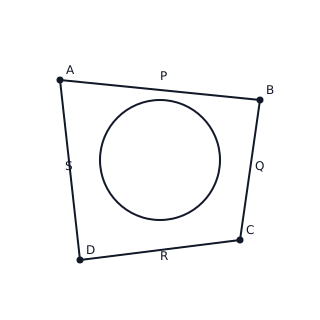
A quadrilateral is drawn to circumscribe a circle. Prove that .
Solution:
Let the points of contact be on sides respectively. Using the property that lengths of tangents from an external point are equal:
Adding these equations: Hence proved.
Explanation:
This result stems from the equality of tangent segments from each vertex of the quadrilateral to the circle. By grouping segments that form the opposite sides, we see the sums are identical.