
Magnetic Effects of Electric Current - DOMESTIC ELECTRIC CIRCUITS12.4 DOMESTIC ELECTRIC CIRCUITS12.4 DOMESTIC ELECTRIC CIRCUITS12.4 DOMESTIC ELECTRIC CIRCUITS12.4 DOMESTIC ELECTRIC CIRCUITS
Review the key concepts, formulae, and examples before starting your quiz.
🔑Concepts
Domestic power supply usually involves three wires: the Live wire (red insulation, positive), the Neutral wire (black insulation, negative), and the Earth wire (green insulation). In India, the potential difference between the live and neutral wires is .
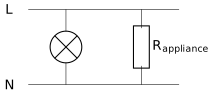
All appliances in a domestic circuit are connected in parallel. This ensures that every appliance receives the full voltage of and can be operated independently using its own switch.
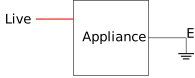
The Earth wire is a safety measure connected to a metal plate deep in the earth. It provides a low-resistance path for current, ensuring that any leakage to the metallic body of an appliance does not give a severe shock to the user.
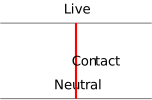
Short-circuiting occurs when the Live wire and Neutral wire come into direct contact, causing the resistance of the circuit to become almost zero and the current to increase abruptly.
An Electric Fuse is a safety device made of a material with a low melting point. It is always connected in series with the live wire to protect the circuit from overcurrent due to overloading or short-circuiting.

📐Formulae
💡Examples
Problem 1:
An electric oven of power rating is operated in a domestic electric circuit () that has a current rating of . What result do you expect? Explain.
Solution:
Given: , . Current drawn .
Explanation:
The current drawn by the oven is , which exceeds the circuit's current rating of . This will lead to overloading, causing the fuse to melt and break the circuit to prevent potential fire hazards.
Problem 2:
Calculate the total current drawn from a line if three appliances—a bulb, a heater, and a refrigerator—are used simultaneously.
Solution:
Total Power . Total Current .
Explanation:
Since the appliances are in parallel, their powers are additive. The total current is found by dividing the total power by the supply voltage. A fuse of at least or would be required for this circuit.
Problem 3:
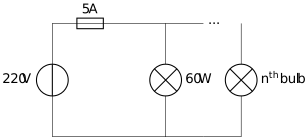
In a house, a line is protected by a fuse. How many bulbs can be safely operated simultaneously in parallel without blowing the fuse?
Solution:
Let be the number of bulbs. Total power Maximum current Voltage Therefore, a maximum of bulbs can be used.
Explanation:
To avoid blowing the fuse, the total current drawn by all bulbs must not exceed the fuse rating. Since the bulbs are in parallel, the total power is the product of the number of bulbs and the power of one bulb. We solve for and round down to the nearest whole number to ensure the current stays below the limit.
Problem 4:
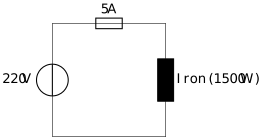
An electric iron with a power rating of is connected to a domestic circuit. If the circuit is protected by a fuse, determine whether the fuse will blow when the iron is switched on. Support your answer with calculations.
Solution:
Since , the fuse will blow.
Explanation:
The current drawn by the electric iron is calculated using the formula . Substituting the given values, we find the current to be approximately . Since the fuse in the circuit has a maximum capacity of , the current exceeds this limit, causing the fuse wire to melt and break the circuit to prevent damage and fire hazards.