
Magnetic Effects of Electric Current - Compare DC and AC, frequency of AC, and domestic electric circuits
Review the key concepts, formulae, and examples before starting your quiz.
🔑Concepts
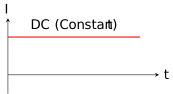
Direct Current () flows in only one direction and has a constant magnitude over time. It is typically produced by cells or batteries. In contrast, Alternating Current () reverses its direction periodically. In India, the direction changes every , which means it completes one full cycle in .
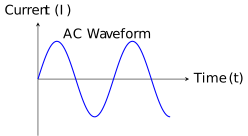
The frequency of in India is . This means the current completes cycles per second. Since the current changes direction twice in every cycle, the current changes direction times in one second. has a frequency of as it does not oscillate.
Domestic electric circuits consist of three types of wires: the Live wire (Positive, Red insulation), the Neutral wire (Negative, Black insulation), and the Earth wire (Green insulation). The potential difference between the Live and Neutral wires in India is .
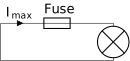
Safety measures in domestic circuits include the use of an Electric Fuse and Earthing. A fuse is a safety device that melts and breaks the circuit during overloading or short-circuiting. Overloading occurs when too many appliances are connected to a single socket, or when the live and neutral wires come into direct contact.
📐Formulae
💡Examples
Problem 1:
A constant current of flows through a straight wire. If the distance from the wire is doubled, what happens to the magnitude of the magnetic field ()?
Solution:
The magnetic field will become half of its original value.
Explanation:
The magnetic field produced by a straight wire is inversely proportional to the distance from the wire (). If becomes , then becomes .
Problem 2:
An electron enters a magnetic field () at a right angle, moving from North to South. The magnetic field is directed from West to East. Determine the direction of the force () acting on the electron.
Solution:
The force acts vertically upwards (out of the plane).
Explanation:
Since the electron moves North to South, the conventional current () is South to North. Using Fleming's Left-Hand Rule: Forefinger (Field) points East, Middle finger (Current) points North. The Thumb then points upwards, indicating the direction of Force ().
Problem 3:
Calculate the force acting on a wire carrying a of placed perpendicular to a magnetic field of .
Solution:
Explanation:
Using the formula , where (so ), we substitute the values: .
Problem 4:
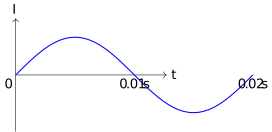
In a standard Indian domestic circuit, the potential difference between the live wire and neutral wire is and the frequency is . Calculate the time interval between two consecutive instances where the current becomes zero.
Solution:
In one full cycle (), the AC current becomes zero twice. Therefore, the time interval between two consecutive zeros is: t = \frac{T}{2} = \frac{0.01 \text{ s}}
Explanation:
Alternating current changes direction periodically. For a supply, there are such direction changes per second, meaning the current passes through the zero value every seconds.
Problem 5:
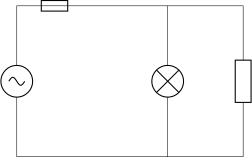
In a domestic circuit, two appliances, a lamp of resistance and a heater of resistance , are connected in parallel to an source of . A fuse of rating is placed in the live wire. Calculate the total current drawn from the source and determine if the fuse will blow when both appliances are switched on.
Solution:
Explanation:
In a domestic circuit, appliances are connected in parallel so they all receive the same potential difference ( in India). The total current is the sum of currents through individual branches. If this sum exceeds the safety limit (fuse rating), the fuse wire melts due to Joule heating, breaking the circuit to prevent fire or damage.