krit.club logo

Trigonometry - Trigonometric Ratios

Grade 9ICSE

Review the key concepts, formulae, and examples before starting your quiz.

🔑Concepts

•

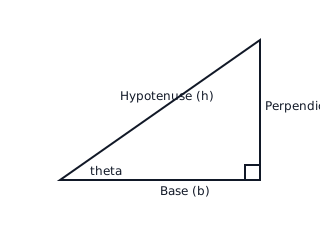
Trigonometric ratios are defined for acute angles in a right-angled triangle. Let θ\theta be an acute angle. The side opposite to θ\theta is the Perpendicular (pp), the side adjacent to it is the Base (bb), and the side opposite the right angle is the Hypotenuse (hh).

Right-angled triangle showing theta, base, perpendicular and hypotenuse.
•

Reciprocal Relations: Each primary trigonometric ratio has a reciprocal counterpart. sin⁡θ\sin \theta is the reciprocal of csc⁡θ\csc \theta, cos⁡θ\cos \theta is the reciprocal of sec⁡θ\sec \theta, and tan⁡θ\tan \theta is the reciprocal of cot⁡θ\cot \theta.

•

Quotient Ratios: The tangent of an angle can be expressed as the ratio of sine to cosine, i.e., tan⁡θ=sin⁡θcos⁡θ\tan \theta = \frac{\sin \theta}{\cos \theta}. Similarly, cot⁡θ=cos⁡θsin⁡θ\cot \theta = \frac{\cos \theta}{\sin \theta}.

•

Pythagorean Identities: Based on Pythagoras Theorem (p2+b2=h2p^2 + b^2 = h^2), we derive three fundamental identities: sin⁡2θ+cos⁡2θ=1\sin^2 \theta + \cos^2 \theta = 1, 1+tan⁡2θ=sec⁡2θ1 + \tan^2 \theta = \sec^2 \theta, and 1+cot⁡2θ=csc⁡2θ1 + \cot^2 \theta = \csc^2 \theta.

📐Formulae

sin⁡θ=PerpendicularHypotenuse=ph\sin \theta = \frac{\text{Perpendicular}}{\text{Hypotenuse}} = \frac{p}{h}

cos⁡θ=BaseHypotenuse=bh\cos \theta = \frac{\text{Base}}{\text{Hypotenuse}} = \frac{b}{h}

tan⁡θ=PerpendicularBase=pb\tan \theta = \frac{\text{Perpendicular}}{\text{Base}} = \frac{p}{b}

csc⁡θ=1sin⁡θ=hp\csc \theta = \frac{1}{\sin \theta} = \frac{h}{p}

sec⁡θ=1cos⁡θ=hb\sec \theta = \frac{1}{\cos \theta} = \frac{h}{b}

cot⁡θ=1tan⁡θ=bp\cot \theta = \frac{1}{\tan \theta} = \frac{b}{p}

tan⁡θ=sin⁡θcos⁡θ\tan \theta = \frac{\sin \theta}{\cos \theta}

cot⁡θ=cos⁡θsin⁡θ\cot \theta = \frac{\cos \theta}{\sin \theta}

sin⁡2θ+cos⁡2θ=1\sin^2 \theta + \cos^2 \theta = 1

1+tan⁡2θ=sec⁡2θ1 + \tan^2 \theta = \sec^2 \theta

1+cot⁡2θ=csc⁡2θ1 + \cot^2 \theta = \csc^2 \theta

💡Examples

Problem 1:

In a right-angled triangle ABCABC, right-angled at BB, if AB=5 cmAB = 5\text{ cm} and BC=12 cmBC = 12\text{ cm}, find the values of sin⁡A\sin A and cos⁡A\cos A.

Solution:

  1. Identify sides relative to ∠A\angle A: Perpendicular (pp) is the side opposite to AA, which is BC=12BC = 12. Base (bb) is the side adjacent to AA, which is AB=5AB = 5.
  2. Find the Hypotenuse (hh) using Pythagoras Theorem: h2=p2+b2h^2 = p^2 + b^2 h2=122+52=144+25=169h^2 = 12^2 + 5^2 = 144 + 25 = 169 h=169=13 cmh = \sqrt{169} = 13\text{ cm}
  3. Calculate sin⁡A\sin A: sin⁡A=ph=1213\sin A = \frac{p}{h} = \frac{12}{13}
  4. Calculate cos⁡A\cos A: cos⁡A=bh=513\cos A = \frac{b}{h} = \frac{5}{13}

Explanation:

To find trigonometric ratios, we first ensure all three sides of the right-angled triangle are known. Using the side lengths relative to the specific angle AA, we apply the standard ratio definitions.

Problem 2:

If sin⁡θ=35\sin \theta = \frac{3}{5}, evaluate the expression 4tan⁡θ−5cos⁡θsec⁡θ+cot⁡θ\frac{4 \tan \theta - 5 \cos \theta}{\sec \theta + \cot \theta}.

Solution:

  1. Given sin⁡θ=35\sin \theta = \frac{3}{5}, let p=3kp = 3k and h=5kh = 5k.
  2. Find bb using b=h2−p2b = \sqrt{h^2 - p^2}: b=(5k)2−(3k)2=25k2−9k2=16k2=4kb = \sqrt{(5k)^2 - (3k)^2} = \sqrt{25k^2 - 9k^2} = \sqrt{16k^2} = 4k
  3. Find required ratios: cos⁡θ=bh=45,tan⁡θ=pb=34,sec⁡θ=hb=54,cot⁡θ=bp=43\cos \theta = \frac{b}{h} = \frac{4}{5}, \quad \tan \theta = \frac{p}{b} = \frac{3}{4}, \quad \sec \theta = \frac{h}{b} = \frac{5}{4}, \quad \cot \theta = \frac{b}{p} = \frac{4}{3}
  4. Substitute values into the expression: Numerator=4(34)−5(45)=3−4=−1\text{Numerator} = 4\left(\frac{3}{4}\right) - 5\left(\frac{4}{5}\right) = 3 - 4 = -1 Denominator=54+43=15+1612=3112\text{Denominator} = \frac{5}{4} + \frac{4}{3} = \frac{15 + 16}{12} = \frac{31}{12}
  5. Result: Value=−13112=−1231\text{Value} = \frac{-1}{\frac{31}{12}} = -\frac{12}{31}

Explanation:

When one ratio is given, we use the Pythagorean theorem to find the missing side (Base in this case). Once all sides are known in terms of a ratio, we calculate the remaining trigonometric functions and substitute them into the given algebraic expression.

Problem 3:

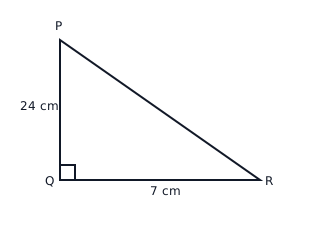
In triangle PQRPQR, right-angled at QQ, PQ=24 cmPQ = 24\text{ cm} and QR=7 cmQR = 7\text{ cm}. Determine the values of sin⁡P\sin P and cos⁡P\cos P.

Triangle PQR with QR=7 and PQ=24.

Solution:

  1. Find Hypotenuse PRPR using Pythagoras theorem: PR=PQ2+QR2=242+72=576+49=625=25 cmPR = \sqrt{PQ^2 + QR^2} = \sqrt{24^2 + 7^2} = \sqrt{576 + 49} = \sqrt{625} = 25\text{ cm}
  2. For angle PP, the side opposite is QR=7QR = 7 (Perpendicular) and the side adjacent is PQ=24PQ = 24 (Base).
  3. Calculate ratios: sin⁡P=OppositeHypotenuse=QRPR=725\sin P = \frac{\text{Opposite}}{\text{Hypotenuse}} = \frac{QR}{PR} = \frac{7}{25} cos⁡P=AdjacentHypotenuse=PQPR=2425\cos P = \frac{\text{Adjacent}}{\text{Hypotenuse}} = \frac{PQ}{PR} = \frac{24}{25}

Explanation:

To find trigonometric ratios of an angle, first identify the sides relative to that specific angle and ensure the hypotenuse is calculated using the Pythagoras theorem.

Problem 4:

Given 5tan⁡A=125 \tan A = 12, find the value of 1+sin⁡A1−sin⁡A\frac{1 + \sin A}{1 - \sin A}.

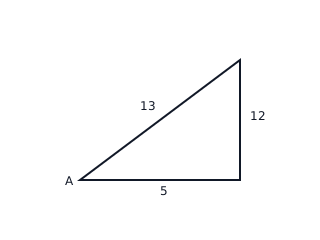
Right triangle with sides 5, 12, and 13 representing angle A.

Solution:

  1. From given equation: tan⁡A=125\tan A = \frac{12}{5}. Here, p=12kp = 12k and b=5kb = 5k.
  2. Find Hypotenuse hh: h=(12k)2+(5k)2=144k2+25k2=169k2=13kh = \sqrt{(12k)^2 + (5k)^2} = \sqrt{144k^2 + 25k^2} = \sqrt{169k^2} = 13k
  3. Find sin⁡A\sin A: sin⁡A=ph=12k13k=1213\sin A = \frac{p}{h} = \frac{12k}{13k} = \frac{12}{13}
  4. Substitute in expression: 1+12131−1213=13+121313−1213=251=25\frac{1 + \frac{12}{13}}{1 - \frac{12}{13}} = \frac{\frac{13+12}{13}}{\frac{13-12}{13}} = \frac{25}{1} = 25

Explanation:

When a ratio is given, treat the numerator and denominator as components of a right triangle to find the third side, then evaluate the required trigonometric function.