
Review the key concepts, formulae, and examples before starting your quiz.
🔑Concepts
The line of sight is an imaginary line drawn from the eye of an observer to the object being viewed. The angle formed between the line of sight and the horizontal level is either the angle of elevation or the angle of depression.
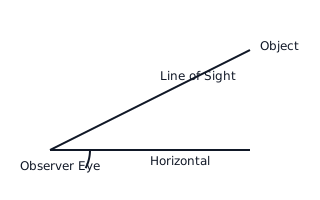
Angle of Elevation: When the object being viewed is above the horizontal level, the angle between the horizontal line and the line of sight is called the angle of elevation. In most problems, the ground is considered the horizontal level.
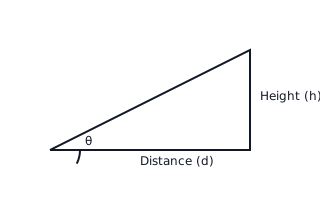
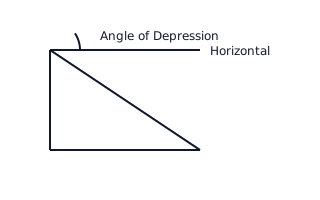
Angle of Depression: When the object being viewed is below the horizontal level, the angle between the horizontal line through the observer's eye and the line of sight is called the angle of depression.
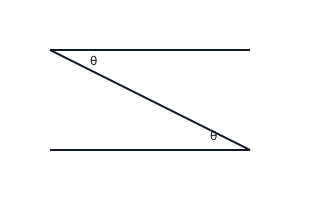
Alternate Angles: In problems involving the angle of depression, the angle of depression from the top of an object is equal to the angle of elevation of the top from the object on the ground because the horizontal lines are parallel.
📐Formulae
💡Examples
Problem 1:
A ladder is placed against a wall such that it reaches the top of the wall of height . If the ladder makes an angle of with the ground, find the length of the ladder.
Solution:
- Let be the wall of height and be the length of the ladder.
- In the right-angled , the angle of elevation .
- We need to find the hypotenuse () and we know the perpendicular ().
- Using the sine ratio:
- Rationalizing the denominator:
- Taking , .
Explanation:
In this problem, we identify the ladder as the hypotenuse of a right-angled triangle. Since we are given the height of the wall (opposite side to the angle) and need the hypotenuse, we apply the sine ratio.
Problem 2:
From the top of a tower high, the angle of depression of a ball on the ground is . Find the distance of the ball from the foot of the tower.
Solution:
- Let be the tower of height and be the position of the ball.
- The angle of depression is given as . This is equal to the angle of elevation due to alternate angles.
- In right-angled , we know the perpendicular () and need to find the base ().
- Using the tangent ratio:
- .
Explanation:
The angle of depression is measured from the horizontal line at the top of the tower. We translate this to the interior angle at the ground level using the property of parallel lines. We then use the tangent ratio to find the horizontal distance.
Problem 3:
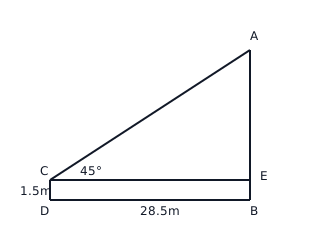
An observer tall is away from a chimney. The angle of elevation of the top of the chimney from her eyes is . What is the height of the chimney?
Solution:
Let be the chimney and be the observer. Given: and distance . Draw parallel to , meeting at . Then, and . In right-angled triangle , we have: Total height of chimney The height of the chimney is .
Explanation:
To solve this, we model the observer and chimney as vertical lines. We create a right triangle above the observer's eye level and use the tangent ratio since we know the horizontal distance and the angle.
Problem 4:
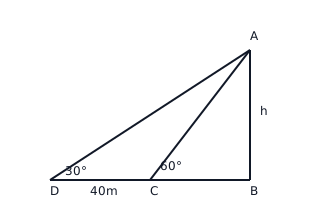
The shadow of a tower standing on a level ground is found to be longer when the Sun's altitude is than when it is . Find the height of the tower.
Solution:
Let be the height of the tower . Let be the shadow when the angle is . Then the shadow when the angle is . In : In : Substituting : The height of the tower is .
Explanation:
This problem involves two different positions of the sun. We set up two trigonometric equations based on the two angles of elevation and solve for the common height 'h' by substituting the variable representing the shorter shadow.