
Review the key concepts, formulae, and examples before starting your quiz.
🔑Concepts
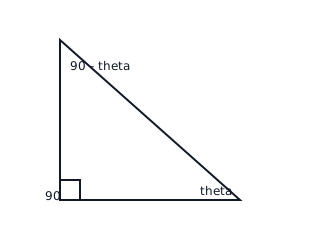
Complementary angles are two angles whose sum is . In a right-angled triangle, if one acute angle is , the other must be because the sum of all angles is .
The sine of an angle is equal to the cosine of its complement. For example, .
The tangent of an angle is the reciprocal of the tangent of its complement, which is the cotangent of that angle. Thus, .
Secant and Cosecant share a similar complementary relationship: .
📐Formulae
💡Examples
Problem 1:
Evaluate:
Solution:
Step 1: Observe the angles. In the first term, . In the second term, . Step 2: Apply the complementary ratio formula to the numerators: Step 3: Substitute these back into the original expression: Step 4: Simplify the fractions:
Explanation:
This solution uses the complementary angle identities to convert the numerator of each fraction to match its denominator, allowing them to be simplified to 1.
Problem 2:
Find the value of if , where and are acute angles.
Solution:
Step 1: Use the identity to make the trigonometric ratios on both sides the same. Step 2: Since the sine ratios are equal and the angles are acute, we can equate the angles: Step 3: Solve the linear equation: Step 4: Divide by 4:
Explanation:
By converting the cosine term into a sine term using complementary angle properties, we can create an algebraic equation to solve for the unknown angle.
Problem 3:
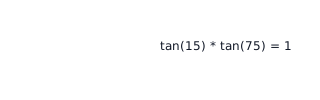
Show that .
Solution:
We know that . Step 1: Express in terms of its complement. Step 2: Substitute this into the original expression. Step 3: Since , the expression becomes: Step 4: Use the standard value .
Explanation:
This problem uses the complementary identity for tangent to pair up angles that sum to , simplifying the product to 1.
Problem 4:
Evaluate:
Solution:
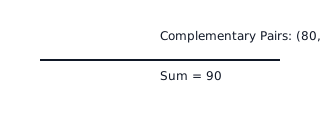
Step 1: Simplify the first term using . Step 2: Simplify the second term. Note that . Step 3: Since , then . Step 4: Add the results from Step 1 and Step 3.
Explanation:
The complementary angle identities for sine-cosine and secant-cosecant are used to reduce fractions and products to unity.