krit.club logo

Trigonometry - Trigonometric Ratios of Standard Angles (0°, 30°, 45°, 60°, 90°)

Grade 9ICSE

Review the key concepts, formulae, and examples before starting your quiz.

🔑Concepts

•

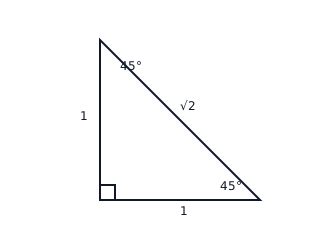
The trigonometric ratios of standard angles (0∘,30∘,45∘,60∘,90∘0^\circ, 30^\circ, 45^\circ, 60^\circ, 90^\circ) are specific constant values derived from the geometric properties of special triangles, such as the 45∘−45∘−90∘45^\circ-45^\circ-90^\circ triangle and the 30∘−60∘−90∘30^\circ-60^\circ-90^\circ triangle.

Isosceles right-angled triangle showing sides of length 1, 1 and hypotenuse square root of 2 for 45 degree ratios.
•

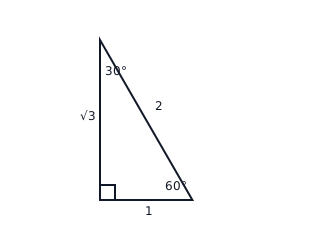
In a 30∘−60∘−90∘30^\circ-60^\circ-90^\circ triangle, the side opposite to 30∘30^\circ is half the hypotenuse, and the side opposite to 60∘60^\circ is 32\frac{\sqrt{3}}{2} times the hypotenuse. These relationships define the ratios for 30∘30^\circ and 60∘60^\circ.

Right-angled triangle with angles 30 and 60 degrees showing side ratios 1, square root of 3, and 2.
•

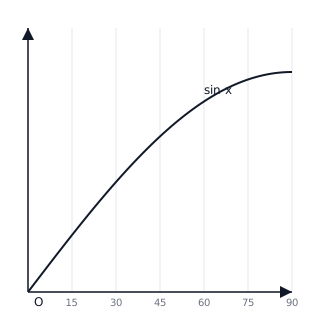
The values of sin⁡θ\sin \theta increase from 00 to 11 as θ\theta increases from 0∘0^\circ to 90∘90^\circ, while cos⁡θ\cos \theta decreases from 11 to 00.

Graph of sine function from 0 to 90 degrees showing value increasing from 0 to 1.
•

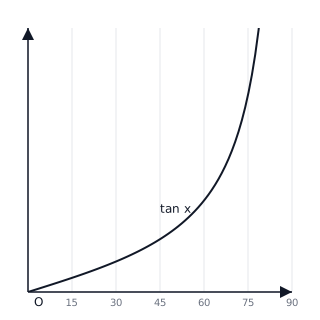
The ratio tan⁡θ\tan \theta is the quotient sin⁡θcos⁡θ\frac{\sin \theta}{\cos \theta}. At 90∘90^\circ, since cos⁡90∘=0\cos 90^\circ = 0, tan⁡90∘\tan 90^\circ is undefined (approaches infinity).

Graph of tangent function showing it approaching infinity as the angle approaches 90 degrees.

📐Formulae

sin⁡0∘=0,sin⁡30∘=12,sin⁡45∘=12,sin⁡60∘=32,sin⁡90∘=1\sin 0^\circ = 0, \sin 30^\circ = \frac{1}{2}, \sin 45^\circ = \frac{1}{\sqrt{2}}, \sin 60^\circ = \frac{\sqrt{3}}{2}, \sin 90^\circ = 1

cos⁡0∘=1,cos⁡30∘=32,cos⁡45∘=12,cos⁡60∘=12,cos⁡90∘=0\cos 0^\circ = 1, \cos 30^\circ = \frac{\sqrt{3}}{2}, \cos 45^\circ = \frac{1}{\sqrt{2}}, \cos 60^\circ = \frac{1}{2}, \cos 90^\circ = 0

tan⁡0∘=0,tan⁡30∘=13,tan⁡45∘=1,tan⁡60∘=3,tan⁡90∘=∞ (Not Defined)\tan 0^\circ = 0, \tan 30^\circ = \frac{1}{\sqrt{3}}, \tan 45^\circ = 1, \tan 60^\circ = \sqrt{3}, \tan 90^\circ = \infty \text{ (Not Defined)}

csc⁡θ=1sin⁡θ\csc \theta = \frac{1}{\sin \theta}

sec⁡θ=1cos⁡θ\sec \theta = \frac{1}{\cos \theta}

cot⁡θ=1tan⁡θ=cos⁡θsin⁡θ\cot \theta = \frac{1}{\tan \theta} = \frac{\cos \theta}{\sin \theta}

💡Examples

Problem 1:

Evaluate the following expression: sin⁡60∘cos⁡30∘+cos⁡60∘sin⁡30∘\sin 60^\circ \cos 30^\circ + \cos 60^\circ \sin 30^\circ

Solution:

  1. Substitute the standard values: sin⁡60∘=32\sin 60^\circ = \frac{\sqrt{3}}{2} cos⁡30∘=32\cos 30^\circ = \frac{\sqrt{3}}{2} cos⁡60∘=12\cos 60^\circ = \frac{1}{2} sin⁡30∘=12\sin 30^\circ = \frac{1}{2}
  2. Plug the values into the expression: (32×32)+(12×12)(\frac{\sqrt{3}}{2} \times \frac{\sqrt{3}}{2}) + (\frac{1}{2} \times \frac{1}{2})
  3. Calculate each term: 34+14\frac{3}{4} + \frac{1}{4}
  4. Simplify: 44=1\frac{4}{4} = 1

Explanation:

This problem uses the direct substitution of trigonometric values for 30∘30^\circ and 60∘60^\circ. The result is consistent with the identity sin⁡(A+B)=sin⁡Acos⁡B+cos⁡Asin⁡B\sin(A+B) = \sin A \cos B + \cos A \sin B where A=60,B=30A=60, B=30.

Problem 2:

Find the value of xx if 2sin⁡2x=32 \sin 2x = \sqrt{3} and 0∘≤2x≤90∘0^\circ \le 2x \le 90^\circ.

Solution:

  1. Divide both sides by 22: sin⁡2x=32\sin 2x = \frac{\sqrt{3}}{2}
  2. Identify the standard angle for which the sine value is 32\frac{\sqrt{3}}{2}: We know that sin⁡60∘=32\sin 60^\circ = \frac{\sqrt{3}}{2}
  3. Equate the angles: 2x=60∘2x = 60^\circ
  4. Solve for xx: x=60∘2x = \frac{60^\circ}{2} x=30∘x = 30^\circ

Explanation:

To find an unknown angle, isolate the trigonometric function and compare the resulting value with the standard angle table values.

Problem 3:

Evaluate the expression: 4sin⁡260∘+3tan⁡230∘−8sin⁡45∘cos⁡45∘4 \sin^2 60^\circ + 3 \tan^2 30^\circ - 8 \sin 45^\circ \cos 45^\circ
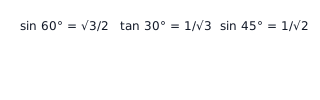
Table showing substitution values for trigonometric ratios of standard angles.

Solution:

Substitute the standard values: sin⁡60∘=32\sin 60^\circ = \frac{\sqrt{3}}{2} tan⁡30∘=13\tan 30^\circ = \frac{1}{\sqrt{3}} sin⁡45∘=12\sin 45^\circ = \frac{1}{\sqrt{2}} cos⁡45∘=12\cos 45^\circ = \frac{1}{\sqrt{2}}

Now substitute into the expression: 4(32)2+3(13)2−8(12)(12)4 \left( \frac{\sqrt{3}}{2} \right)^2 + 3 \left( \frac{1}{\sqrt{3}} \right)^2 - 8 \left( \frac{1}{\sqrt{2}} \right) \left( \frac{1}{\sqrt{2}} \right) =4(34)+3(13)−8(12)= 4 \left( \frac{3}{4} \right) + 3 \left( \frac{1}{3} \right) - 8 \left( \frac{1}{2} \right) =3+1−4= 3 + 1 - 4 =0= 0

Explanation:

To solve expressions involving trigonometric ratios of standard angles, substitute the fixed values for each ratio and then use algebraic simplification and BODMAS rules.

Problem 4:

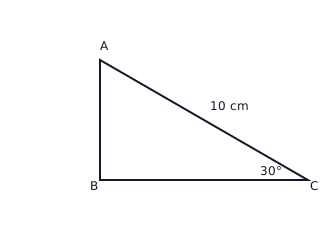
In a right-angled triangle ABCABC with ∠B=90∘\angle B = 90^\circ and ∠C=30∘\angle C = 30^\circ, if the hypotenuse AC=10 cmAC = 10 \text{ cm}, find the lengths of the sides ABAB and BCBC.

Triangle ABC with right angle at B, angle C = 30 degrees and hypotenuse AC = 10 cm.

Solution:

Given: AC=10 cmAC = 10 \text{ cm} (Hypotenuse) ∠C=30∘\angle C = 30^\circ

To find ABAB (Side opposite to 30∘30^\circ): sin⁡30∘=ABAC\sin 30^\circ = \frac{AB}{AC} 12=AB10\frac{1}{2} = \frac{AB}{10} AB=102=5 cmAB = \frac{10}{2} = 5 \text{ cm}

To find BCBC (Side adjacent to 30∘30^\circ): cos⁡30∘=BCAC\cos 30^\circ = \frac{BC}{AC} 32=BC10\frac{\sqrt{3}}{2} = \frac{BC}{10} BC=10×32=53 cmBC = 10 \times \frac{\sqrt{3}}{2} = 5\sqrt{3} \text{ cm}

Final answers: AB=5 cmAB = 5 \text{ cm}, BC=53 cmBC = 5\sqrt{3} \text{ cm}.

Explanation:

By using the definition of sine and cosine for the standard angle 30 degrees, we can calculate the lengths of the legs of the right triangle when the hypotenuse is known.