
Review the key concepts, formulae, and examples before starting your quiz.
🔑Concepts
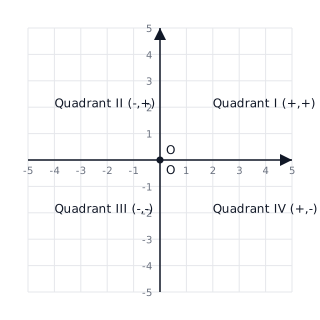
The 2D Cartesian Coordinate System is formed by two mutually perpendicular number lines: the horizontal -axis and the vertical -axis. Their intersection point is called the Origin . These axes divide the plane into four regions called quadrants.
Every point in the plane is represented by an ordered pair , where is the 'abscissa' (distance from the -axis) and is the 'ordinate' (distance from the -axis). To plot , move units along the -axis and units parallel to the -axis.
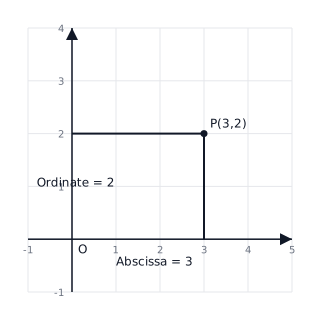
Points on the -axis always have a -coordinate of , taking the form . Conversely, points on the -axis always have an -coordinate of , taking the form .
The signs of the coordinates determine the quadrant: Quadrant I , Quadrant II , Quadrant III , and Quadrant IV .
📐Formulae
💡Examples
Problem 1:
In which quadrant or on which axis do the following points lie? , , , and .
Solution:
lies in Quadrant IV, lies in Quadrant III, lies on the -axis, and lies on the -axis.
Explanation:
For , and , which corresponds to Quadrant IV. For , and , which is Quadrant III. For , since the -coordinate is , it lies on the -axis. For , since the -coordinate is , it lies on the -axis.
Problem 2:
Write the coordinates of a point whose ordinate is and abscissa is .
Solution:
Explanation:
The abscissa refers to the -coordinate and the ordinate refers to the -coordinate. Writing them in the form gives .
Problem 3:
If the coordinates of a point are , find its perpendicular distance from the -axis and the -axis.
Solution:
Distance from -axis = units; Distance from -axis = units.
Explanation:
The distance from the -axis is given by the absolute value of the -coordinate (ordinate), which is . The distance from the -axis is given by the absolute value of the -coordinate (abscissa), which is .
Problem 4:
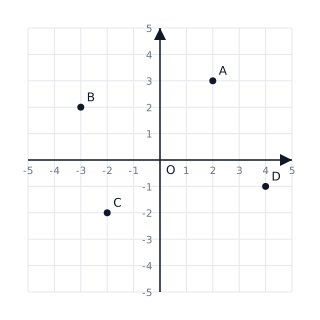
Plot the points , , , and on the Cartesian plane and identify which quadrant each belongs to.
Solution:
(both positive) ( negative, positive) (both negative) ( positive, negative)
Explanation:
By checking the signs of the and coordinates, we determine the quadrant. Point is in the top-right, is top-left, is bottom-left, and is bottom-right.
Problem 5:
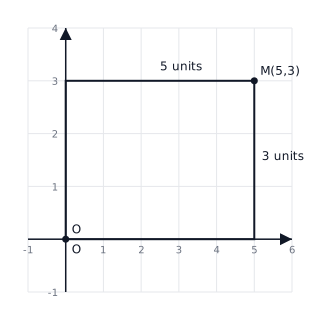
Find the area of the rectangle formed by the origin and the point when perpendiculars are dropped to the axes.
Solution:
The vertices of the rectangle are , on the -axis, , and on the -axis. Length units. Width units.
Explanation:
The coordinates define a rectangle with the axes where the length is the abscissa and the height is the ordinate.