
Review the key concepts, formulae, and examples before starting your quiz.
🔑Concepts
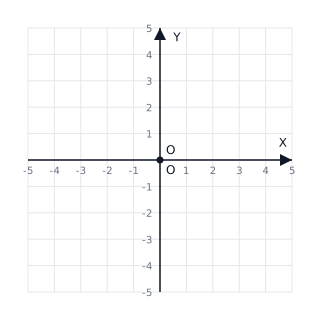
The Cartesian Coordinate System: A system used to specify the position of points on a plane using a pair of numerical coordinates. It consists of two perpendicular number lines: the horizontal -axis and the vertical -axis. Their intersection point is called the Origin .
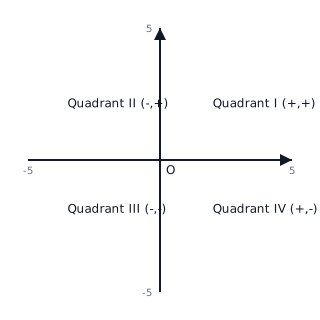
Quadrants: The two axes divide the plane into four regions called quadrants, numbered I to IV in counter-clockwise order. In Quadrant I, both and are positive (). In Quadrant II, is negative and is positive (). In Quadrant III, both are negative (). In Quadrant IV, is positive and is negative ().
Coordinates (Abscissa and Ordinate): For a point , the -coordinate is called the abscissa (distance from the -axis) and the -coordinate is called the ordinate (distance from the -axis).
Location of points on Axes: Any point lying on the -axis has an ordinate of , i.e., its form is . Any point lying on the -axis has an abscissa of , i.e., its form is .
📐Formulae
Paradigms
💡Examples
Problem 1:
Determine the quadrant or axis where the following points lie: , , and .
Solution:
lies in Quadrant IV. lies in Quadrant III. lies on the -axis.
Explanation:
For , and , which corresponds to Quadrant IV. For , both and are negative, placing it in Quadrant III. For , the -coordinate is , meaning the point must lie on the -axis.
Problem 2:
Find the coordinates of a point which is units away from the -axis and units away from the -axis, given that it lies in the second quadrant.
Solution:
The coordinates of point are .
Explanation:
The distance from the -axis is the absolute value of the -coordinate (abscissa), so . The distance from the -axis is the absolute value of the -coordinate (ordinate), so . Since the point is in the second quadrant, must be negative and must be positive. Thus, and .
Problem 3:
Calculate the area of a triangle whose vertices are , , and .
Solution:
Explanation:
The point lies on the -axis, so the base has a length of units. The point lies on the -axis, so the height has a length of units. Since the and axes are perpendicular, the triangle is right-angled at the origin.
Problem 4:
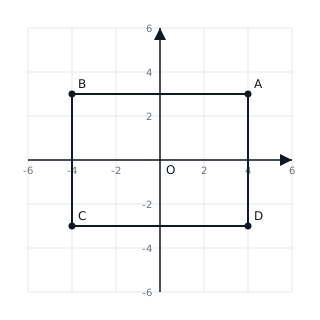
Plot the points , , , and on a Cartesian plane. Join them in order. What shape is formed?
Solution:
Joining forms a rectangle. Length units. Breadth units. The shape is a rectangle.
Explanation:
Points are plotted based on their signs. Since the lengths of opposite sides are equal ( units and units) and the axes are perpendicular, the resulting figure is a rectangle.
Problem 5:
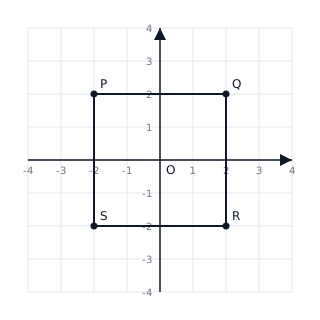
Find the area of a square whose opposite vertices are and .
Solution:
The coordinates of the four vertices of the square would be , , , and . Length of side units. Area of square = sq units.
Explanation:
By plotting opposite vertices and , we can identify the other two vertices and to complete the square. The side length is calculated by the horizontal or vertical distance between adjacent vertices.