
Orienting Yourself: The Use of Coordinates - Distance Between Two Points in the 2-D Plane
Review the key concepts, formulae, and examples before starting your quiz.
🔑Concepts
The distance between two points in a 2-D plane is the length of the straight line segment connecting them. This is calculated using the coordinates and of the two points.
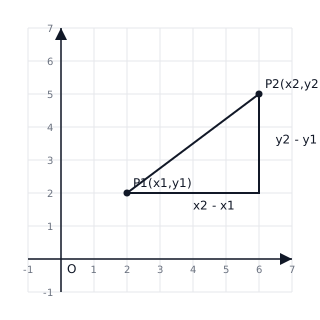
The Distance Formula is derived from the Pythagoras Theorem. In a right-angled triangle, the distance (hypotenuse) is related to the horizontal difference and vertical difference as: .
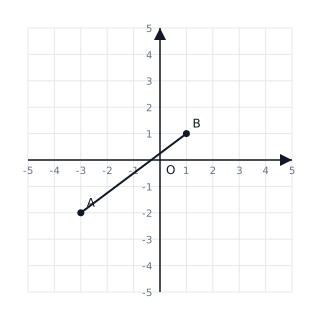
When calculating distance, the order of points does not matter because squaring the differences and always results in a non-negative value.
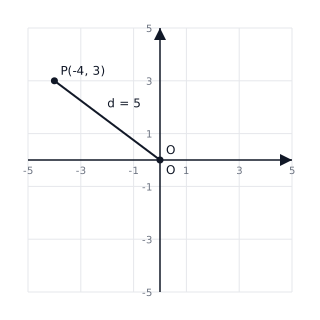
The distance of any point from the Origin is a special case of the formula, simplified to .
Distance is always a non-negative quantity. Even if coordinates are negative, the square root of the sum of squares will yield a positive value (or zero if the points coincide).
📐Formulae
💡Examples
Problem 1:
Find the distance between the points and .
Solution:
Let and . Using the distance formula:
Explanation:
We substitute the coordinates of and into the distance formula. The horizontal difference is and the vertical difference is . Calculating the square root of the sum of their squares gives the distance.
Problem 2:
Calculate the distance of the point from the origin.
Solution:
The coordinates of the origin are . Using the distance from origin formula:
Explanation:
When calculating distance from the origin, and are both zero, simplifying the formula to the square root of the sum of the squares of the point's coordinates.
Problem 3:
Find the distance between and .
Solution:
Let and .
Explanation:
Care must be taken with negative signs. Subtracting a negative number is the same as adding its absolute value. becomes positive because any real number squared is non-negative.
Problem 4:
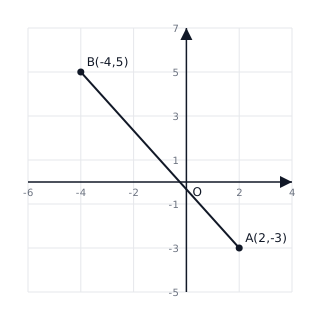
Find the distance between the points and .
Solution:
- Identify the coordinates: and .
- Apply the distance formula:
- Simplify the terms:
- Calculate the final value:
Explanation:
We subtract the coordinates to find the horizontal and vertical displacements, then use the square root of the sum of their squares.
Problem 5:
Show that the point is at a distance of units from the origin.
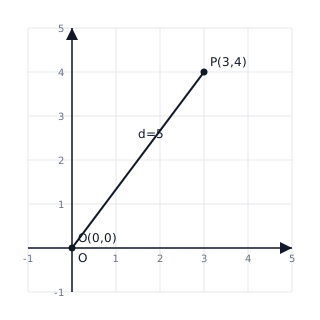
Solution:
- The coordinates of the point are .
- Use the distance from origin formula:
- Substitute the values:
- Final result:
Explanation:
The distance of a point from the origin is simply the square root of the sum of the squares of its coordinates.