
Review the key concepts, formulae, and examples before starting your quiz.
🔑Concepts
The Cartesian Coordinate System consists of two perpendicular number lines that intersect at a point called the origin. The horizontal line is the -axis and the vertical line is the -axis. These axes divide the plane into four regions called quadrants, numbered I, II, III, and IV in counter-clockwise order.
Every point in the plane is represented by an ordered pair . The first number is the Abscissa (perpendicular distance from the -axis), and the second number is the Ordinate (perpendicular distance from the -axis).
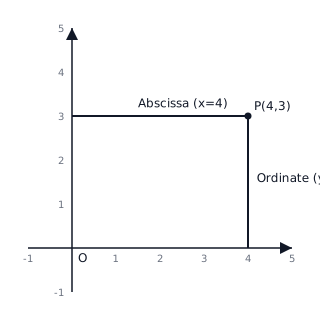
Points lying on the -axis have an ordinate of , taking the form . Points lying on the -axis have an abscissa of , taking the form . The origin is the unique point where both coordinates are zero.
To plot a point like , start at the origin, move units to the left along the -axis, then move units upwards parallel to the -axis.
📐Formulae
💡Examples
Problem 1:
Identify the quadrant or axis in which the following points lie: , , , and .
Solution:
is in Quadrant II, is in Quadrant IV, is on the -axis, and is in Quadrant III.
Explanation:
For , and (Quadrant II). For , and (Quadrant IV). For , since the abscissa is , it lies on the -axis. For , both and (Quadrant III).
Problem 2:
Write the coordinates of a point whose abscissa is and which lies on the -axis.
Solution:
Explanation:
If a point lies on the -axis, its ordinate (-coordinate) must be . Given the abscissa , the ordered pair is .
Problem 3:
A point is at a distance of units from the -axis and units from the -axis. If it lies in the third quadrant, find its coordinates.
Solution:
Explanation:
The distance from the -axis gives the absolute value of the -coordinate, so . The distance from the -axis gives the absolute value of the -coordinate, so . Since the point lies in the third quadrant, both and must be negative. Thus, and .
Problem 4:
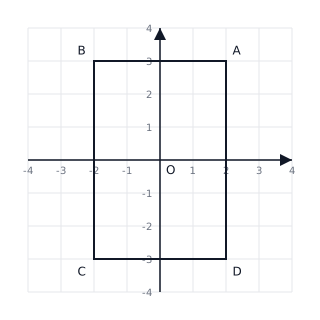
Plot the points , , , and on a Cartesian plane. Connect the points in order. What geometric shape is formed?
Solution:
By connecting , we form a rectangle.
Explanation:
The points form a rectangle because the opposite sides are parallel and the adjacent sides are perpendicular. The length is units (from to ) and the width is units (from to ).
Problem 5:
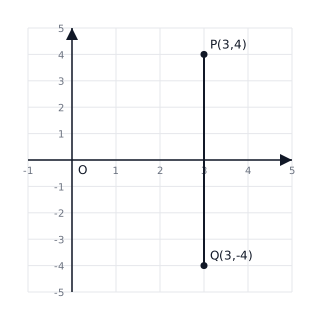
Find the coordinates of the point which is the reflection of point in the -axis.
Solution:
Point Reflection in -axis keeps the -coordinate same and negates the -coordinate.
Explanation:
When a point is reflected across the -axis, its distance from the -axis remains the same, but it moves to the opposite side. Thus, the ordinate becomes , while the abscissa remains unchanged.