
Mensuration: Surface Area and Volume - Compute surface area and volume of spheres and hemispheres in applications
Review the key concepts, formulae, and examples before starting your quiz.
🔑Concepts
A sphere is a perfectly round geometrical object in three-dimensional space that is the surface of a completely round ball. The surface area of a sphere depends solely on its radius . It is exactly four times the area of a circle with the same radius: .
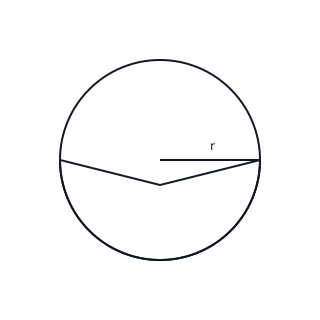
A hemisphere is exactly half of a sphere. When a sphere is cut through its center, two hemispheres are formed. Unlike a sphere, a hemisphere has two types of surface areas: the Curved Surface Area (CSA) which is and the Total Surface Area (TSA), which includes the flat circular base ().
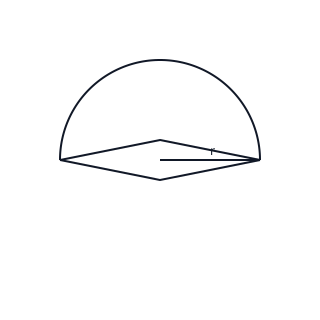
The volume of a sphere represents the amount of space occupied by it. It is calculated as . For a hemisphere, the volume is exactly half of the sphere's volume, given by .
In practical applications, if you are asked to find the cost of painting a hemispherical dome, you calculate the CSA (). If you are asked to find the cost of painting a solid hemispherical bowl (including the base), you use TSA ().
📐Formulae
💡Examples
Problem 1:
Find the surface area of a sphere of radius . (Use )
Solution:
- Given: Radius () = .
- Formula for Surface Area of a Sphere = .
- Substitute the values: .
- .
- .
Explanation:
To find the surface area of a sphere, identify the radius and substitute it into the formula . Since the radius is a multiple of 7, using makes the calculation simpler by allowing for cancellation.
Problem 2:
Find the Total Surface Area (TSA) of a hemisphere of radius . (Use )
Solution:
- Given: Radius () = .
- Formula for TSA of a Hemisphere = .
- Substitute the values: .
- .
- .
Explanation:
For a solid hemisphere, we must account for both the curved surface () and the flat circular base (), which totals . Using for is convenient here because the radius squared () easily clears the decimals.
Problem 3:
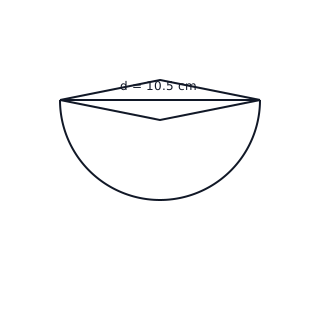
A hemispherical bowl made of brass has an inner diameter of . Find the cost of tin-plating it on the inside at the rate of Rs 16 per .
Solution:
Inner radius . Inner surface area of the bowl (CSA) Cost of tin-plating Cost of tin-plating Total cost
Explanation:
Since the tin-plating is done on the inside surface of a bowl, we calculate the Curved Surface Area (CSA). The diameter is converted to radius, then the area is found and multiplied by the rate per unit area.
Problem 4:
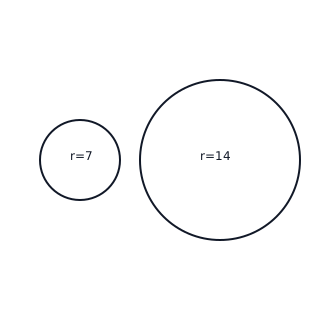
The radius of a spherical balloon increases from to as air is being pumped into it. Find the ratio of the surface areas of the balloon in the two cases.
Solution:
Let and . Surface area Surface area Ratio Therefore, the ratio is .
Explanation:
The surface area of a sphere is proportional to the square of its radius. When the radius doubles ( to ), the surface area increases by a factor of .