
Mensuration: Surface Area and Volume - Compute curved and total surface area and volume of cylinders
Review the key concepts, formulae, and examples before starting your quiz.
🔑Concepts
A cylinder is a solid with two congruent circular bases connected by a curved surface. The distance between the centers of the circular bases is the height and the radius of the circular base is .
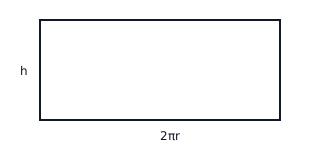
The Curved Surface Area (CSA) of a cylinder is the area of the side surface, excluding the top and bottom. It can be visualized as unrolling a rectangle with length equal to the circumference and width equal to the height .
The Total Surface Area (TSA) of a cylinder is the sum of the curved surface area and the areas of the two circular bases: .
The volume of a cylinder represents the amount of space it occupies, calculated by multiplying the area of the base by the height .
📐Formulae
Area of the circular base =
Volume of a Cylinder () =
Radius () in terms of Diameter () =
Height () =
Capacity in Liters (if is in ) =
Capacity in Liters (if is in ) =
💡Examples
Problem 1:
Find the volume of a right circular cylinder with a base radius of and a height of . (Use )
Solution:
Given: Radius () = , Height () = . Using the formula:
Explanation:
To find the volume, we substitute the given radius and height into the volume formula. The value of is taken as to simplify calculation with the radius of . The final result is expressed in cubic centimeters.
Problem 2:
The capacity of a closed cylindrical vessel of height is . How many square meters of metal sheet would be needed to make it? (Find the radius first to determine volume components)
Solution:
Given: Capacity = , Height () = . First, convert capacity to volume in : Now, use the volume formula to find radius ():
Explanation:
First, we convert the capacity from liters to since the height is in meters. We then use the volume formula to solve for the unknown radius . This radius is crucial for any further calculations regarding the cylinder's dimensions.
Problem 3:
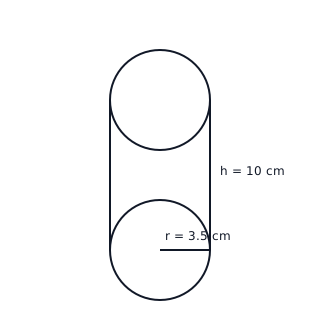
A soft drink is available in a cylindrical tin with a plastic base of diameter and height . Find the capacity of the tin container. (Use )
Solution:
-
Identify Given Values: Diameter () = Radius () = Height () =
-
Apply Volume Formula:
-
Calculation:
-
Conclusion: The capacity of the tin container is .
Explanation:
The capacity of a container is equivalent to its internal volume. Since the tin is cylindrical, we use the formula for the volume of a cylinder. Note that radius is half of the diameter.
Problem 4:
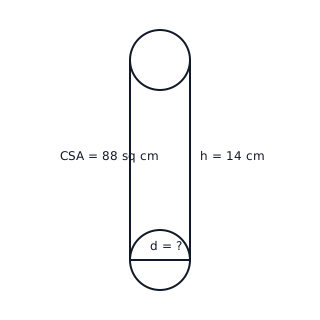
The curved surface area of a right circular cylinder of height is . Find the diameter of the base of the cylinder.
Solution:
-
Identify Given Values: Curved Surface Area () = Height () =
-
Apply CSA Formula:
-
Solve for r:
-
Find Diameter:
-
Conclusion: The diameter of the base of the cylinder is .
Explanation:
The Curved Surface Area (CSA) is the area of the side surface. By substituting the known CSA and height into the formula , we solve for the unknown radius , then double it to find the diameter.