
Mensuration: Surface Area and Volume - Compute surface area and volume of pyramids from given dimensions
Review the key concepts, formulae, and examples before starting your quiz.
🔑Concepts
A pyramid is a three-dimensional solid with a polygonal base and triangular lateral faces that meet at a common vertex called the apex.
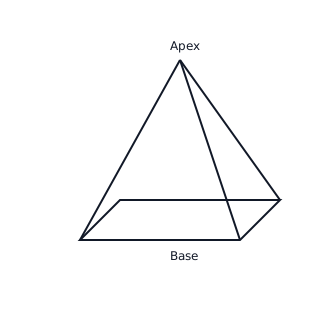
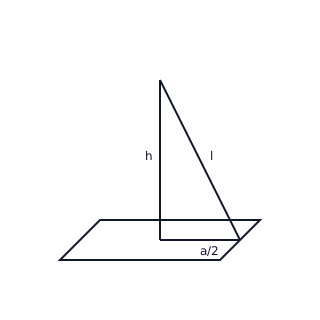
In a right square pyramid, the vertical height () is the distance from the apex to the center of the base, while the slant height () is the distance from the apex to the midpoint of a base edge.
The Volume of any pyramid is exactly one-third of the volume of a prism with the same base area and height.
The Lateral Surface Area (LSA) of a regular pyramid consists of the sum of the areas of all congruent triangular lateral faces.
Total Surface Area (TSA) is calculated by adding the area of the base to the Lateral Surface Area.
📐Formulae
💡Examples
Problem 1:
A right pyramid has a square base with a side of and a height of . Find its volume and total surface area.
Solution:
-
Find the Volume: Base Area . .
-
Find the Slant Height (): .
-
Find the Lateral Surface Area (LSA): Perimeter . .
-
Find the Total Surface Area (TSA): . .
Explanation:
We first calculate the base area to find the volume using the formula. To find the surface area, we calculate the slant height using Pythagoras' theorem on the triangle formed by the height, slant height, and half the base side. Finally, we sum the LSA and base area.
Problem 2:
Find the volume of a pyramid with a rectangular base of dimensions and a height of .
Solution:
-
Calculate Base Area (): .
-
Calculate Volume (): .
Explanation:
For any pyramid, the volume formula remains , regardless of the shape of the base.
Problem 3:
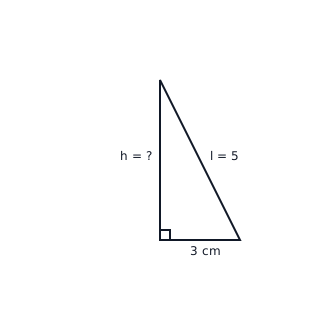
A right pyramid has a square base with side . If the slant height of the pyramid is , find its vertical height and volume.
Solution:
- Let and slant height .
- The relationship between height , slant height , and base side is .
- Substitute the values: .
- Base Area .
- Volume Volume .
Explanation:
To find the volume, we first need the vertical height . We use the Pythagorean theorem on the triangle formed by , , and half of the base side (). Once is found, we apply the standard volume formula.
Problem 4:
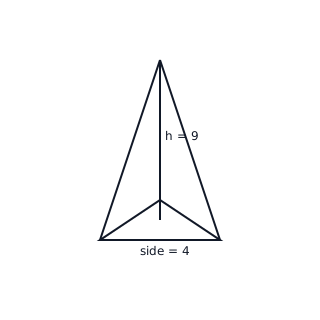
The base of a pyramid is an equilateral triangle with side . If the height of the pyramid is , calculate its volume.
Solution:
- Side of equilateral triangle .
- Base Area Base Area .
- Height .
- Volume Volume Volume .
- Using , Volume .
Explanation:
For a triangular pyramid, we first calculate the area of the triangular base. Since the base is equilateral, we use the formula . Then, we use the general pyramid volume formula.