
Mensuration: Surface Area and Volume - Compute curved and total surface area and volume of right circular cones
Review the key concepts, formulae, and examples before starting your quiz.
🔑Concepts
A right circular cone is a solid generated by the rotation of a right-angled triangle about one of its sides (other than the hypotenuse) which remains fixed. It consists of a circular base and a curved surface tapering to a point called the vertex.
The Slant Height () of a cone is the distance from the vertex to any point on the edge of the circular base. It forms the hypotenuse of a right-angled triangle where the legs are the vertical height () and the radius (). The relationship is given by .
The Curved Surface Area (CSA) of a cone refers to the area of the lateral surface excluding the base. It is calculated using the formula . If the slant height is not given, it must be calculated first using the radius and height.
The Total Surface Area (TSA) of a cone is the sum of its curved surface area and the area of its circular base (). Thus, .
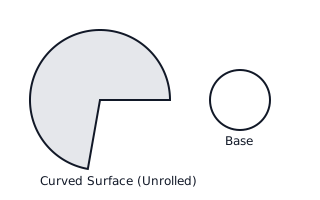
The Volume of a cone represents its capacity. It is exactly one-third of the volume of a cylinder with the same radius and height: . Note that volume depends on the vertical height (), not the slant height ().
📐Formulae
Volume of a Right Circular Cone:
Slant Height formula:
Vertical Height in terms of Slant Height:
Radius in terms of Volume and Height:
💡Examples
Problem 1:
Find the volume of a right circular cone whose base radius is cm and vertical height is cm. (Take )
Solution:
- Identify the given values: Radius cm and Height cm.
- Apply the volume formula:
- Substitute the values:
- Simplify the expression:
- Cancel from numerator and denominator and divide by :
- Final calculation:
Explanation:
This is a direct application of the volume formula where the base radius and vertical height are provided. We substitute the values into the formula and simplify to find the space occupied by the cone.
Problem 2:
A conical pit has a radius of m and a slant height of m. Calculate its capacity in kiloliters.
Solution:
- Identify given values: m, m.
- We need vertical height to find the volume. Use .
- m.
- Calculate Volume:
- .
- Since kiloliter, Capacity = kl.
Explanation:
In this problem, the slant height () is given instead of the vertical height (). We first use the Pythagorean relationship to find . Once is found, we calculate the volume in cubic meters and convert it to kiloliters.
Problem 3:
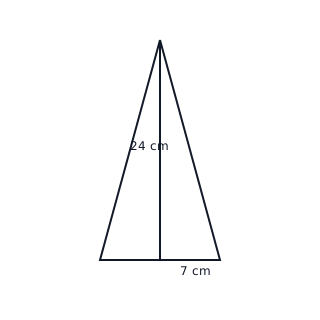
A joker's cap is in the form of a right circular cone of base radius cm and height cm. Find the area of the sheet required to make such caps.
Solution:
Given: Radius cm Height cm
Step 1: Find the slant height () $$l = \sqrt{625} = 25$ cm
Step 2: Find the Curved Surface Area (CSA) of one cap
Step 3: Find the area for caps
The total area of the sheet required is .
Explanation:
To make a cap, only the lateral (curved) surface is needed as the base remains open. We use the Pythagorean theorem to find the slant height because the formula for CSA requires , not .
Problem 4:
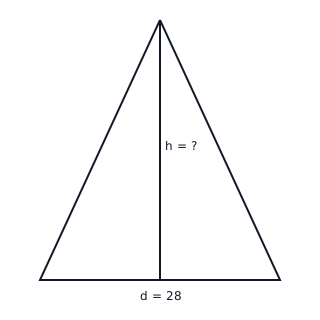
The volume of a right circular cone is . If the diameter of the base is cm, find the height and the slant height of the cone.
Solution:
Given: Volume Diameter cm Radius cm
Step 1: Find the height ()
Step 2: Find the slant height ()
The height is cm and the slant height is cm.
Explanation:
First, the radius is derived from the diameter. Then, the volume formula is rearranged to solve for the unknown height . Finally, and are used to find using the relation between the dimensions of a cone.