
Review the key concepts, formulae, and examples before starting your quiz.
🔑Concepts
The concept of 'Squaring a Rectangle' refers to finding a square that has the exact same area as a given rectangle. If a rectangle has length and breadth , its area is . To find the side of the equivalent square, we solve the equation , which gives .
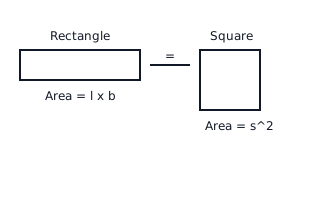
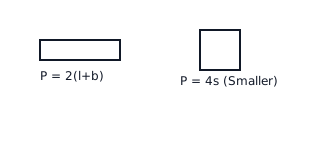
While the area remains constant during this conversion, the perimeter changes. A square is the most efficient rectangular shape, meaning for a fixed area, the square will always have a smaller perimeter than any non-square rectangle.
The geometric mean: The side of the square is mathematically known as the geometric mean of the rectangle's dimensions and .
Applications: This principle is used in architecture and land surveying to standardize plot sizes or to compare the material efficiency of different boundary shapes.
📐Formulae
pieces
💡Examples
Problem 1:
A rectangle has a length of and a breadth of . Calculate its area and find the side of a square that has the same area as this rectangle.
Solution:
Given: , . To find the side of the square with the same area:
Explanation:
First, the area of the rectangle is found by multiplying length and breadth. Since the square must have the same area, we set the square's area formula equal to the rectangle's area and solve for by taking the square root.
Problem 2:
Calculate the difference in perimeter between a rectangle of dimensions by and a square having the same area.
Solution:
For the square: Difference in perimeter: Difference = .
Explanation:
We calculate the area of the rectangle to find the side of the equivalent square. Then, we calculate the perimeters of both shapes and find the difference by subtraction.
Problem 3:
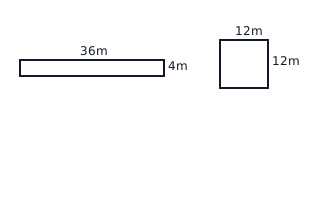
A rectangular plot of land measures by . A builder wants to construct a square-shaped shed with the same area. Find the side of the shed and determine how much fencing is saved by choosing the square shape instead of the rectangular shape.
Solution:
- Find Area of rectangle:
- Find side of the square:
- Calculate Perimeter of rectangle:
- Calculate Perimeter of square:
- Calculate fencing saved:
Explanation:
First, the area is calculated using the rectangular dimensions. Since the square must have the same area, we take the square root to find its side. Comparing the perimeters shows the efficiency of the square.
Problem 4:
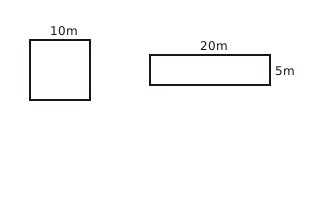
A square courtyard has a side of . If this is converted into a rectangle with a breadth of while keeping the area constant, find the new length and the increase in the boundary length (perimeter).
Solution:
- Find Area of the square:
- Find length of the rectangle:
- Calculate Perimeter of square:
- Calculate Perimeter of rectangle:
- Increase in boundary length:
Explanation:
We start with the square's area and divide by the new breadth to find the length of the equivalent rectangle. The perimeter increases because the shape becomes less compact.