
Review the key concepts, formulae, and examples before starting your quiz.
🔑Concepts
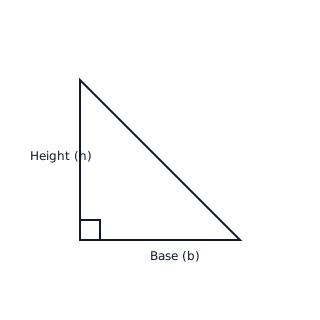
For a right-angled triangle, the area can be calculated directly using the legs of the triangle as base and height. The area is given by .
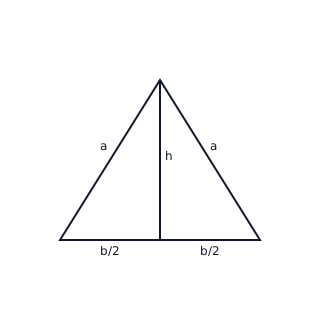
In an isosceles triangle, the altitude (height) drawn from the vertex between the equal sides bisects the base. This allows the use of the Pythagorean theorem to find the height before calculating the area.
Heron's Formula is used when the lengths of all three sides are known but the height is not given. First, calculate the semi-perimeter , then use .
The area of a triangle remains the same regardless of which side is chosen as the base, provided the corresponding altitude (perpendicular distance from the opposite vertex) is used.
📐Formulae
💡Examples
Problem 1:
Find the area of a triangle whose sides are , , and .
Solution:
- Calculate the semi-perimeter :
- Apply Heron's Formula:
Explanation:
Since all three sides are known, Heron's formula is the most efficient method. We first find the semi-perimeter and then substitute and into the radical expression.
Problem 2:
The sides of a triangular plot are in the ratio of and its perimeter is . Find its area.
Solution:
- Let the sides be , , and .
- Given perimeter , so:
- The sides are: , , .
- Calculate :
- Apply Heron's Formula:
Explanation:
First, find the actual side lengths using the given ratio and perimeter. Once the sides are determined, use Heron's formula to calculate the area.
Problem 3:
Find the area of an equilateral triangle with side . (Use )
Solution:
- Side .
- Use the area formula for an equilateral triangle:
- Substitute the value of :
Explanation:
For equilateral triangles, using the specific formula is faster than the general Heron's formula.
Problem 4:
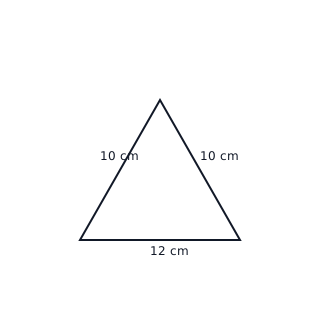
An isosceles triangle has a perimeter of and its base is . Find the area of the triangle.
Solution:
- Let the equal sides be and base be .
- Perimeter .
- The semi-perimeter .
- Using Heron's Formula: .
Explanation:
First find the length of the equal sides using the perimeter. Then, apply Heron's formula using the three known sides ().
Problem 5:
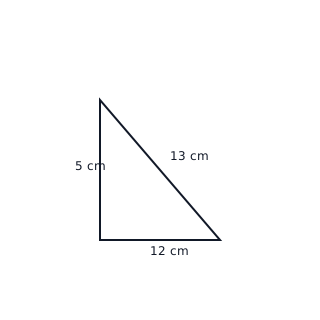
The sides of a triangle are , , and . Calculate its area using the semi-perimeter method.
Solution:
- Sides are .
- .
- .
Explanation:
This is a right-angled triangle (), but Heron's formula works for any triangle. We calculate the semi-perimeter and substitute the values into the formula.