krit.club logo

Measuring Space: Perimeter and Area - Area of a Parallelogram

Grade 9CBSE

Review the key concepts, formulae, and examples before starting your quiz.

🔑Concepts

•

A parallelogram is a quadrilateral with two pairs of parallel sides. In a parallelogram, opposite sides are equal in length, and opposite angles are equal.
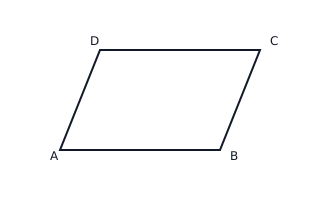
A standard parallelogram ABCD showing parallel opposite sides.
•

The 'Base' (bb) of a parallelogram can be any of its sides. The 'Height' or 'Altitude' (hh) is the perpendicular distance from that base to the opposite side.
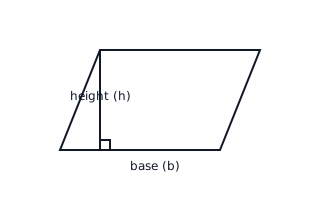
Parallelogram showing the perpendicular height dropped from a vertex to the base.
•

The area of a parallelogram is calculated by multiplying its base by its corresponding height: Area=b×h\text{Area} = b \times h. It is measured in square units like cm2\text{cm}^2 or m2\text{m}^2.

•

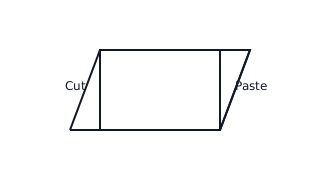
A parallelogram can be converted into a rectangle of the same area by cutting a right-angled triangle from one side and shifting it to the other. This proves why the area is b×hb \times h.

Visual demonstration of converting a parallelogram into a rectangle to show Area = base x height.
•

A diagonal of a parallelogram divides it into two congruent triangles of equal area. Therefore, Area of Parallelogram=2×Area of Triangle\text{Area of Parallelogram} = 2 \times \text{Area of Triangle}.

•

If you know the area and one dimension (either base or height), you can find the other using: b=Areahb = \frac{\text{Area}}{h} or h=Areabh = \frac{\text{Area}}{b}.

📐Formulae

Area of a Parallelogram=base×height\text{Area of a Parallelogram} = \text{base} \times \text{height}

Area=b×h\text{Area} = b \times h

Height(h)=AreaBase\text{Height} (h) = \frac{\text{Area}}{\text{Base}}

Area of Triangle=12×base×height\text{Area of Triangle} = \frac{1}{2} \times \text{base} \times \text{height}

💡Examples

Problem 1:

Find the area of a parallelogram whose base is 14 cm14\text{ cm} and whose corresponding height is 7 cm7\text{ cm}.

Solution:

Given: Base b=14 cmb = 14\text{ cm} and Height h=7 cmh = 7\text{ cm}. Using the formula: Area=b×h\text{Area} = b \times h Area=14 cm×7 cm\text{Area} = 14\text{ cm} \times 7\text{ cm} Area=98 cm2\text{Area} = 98\text{ cm}^2

Explanation:

To find the area, we simply multiply the length of the base by the perpendicular height.

Problem 2:

The area of a parallelogram is 56 cm256\text{ cm}^2. If its altitude is 8 cm8\text{ cm}, find the length of the corresponding base.

Solution:

Given: Area=56 cm2\text{Area} = 56\text{ cm}^2 and h=8 cmh = 8\text{ cm}. Using the formula: Base=AreaHeight\text{Base} = \frac{\text{Area}}{\text{Height}} Base=568\text{Base} = \frac{56}{8} Base=7 cm\text{Base} = 7\text{ cm}

Explanation:

We rearrange the area formula to solve for the base by dividing the total area by the given height.

Problem 3:

In a parallelogram ABCDABCD, AB=10 cmAB = 10\text{ cm}. The altitudes corresponding to sides ABAB and ADAD are 7 cm7\text{ cm} and 8 cm8\text{ cm} respectively. Find the length of side ADAD.

Solution:

The area of the parallelogram remains constant regardless of which base is chosen. Area=AB×altitude to AB=AD×altitude to AD\text{Area} = AB \times \text{altitude to } AB = AD \times \text{altitude to } AD 10 cm×7 cm=AD×8 cm10\text{ cm} \times 7\text{ cm} = AD \times 8\text{ cm} 70=AD×870 = AD \times 8 AD=708AD = \frac{70}{8} AD=8.75 cmAD = 8.75\text{ cm}

Explanation:

Since the area of the same parallelogram is being calculated using two different base-height pairs, we equate them to find the unknown side.

Problem 4:

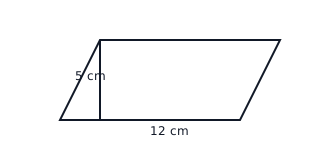
Calculate the area of a parallelogram where the base is 12 cm12\text{ cm} and the corresponding height is 5 cm5\text{ cm}.

Parallelogram with base 12 and height 5.

Solution:

Given: Base (b)=12 cm\text{Given: Base } (b) = 12\text{ cm} Height (h)=5 cm\text{Height } (h) = 5\text{ cm} Area=b×h\text{Area} = b \times h Area=12×5=60 cm2\text{Area} = 12 \times 5 = 60\text{ cm}^2

Explanation:

We simply multiply the length of the base by the perpendicular height to find the total area occupied by the parallelogram.

Problem 5:

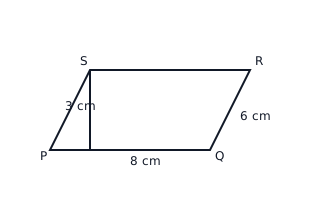
In parallelogram PQRSPQRS, PQ=8 cmPQ = 8\text{ cm} and QR=6 cmQR = 6\text{ cm}. If the height corresponding to base PQPQ is 3 cm3\text{ cm}, find the height corresponding to base QRQR.

Parallelogram PQRS with marked sides and altitude.

Solution:

Case 1: Base PQ=8 cm, Height h1=3 cm\text{Case 1: Base } PQ = 8\text{ cm, Height } h_1 = 3\text{ cm} Area=8×3=24 cm2\text{Area} = 8 \times 3 = 24\text{ cm}^2 Case 2: Base QR=6 cm, Height h2=?\text{Case 2: Base } QR = 6\text{ cm, Height } h_2 = ? Since area remains the same:\text{Since area remains the same:} 24=6×h224 = 6 \times h_2 h2=246=4 cmh_2 = \frac{24}{6} = 4\text{ cm}

Explanation:

Since the area of the parallelogram is constant regardless of which side is chosen as the base, we first find the area using the known base and height, then use that area to find the missing height for the other base.